
Social selling used to mean something straightforward: be visible where your buyers are, be useful in public, and be easy to contact. Then the automation vendors took the term, and now it mostly means a connection-request sequence with a three-step follow-up.
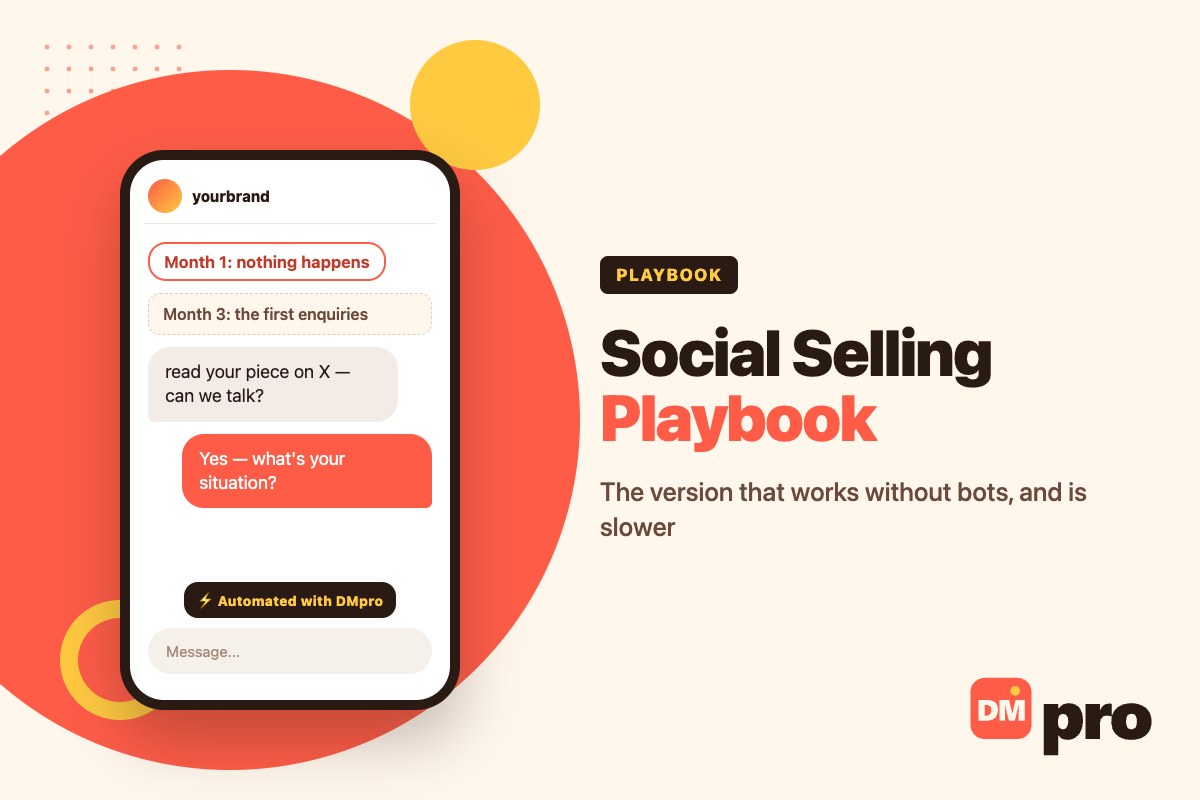
The original version still works and it is slower. It produces nothing in the first month, conversations in the second, and the first real enquiries in the third – which is exactly why so many teams abandon it in week five for something that promises numbers immediately.
This is that version, written honestly: the five habits, what a realistic quarter looks like, and the one part worth automating. Why the fast version is a bad trade is in LinkedIn automation.
Key takeaways
- Answering everything personally and quickly is the highest-value habit and the cheapest. In B2B it is still unusual.
- Publish one substantive thing a week – something you know that your buyers do not.
- Comment substantively on other people’s posts. It is how people find you without you contacting anyone.
- Be obviously reachable. A surprising number of profiles make this hard.
- Follow up by hand, only on genuine questions, one message each.
- Month one produces nothing. That is the design, and it is where almost everybody quits.
- Automate the answering, never the reaching out – the part that scales is the part that happens after someone speaks.
The Five Habits
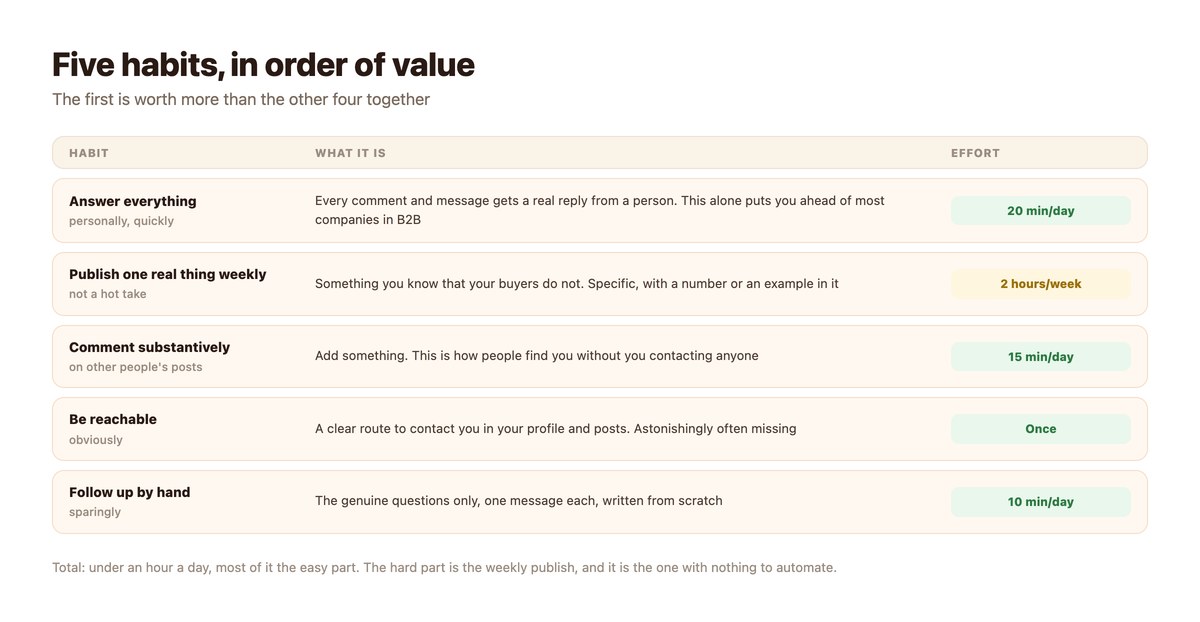
Under an hour a day, and the ordering matters.
Answer Everything, Personally, Quickly
Every comment, every message, from a person, within hours. This is the highest-return habit on the list and the one most companies skip because it feels like admin rather than selling.
In B2B, where a considered reply the same day is genuinely uncommon, it is a differentiator by itself. It also compounds – people who got a real answer once come back, and they tell colleagues.
Publish One Real Thing a Week
Something you know that your buyers do not, with a specific number or a concrete example in it. Not an opinion about the industry – those are free and nobody remembers them.
This is the hard part, it takes a couple of hours, and there is nothing in it to automate. It is also the asset: a post published in March is still producing in September, which is the entire argument for the slow route.
Comment Substantively on Other People’s Posts
Add a point, a counterexample, a number. This is how people discover you without you contacting them, and it is the single most underused mechanism on professional networks.
The economics are good: fifteen minutes a day, no account risk, and the audience is somebody else’s – which is the whole point.
Be Obviously Reachable
A clear route to contact you, in your profile and in your posts. Extraordinarily often missing, including from accounts publishing weekly about how to generate leads.
If somebody decides they want to talk to you, the next ten seconds decide whether they do.
Follow Up by Hand, Sparingly
Only on genuine questions, one message each, written from scratch. The discipline is what makes the messages land – a person who has seen you answer thoughtfully in public reads a private message differently.
The criteria for which threads deserve one are in LinkedIn content to DM.
The Honest Timeline
Worth agreeing internally before starting, because month one is a test of nerve rather than of method.
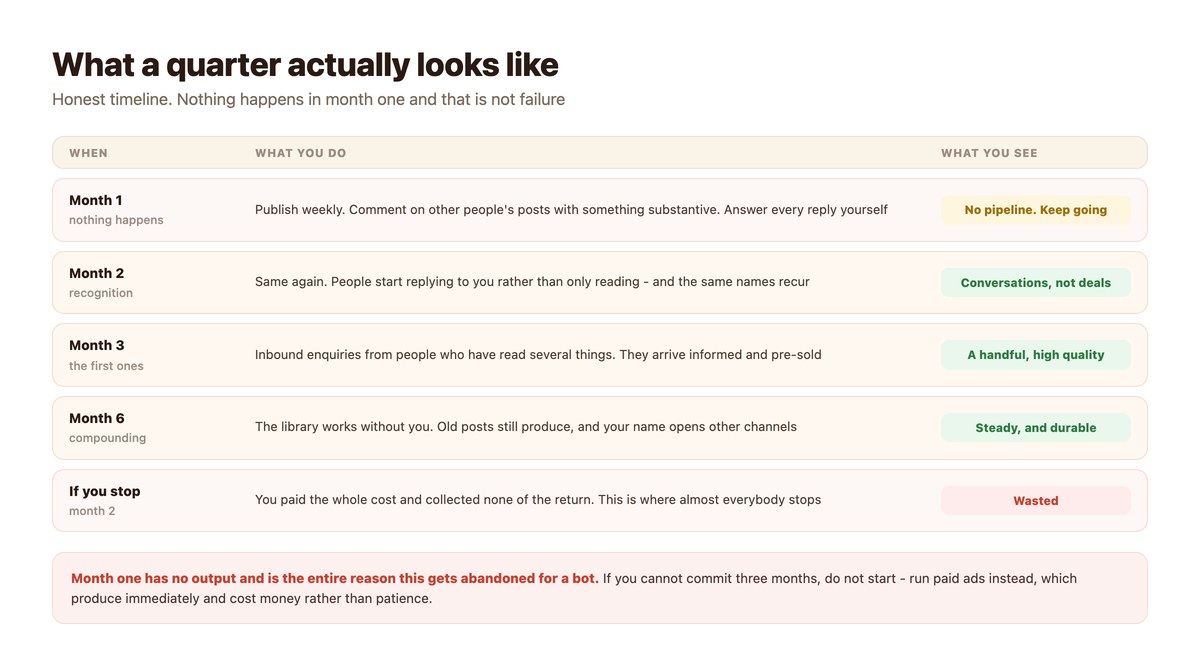
Month One: Nothing
You publish four times, comment daily, answer everything, and produce no pipeline. This is not a sign that it is not working – it is what the first month looks like, every time.
It is also precisely when somebody suggests a tool that would have generated three hundred connection requests in the same period. That comparison is the reason most teams never reach month three.
Month Two: Recognition
The same names start appearing in your comments. People reply to you rather than only reading. Conversations begin, and none of them are deals yet.
This is the leading indicator worth tracking, because it arrives a month before the enquiries do.
Month Three: The First Enquiries
A handful of people get in touch having read several things you wrote. They arrive informed, they have already decided you know the subject, and the conversation starts much further along than a cold one would.
Small numbers, high quality. The ratio is usually better than anything the outbound sequence produced.
Month Six: It Compounds
The library works without you. Posts from months ago still produce enquiries, your name opens doors on other channels, and the weekly publish gets easier because you know what lands.
This is the part the fast route never reaches, because it has usually been switched off by enforcement before then.
What to Automate
One rule, and it holds across every platform.
Automate the Answering, Never the Reaching Out
Everything that happens after someone contacts you is fair game: an instant acknowledgement, the resource they asked for, a qualifying question, a booking link, a lookup against your own data.
Everything that happens before they contact you is either impossible or restricted, depending on the platform. That single line is the whole policy and it needs no exceptions.
Especially: Never Be Slow
The habit that produces most of the return – answering quickly – is also the one automation genuinely helps with. An instant, honest acknowledgement buys the hours it takes to write a real reply, and it costs nothing.
Coverage models for the hours nobody is at a keyboard are in the after-hours coverage models.
And Capture What You Publish
Comment automation on your own posts delivers the resource instantly and tells you which posts produce clicks, which is how the content calendar gets better rather than just longer.
The playbook is in LinkedIn comment automation.
What to Measure, Month by Month
Measuring the wrong thing in month one is how this gets cancelled in month two.
| Month | Measure | Do not measure |
|---|---|---|
| 1 | Posts published, replies answered | Pipeline |
| 2 | Repeat names in your comments | Pipeline |
| 3 | Inbound enquiries, and their quality | Volume |
| 4-6 | Enquiries per post, over time | Impressions |
| Ongoing | How fast you answer | Follower count |
If an immediate number is non-negotiable, run paid alongside rather than instead – the options are compared in permitted outreach routes.
Starting This Week
Four decisions and one commitment.
- Agree the three-month commitment, out loud. With whoever will ask about pipeline in week five. This is the real prerequisite.
- Pick the one thing you know that buyers do not. That is your first post, and probably your next ten.
- Block two hours a week for writing. In the calendar. It is the only part that cannot be done in gaps.
- Set up instant acknowledgement on your channels. So nobody waits in silence while you write a real reply.
- Add comment capture to your posts. Delivery automated, tracked, and the thread still readable by everyone.
- Answer everything yourself, within hours. The cheapest habit on the list and the one that produces most of the return.
Doing It With DMpro
The parts that should be automated, and only those.
Never Slow, Across Every Channel
DMpro gives an instant, honest first response on Instagram, TikTok, WhatsApp, Messenger, Telegram and Discord, with one Conversations view behind them – so the fast-answer habit survives evenings, weekends and the day you are in meetings.
Capture What Your Content Earns
Keyword comment triggers deliver the resource immediately and tracked links tell you which posts produced the clicks. On LinkedIn that runs through the company page comment API; on Instagram the reply can be a DM with a seven-day window behind it.
And Not the Reaching Out
DMpro does not send LinkedIn DMs. The connection is comment-trigger only, DM sending is switched off in configuration, and LinkedIn is the one platform shipped disabled by default. Outbound, where you need it, belongs on channels built for it – contactID for published contact forms, the Chrome extension for Instagram from your own account.
Be the Company That Answers
Publishing weekly and answering everything within hours beats any sequence over a quarter, and it does not stop working because somebody else made an enforcement decision.
DMpro handles the half worth automating: instant first responses across six channels, and keyword comment capture with tracked links so you learn which posts actually produce.
Conclusion
Social selling worked before the tools and still does. Publish one substantive thing a week, comment usefully on other people’s posts, be obviously reachable, and answer everything personally and fast. Under an hour a day, and the hard part is the writing.
Be honest about the timeline. Nothing in month one, conversations in month two, the first real enquiries in month three, and compounding from month six – at which point posts written in the spring are still producing.
And keep the automation on the right side of the line: everything after somebody contacts you, nothing before. That line is where the platforms are generous, it needs no daily caps, and it does not depend on anyone failing to notice.
Frequently asked questions
What is social selling, really?
Being visible where your buyers are, useful in public, and easy to contact – then answering well when someone gets in touch. The term has been borrowed by automation vendors, but the original practice is this and it still works.
How long before social selling produces leads?
Nothing in month one, conversations in month two, the first real enquiries in month three, and compounding returns from around month six. Teams that quit do so in week five.
What is the highest-value habit?
Answering every comment and message personally and quickly. It is the cheapest thing on the list and in B2B a same-day considered reply is still unusual enough to be a differentiator.
What should I automate?
Everything after someone contacts you: instant acknowledgement, delivering a resource, qualifying questions, booking links. Never the reaching out, which is either impossible or restricted depending on the platform.
How often should I post?
Once a week, with something specific you know that your buyers do not. Frequency matters far less than having something concrete to say.
What should I measure in the first month?
Posts published and replies answered – not pipeline. Measuring pipeline in month one is the most common reason this gets cancelled in month two.