
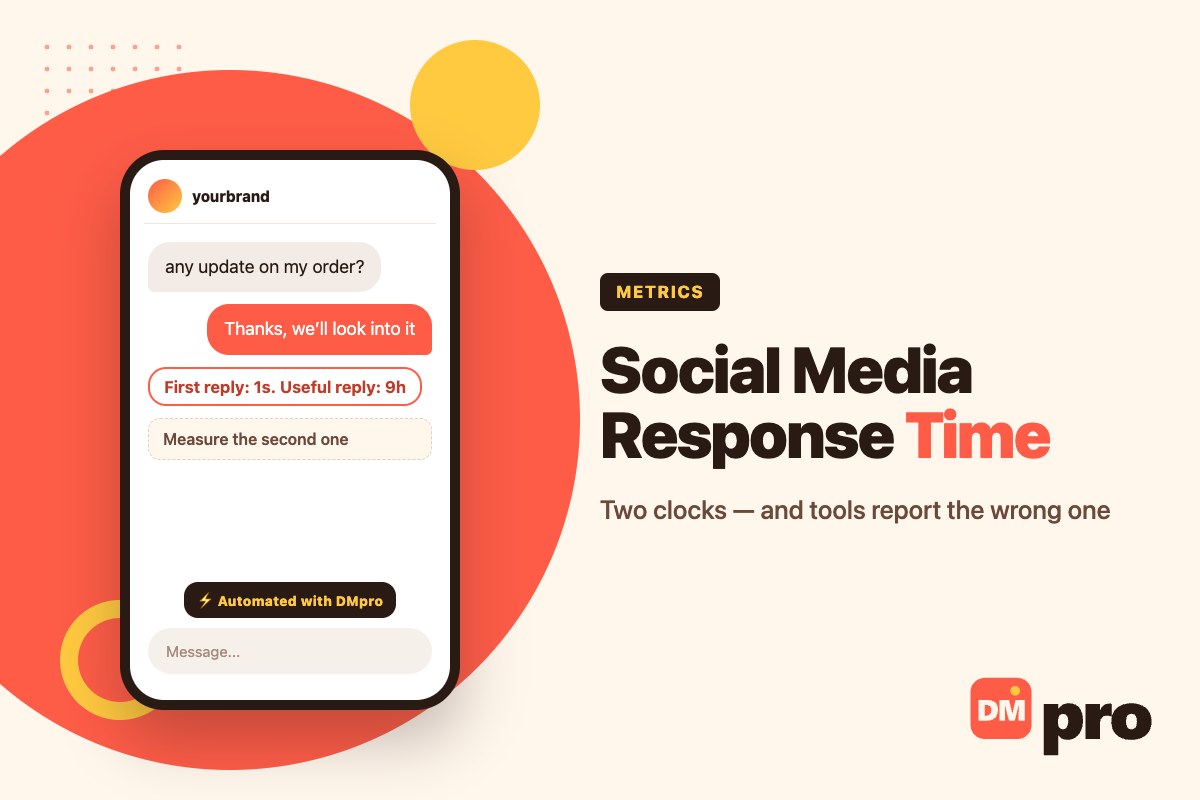
Social media response time is the most-quoted support metric and the most quietly misreported. Almost every tool measures the moment any message goes back – which an automatic acknowledgement satisfies in under a second, while the customer still knows nothing at all.
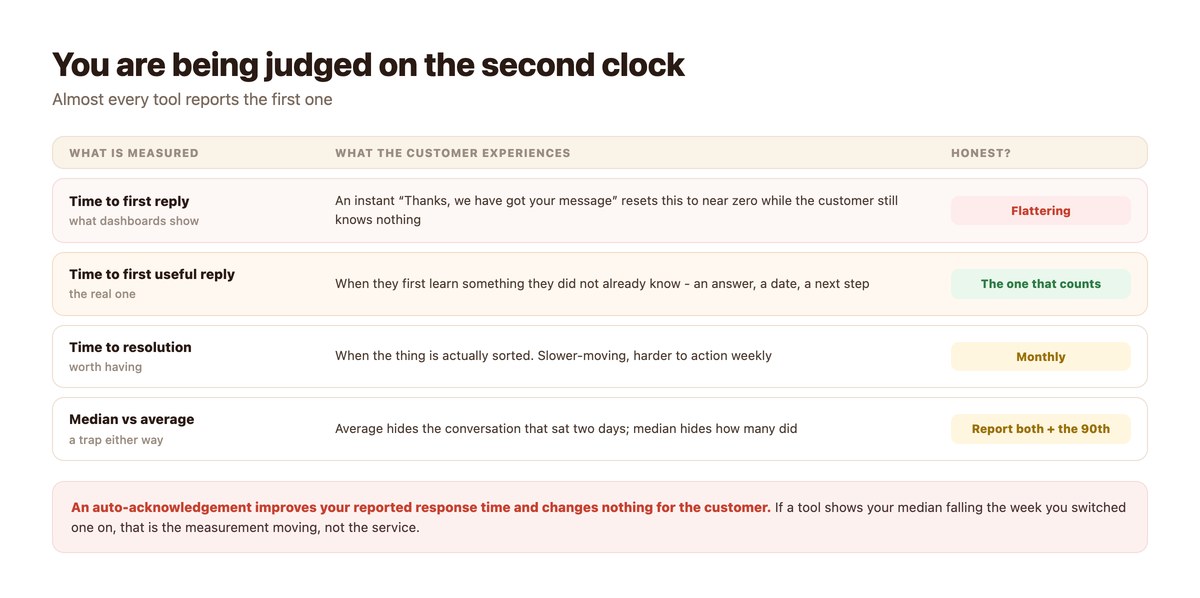
There are two clocks. The one your dashboard shows, and the one the customer is actually experiencing: how long until they learn something they did not already know. Only the second predicts whether they come back or write a review.
This covers what people genuinely expect by channel, what the platforms technically allow, and how to measure the number without flattering yourself. For what to automate in the first place, see customer support automation.
Key takeaways
- Measure time to first useful reply, not time to first reply. An auto-acknowledgement satisfies the second and changes nothing.
- Report median, average and the 90th percentile together – each alone hides a different failure.
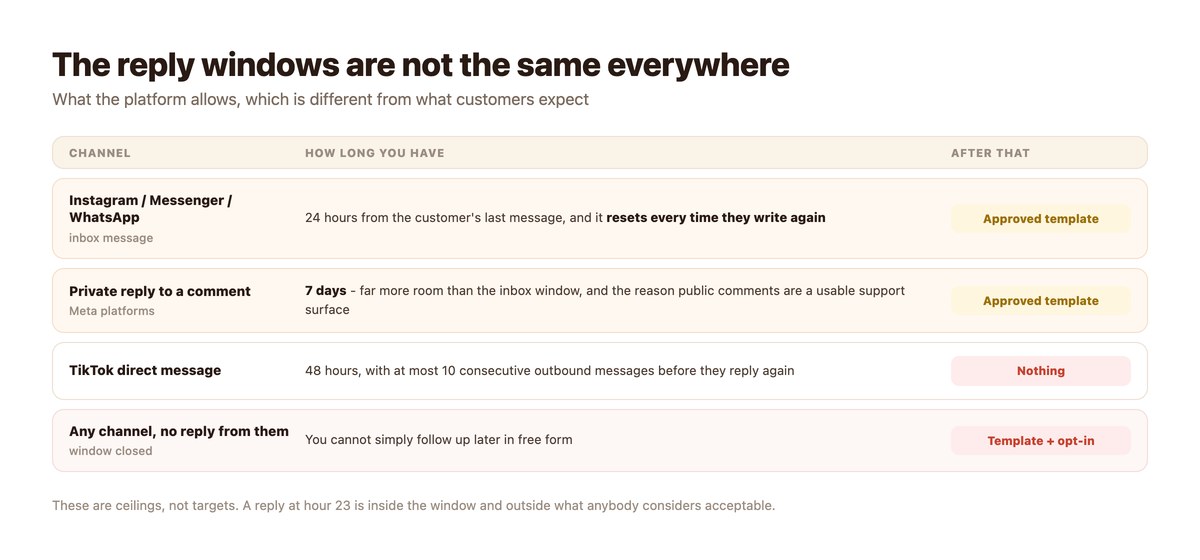
- The Meta inbox window is 24 hours and resets with every customer message; a private reply to a comment gets 7 days.
- Windows are ceilings, not targets. Hour 23 is inside the window and outside acceptable.
- Expectations differ by channel: a DM is treated like a text message, a comment like a public question.
- Consistency beats speed. A reliable two hours is judged better than a median of ten minutes with occasional two-day gaps.
The Two Clocks
The distinction is the whole article, and it takes one paragraph to see.
What Tools Report
Time to first reply: the gap between the customer’s message and anything coming back. Switch on an away message and this becomes about one second, permanently, across your whole inbox.
The number will look excellent and nothing about the customer’s experience will have changed. If you watch a response-time chart fall the week somebody enabled an auto-reply, that is the measurement moving.
What Customers Experience
Time to first useful reply: the gap until they learn something. A delivery date, an answer, a next step, a genuine “we are looking into it and will come back by five” with a name on it.
This is harder to compute because it needs someone to decide which messages count, but you can approximate it well by excluding automated acknowledgements and anything under about five seconds.
Report Three Figures, Not One
Median tells you the typical case and hides how bad the tail is. Average is dragged around by a single two-day conversation. The 90th percentile is where the complaints live.
Publishing all three takes no extra work and stops the monthly argument about whose number is right.
What People Actually Expect
Expectations are set by the channel, not by your support policy.
A DM Is Judged Like a Text Message
Instagram, WhatsApp and Messenger sit in the same app as messages from family. That sets the mental model: people do not expect an instant reply from a business, but they expect the same-day responsiveness they would give a friend who was busy.
Practically that means hours, not days, and it means a visible acknowledgement with a real time attached buys you most of the patience you need.
A Public Comment Is a Different Problem
A comment is being read by other people, so the cost of silence is not just one customer. The good news is the seven-day private-reply window gives genuine room to move it to a private conversation.
The practical rule: acknowledge publicly fast, resolve privately properly.
Out of Hours Is Judged on Honesty
Nobody expects a reply at 2am. What they resent is being left to guess whether one is coming. Stating your hours and meaning them scores better than vague availability – the models for doing that are in after-hours DM support.
The Windows You Have to Work Inside
Platform limits, which are ceilings rather than targets – but worth knowing because one of them is much more generous than people assume.
Twenty-Four Hours, Resetting
On Instagram, Messenger and WhatsApp inboxes you have 24 hours from the customer’s last message to reply freely, and the clock resets every time they write again. For support this is rarely binding, because support conversations are started by the customer.
Where it does bite is a slow escalation: a conversation handed to a person and left overnight can lose the free-form window as well as the customer.
Seven Days for a Private Reply
A private reply to a public comment on Meta platforms carries a seven-day window rather than twenty-four hours. That is a materially different constraint and most teams do not know it.
It means a complaint left under a post on Friday can still be picked up properly on Monday – though it should not be.
Past the Window
Reaching somebody after their window has closed needs an approved template and opt-in, which for support almost always means the conversation should have been resolved sooner. Treat window expiry as an incident, not a routine.
Targets Worth Setting
Starting points rather than laws. Pick numbers you can actually hit, then hit them consistently.
| Situation | Reasonable target | What matters more |
|---|---|---|
| In hours, any channel | Useful reply within 1 hour | Hitting it consistently |
| Out of hours | Honest holding message instantly | Saying when, accurately |
| Public comment | Public acknowledgement within 2 hours | Moving it private properly |
| Escalated to a person | Human reply within 2 hours | A timeout so it cannot sit |
| Complaint or refund | Useful reply same working day | Who owns it by name |
The escalation targets in rows four and five only hold if somebody is named – see writing escalation rules.
Measuring It Properly
An afternoon, and it stops being arguable.
- Decide what counts as a useful reply. Write the rule down: not an acknowledgement, not an auto-reply, not anything under five seconds. Everything after depends on this.
- Measure median, average and 90th percentile. All three, every time. Each one alone hides a different failure.
- Split in-hours from out-of-hours. A single blended figure is dominated by overnight and tells you nothing actionable.
- Split automated from human. The automated half should be near-instant. If the human half is in hours, that is an ownership problem, not a tooling one.
- Record a baseline before changing anything. Four weeks. The first improvement is unprovable without it.
- Watch the 90th percentile weekly. The median will look stable while the tail gets worse. The tail is where reviews come from.
What Actually Moves the Number
In rough order of effect, and the first one surprises people.
Answering the Top Three Questions Completely
Not more flows – better ones. Three questions answered so thoroughly that nobody needs a follow-up will do more for your median than a dozen shallow flows, because every follow-up is another clock starting.
The repeat-contact rate in the support KPIs worth tracking is how you spot shallow answers.
Naming Who Is On
Most slow human replies are not capacity problems, they are ownership problems: the conversation was escalated to everybody, which means nobody. A rota with a name per day typically does more than hiring would.
Fetching Data Instead of Promising to Check
“Let me look into that” starts a second clock. A webhook that returns the real order status ends the conversation in the first reply, which is the single biggest structural improvement available – the build is in the order-status lookup.
Not Chasing the Median
A consistent two hours is experienced as better service than a median of ten minutes with occasional two-day gaps, because people remember the gap. Optimise the tail.
Where This Connects
Two places response time stops being a measurement problem.
When It Is Really a Coverage Question
If your out-of-hours figures are the whole problem, no flow fixes that – it is a staffing model decision with four honest options, covered in after-hours DM support.
When It Is Really a Tooling Question
If replies are slow because nobody can tell which conversations are already being handled, you have outgrown the shared inbox rather than the team. The threshold is in shared inbox vs helpdesk.
Answer Before the Second Clock Starts
“Thanks, we will look into it” resets your dashboard and nothing else. The reply that counts is the one carrying an actual answer.
DMpro answers the predictable questions instantly with real data from your own systems, and routes the rest to a named person with the whole conversation attached – so the useful reply is usually the first one.
Conclusion
There are two response-time clocks and the industry reports the wrong one. An automatic acknowledgement takes your first-reply figure to nearly zero and leaves the customer exactly where they were.
Measure time to first useful reply, publish median, average and the 90th percentile together, and split in-hours from out-of-hours so the number is actionable rather than blended into meaninglessness.
Then optimise the tail rather than the median. Customers forgive a business that takes two hours every time; they do not forgive the one that usually takes ten minutes and occasionally takes two days.
Frequently asked questions
What is a good social media response time?
In working hours, a useful reply within an hour is a reasonable target for most businesses. Consistency matters more than the number – a reliable two hours is experienced better than a median of ten minutes with occasional two-day gaps.
Does an auto-reply improve response time?
It improves the reported number and changes nothing for the customer. Measure time to first useful reply instead – the moment they learn something they did not already know.
How long do I have to reply on Instagram or WhatsApp?
24 hours from the customer’s last message, and the window resets every time they write again. A private reply to a public comment gets seven days, which is far more room than most teams realise.
Should I report median or average?
Both, plus the 90th percentile. Median hides how bad the tail is, average is dragged by a single stalled conversation, and the 90th percentile is where complaints come from.
Why are our human replies so slow?
Usually ownership rather than capacity. Conversations escalated to everybody belong to nobody. A rota naming one person per day typically helps more than hiring.
What improves response time most?
Answering the top three questions so completely that nobody needs a follow-up, and fetching real data instead of promising to check – every “let me look into that” starts a second clock.