
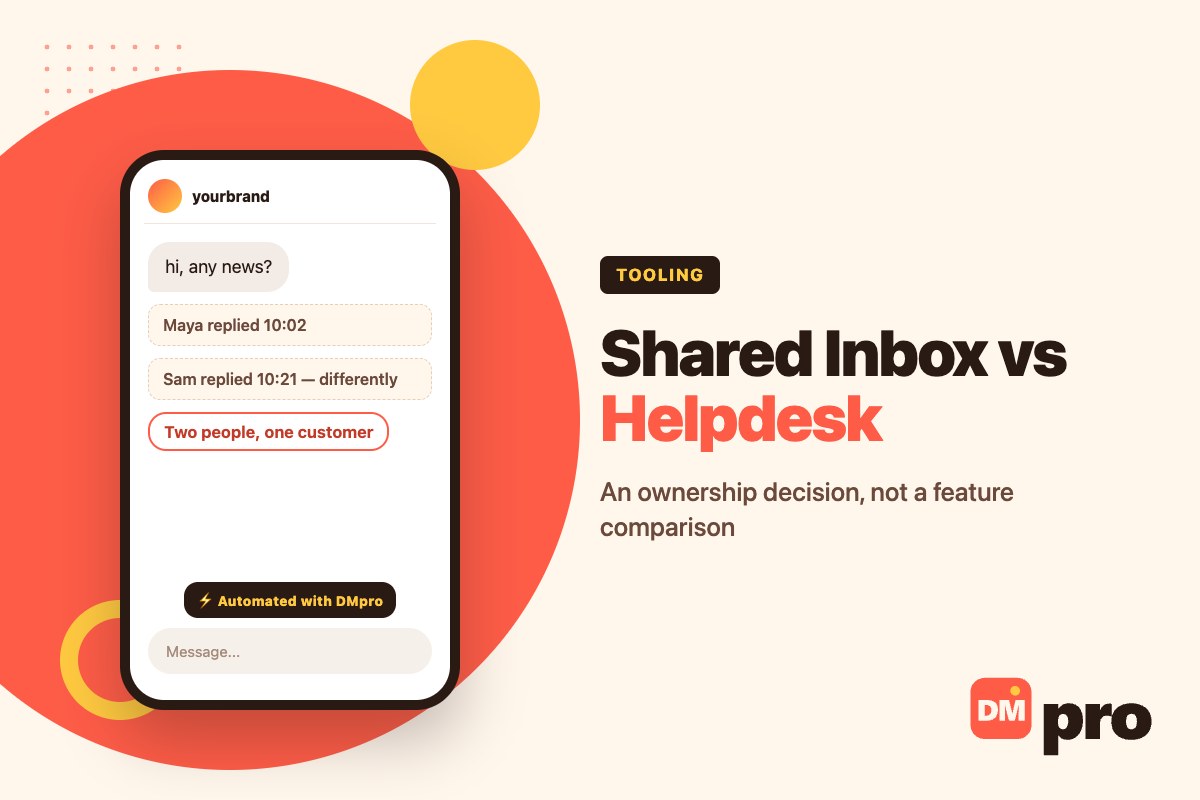
The shared-inbox-versus-helpdesk decision is usually made from a feature comparison, which is the wrong input. Both categories do roughly the same things, and the differences that matter are not the ones vendors lead with.
What actually decides it is volume and ownership. A shared inbox works until two people need to know who is handling what, and at that point no amount of features substitutes for a tool that can hold state.
This covers the five signals you have crossed that line, the three cheaper things to do first, and what each option genuinely costs. For the wider framework, see customer support automation.
Key takeaways
- The decision is about ownership and state, which are the only two things a helpdesk adds that a shared inbox cannot express.
- Two people answering the same customer is the decisive signal, not a volume number.
- Try three cheaper fixes first: a named owner per day, a claiming convention, and automating the top three questions.
- A helpdesk makes ownership expressible; it does not make it decided.
- Migration costs more than the licence – rebuilt automations, retraining, and a fortnight of worse service.
- If you move, move for state and assignment. Everything else is secondary.
What Each One Actually Is
Stripped of the marketing, the categories are narrower than they appear.
A Shared Inbox Is a Stream
Messages, sorted by recency, visible to everyone. It is excellent at what it does: no training required, nothing to configure, and the whole team sees the same thing.
What it fundamentally lacks is state. A conversation is not open, assigned, waiting or closed – it is just a message that arrived at a time, and everything else lives in people’s heads.
A Helpdesk Adds State and Ownership
Assignment, status, and a record of who did what. That is the whole substance of the upgrade; the reporting, macros and SLA timers that fill the comparison tables are conveniences built on top of those two things.
Which is why the decision should be made on whether you need state, not on whether a feature list is longer.
Automation Sits Underneath Both
Worth separating, because it gets conflated. Whether messages are answered automatically is independent of whether the remainder is managed in a stream or a ticketing system.
A team can automate heavily and stay on a shared inbox for a long time – and doing so is often what delays the migration by a year.
The Signals
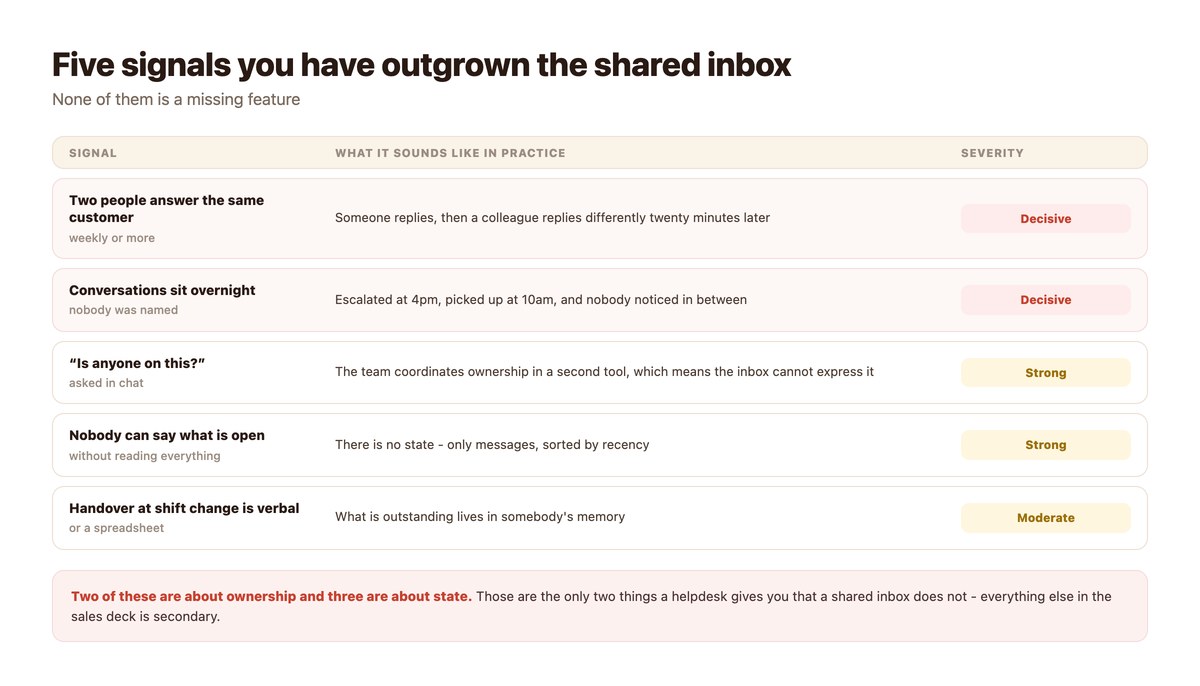
Five, and the first two settle it on their own.
Collisions
Two people answering the same customer, differently, twenty minutes apart. This is the decisive signal because it is visible to the customer and because no convention reliably prevents it past a certain volume.
If it happens weekly, you have outgrown the stream. If it happens monthly, a claiming convention will probably hold for another quarter.
Overnight Sitting
A conversation escalated at four in the afternoon and picked up at ten the next morning, with nobody aware in between. That is an ownership failure, and a stream cannot fix it because it has nowhere to record that somebody took responsibility.
It is also the most expensive failure in support, which is why it appears in almost every page of this cluster – including AI to human handoff, where the fix is a timeout.
Coordination Happening Elsewhere
If the team manages ownership in a group chat – “I’ve got this one”, “anyone on the Smith order?” – the inbox has already failed to express something the team needs. That coordination is the feature you are about to pay for.
Worth noticing rather than normalising: it looks like good teamwork and is actually a missing capability.
Three Things to Try First
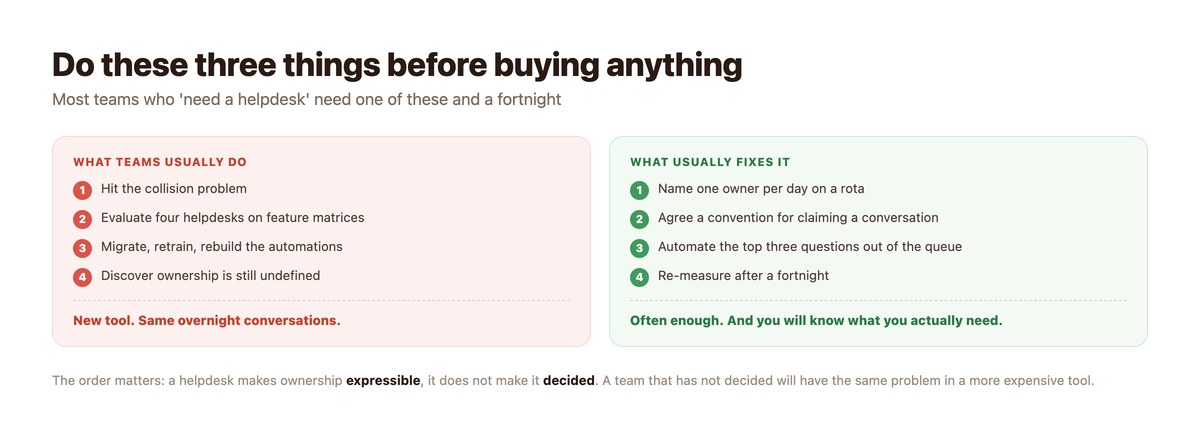
Each costs nothing and each buys months. Do them in order.
Name One Owner Per Day
A rota with a name against each day, visible to everybody. Not “the team” – a person. This single change fixes most overnight sitting, because somebody is accountable for the queue being empty.
It is also the prerequisite for everything in how escalation rules get written, which cannot route to a destination that does not exist.
Agree a Claiming Convention
A reaction, a prefix, an internal note – anything visible that means “I am on this”. Crude, free, and sufficient up to a surprising volume.
It fails when the team is large enough that people stop seeing each other’s claims, which is roughly where the collision signal starts appearing weekly.
Automate the Top Three Questions
The cheapest capacity increase available. If order status, delivery and stock stop reaching the queue at all, the remaining volume is often small enough that ownership stops being hard.
Many teams who conclude they need a helpdesk actually need this – the arithmetic is in reducing support costs with automation.
What It Costs to Move
The licence is the smallest line. Budget for the rest or the migration lands badly.
| Cost | What it involves | Typically |
|---|---|---|
| Licence | Per agent, per month | The number people quote |
| Rebuilding automations | Flows and routing re-expressed in the new tool | Days to weeks |
| Channel reconnection | Re-authorising every social account | A day, plus surprises |
| Retraining | New habits, not just new buttons | Two weeks of slower replies |
| Historical conversations | Usually not migrated, or migrated badly | Accept the gap |
| Worse service during | The fortnight everybody is learning | Plan around peak |
If you are near a seasonal peak, move afterwards – peak-week planning is not the moment to be learning a tool.
Making the Decision
A fortnight, and most of it is measurement rather than evaluation.
- Count collisions for two weeks. Actual instances of two people replying to one customer. This is your primary input, not a volume threshold.
- Count conversations that sat overnight. And ask, for each, whether anybody had been named as responsible.
- Try the three cheap fixes. Rota, claiming convention, automate the top three. Give it a fortnight.
- Re-measure the same two numbers. If collisions and overnight sitting both dropped sharply, you have bought yourself months.
- If they did not, define what you need in one sentence. Almost always: assignment and status. Evaluate against that sentence, not against feature matrices.
- Plan the migration away from a peak. And budget two weeks of worse service, because that is what happens.
Where DMpro Sits in This
Worth being precise, because it is neither of the two categories exactly.
It Removes Volume Before the Question Arises
DMpro handles the predictable majority automatically, which is the lever that most changes the answer. A team answering forty conversations a day manually has an ownership problem; the same team with the top three questions automated may be answering twelve, and twelve is manageable in a stream.
Conversations land in one place across Instagram, WhatsApp, Messenger, Telegram and TikTok, which also removes the per-channel fragmentation that makes ownership harder than it needs to be.
Team Seats and Named Owners
Multi-seat workspaces with invites and seat management mean escalations can go to a person rather than a pile, which is the ownership half of the problem.
If what you need is full ticket state – statuses, queues, SLA timers across a large team – that is a helpdesk, and the honest answer is that it is a different category of tool.
Where This Connects
Two numbers that tell you which side of the line you are on.
The 90th Percentile
If median response time is fine and the 90th percentile is dreadful, the cause is almost always unowned conversations rather than capacity. That split is the clearest quantitative version of this decision – customer support KPIs covers how to report it.
Overnight Separately
Coverage and ownership get confused constantly. If the problem is only overnight, it is a coverage model question rather than a tooling one – after-hours DM support has the four options, none of which require a migration.
Fewer Conversations Beats a Bigger Tool
Most teams reaching for a helpdesk are not drowning in complexity. They are answering the same three questions forty times a day and losing track of who said what.
DMpro takes those three out of the queue entirely, brings every channel into one place, and routes what is left to a named person – which is usually the ownership problem solved without a migration.
Conclusion
This decision is about ownership and state, not features. A shared inbox is a stream with no memory of who is doing what; a helpdesk adds assignment and status, and everything else in the comparison is built on those two things.
The signal that matters is collisions – two people answering one customer – followed by conversations sitting overnight with nobody named. Count both for a fortnight before evaluating anything.
Then try the three cheap fixes first, because a helpdesk makes ownership expressible rather than decided. A team that has not decided who owns what will have exactly the same problem in a more expensive tool, two weeks of retraining later.
Frequently asked questions
When should we move from a shared inbox to a helpdesk?
When two people regularly answer the same customer, and when conversations sit overnight with nobody named as responsible. Those two signals matter more than any volume threshold.
What does a helpdesk actually add?
Assignment and status – the ability to record who owns a conversation and what state it is in. Reporting, macros and SLA timers are conveniences built on top of those two things.
What should we try first?
A rota naming one owner per day, a visible convention for claiming a conversation, and automating the top three questions out of the queue. Give it a fortnight and re-measure.
Will a helpdesk fix our overnight conversations?
Only if somebody is named as responsible. A helpdesk makes ownership expressible; it does not make it decided. A team that has not decided will have the same problem in a more expensive tool.
What does migrating really cost?
More than the licence: rebuilding automations, reconnecting every channel, retraining, and roughly two weeks of slower replies while everyone learns. Plan it away from a seasonal peak.
Is DMpro a helpdesk?
No – it removes volume before the question arises, brings the channels into one place, and routes escalations to named people via team seats. If you need full ticket state across a large team, that is a helpdesk and a different category of tool.