
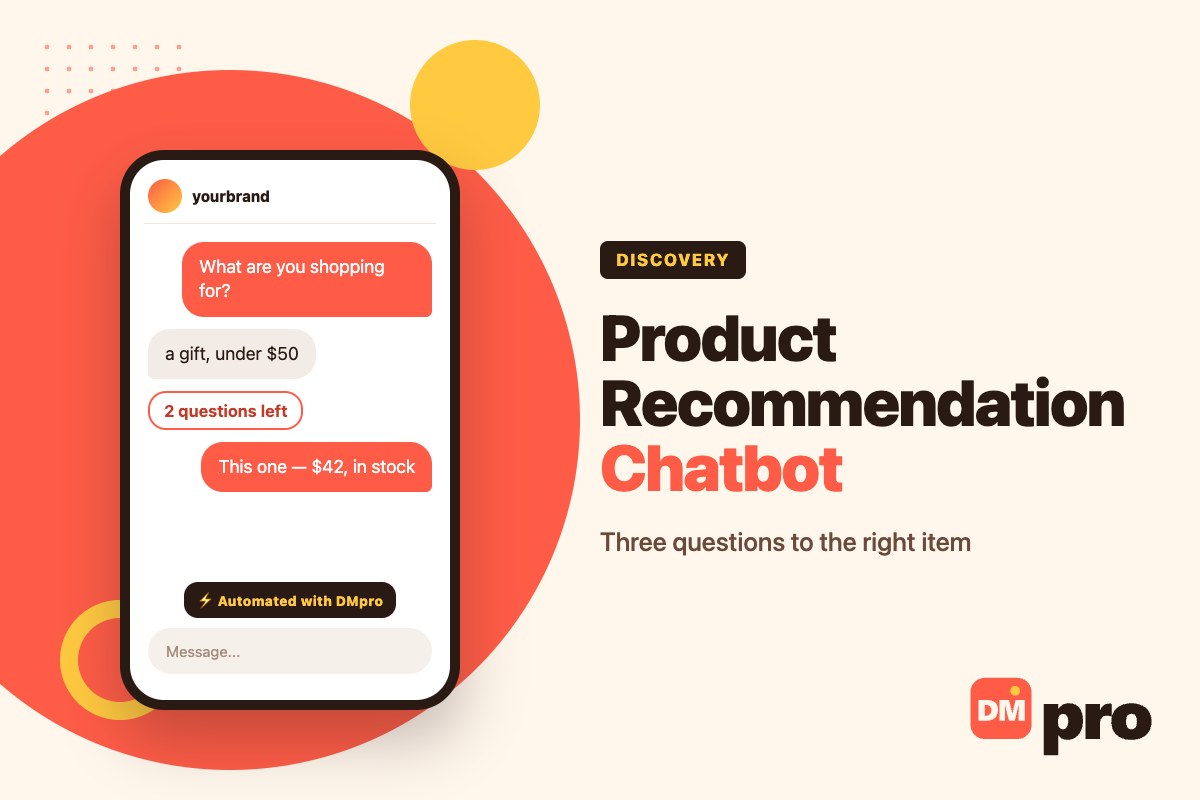
A recommendation chatbot is not an AI that understands your catalogue. In almost every store that works, it is three questions and a lookup – a short quiz whose last step is a real product card the customer can buy from.
That framing matters, because the version people imagine is expensive, slow to build and usually worse. The version that works can be built in an afternoon by anyone who knows which three questions their best salesperson asks.
This covers choosing those questions, how far to branch before it stops paying, and where an actual model earns its cost. For the rules on when any of it may be sent, see e-commerce DM automation.
Key takeaways
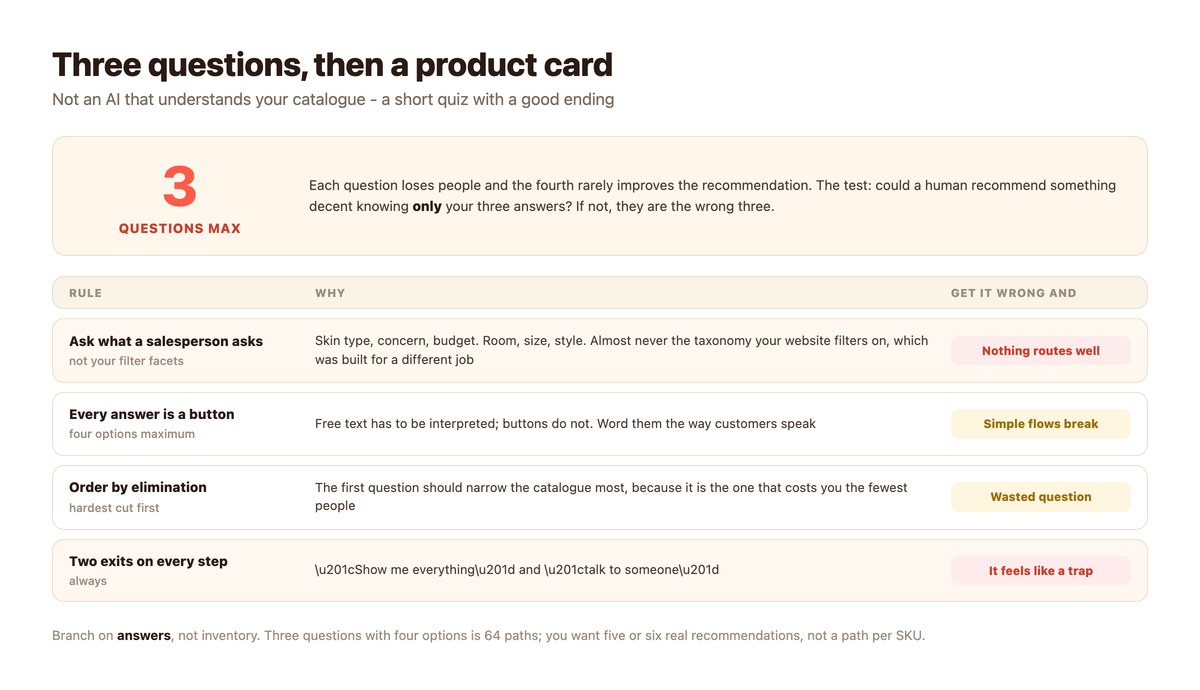
- Three questions is the practical ceiling. Each one loses people, and the fourth rarely improves the recommendation.
- The questions should be the ones your best salesperson asks, not the ones your filters use.
- The flow must end in a product card from the connected store, not a link to a category page.
- Always include an exit – “show me everything” and “talk to someone”.
- Branch on answers, not on inventory. A flow with 40 endings is a maintenance problem.
- AI genuinely helps when the catalogue is wide or phrasing is unpredictable – but it is not available on the WhatsApp channel.
Choosing the Three Questions
Get these right and the rest is mechanical. Get them wrong and no amount of branching saves it.
Ask What a Salesperson Asks
Stand behind the counter, or read a month of DMs, and notice what the question actually is. In a skincare shop it is skin type, concern and budget. In furniture it is room, size and style. It is almost never the facets on your filter menu, which were built for a different job.
The test is whether a human could give a decent recommendation knowing only the answers to your three questions. If not, they are the wrong three.
Make Every Answer a Button
Free text answers have to be interpreted; buttons do not. Four options maximum per question, worded in the customer’s language rather than your taxonomy.
If an answer genuinely needs free text – a measurement, a name – put it last, once they are invested.
Order Them by Elimination
The first question should cut the catalogue hardest. Asking budget first in a store with one price band wastes the question that costs you the most people.
How Far to Branch
The commonest way these flows die is not failure. It is becoming unmaintainable.
Branch on Answers, Not Inventory
Three questions with four answers each is 64 possible paths. You do not want 64 endings. Group them: most stores have five or six genuine recommendations, and the questions exist to route to those, not to address every combination.
If you find yourself building a path per SKU, the flow has become a catalogue with extra steps.
Always Offer the Exit
Two of them, on every question. “Show me everything” for the person who knows what they want and is being slowed down, and “talk to someone” for the person whose question your quiz does not cover.
Flows without exits do not feel efficient. They feel like being held.
The exit is not failure
People who bail to a human were going to, and they convert better than people trapped in a quiz.
Watch where they leave
Consistent drop-off at question two usually means it is the wrong question, not that quizzes do not work.
End on a Product, Not a Page
The last step must send an actual item from the connected store, with its photo and price in the chat. Sending a filtered category URL hands the customer back the work they came to you to avoid – see Shopify DM automation for the connection.
Quiz, Keywords, or AI
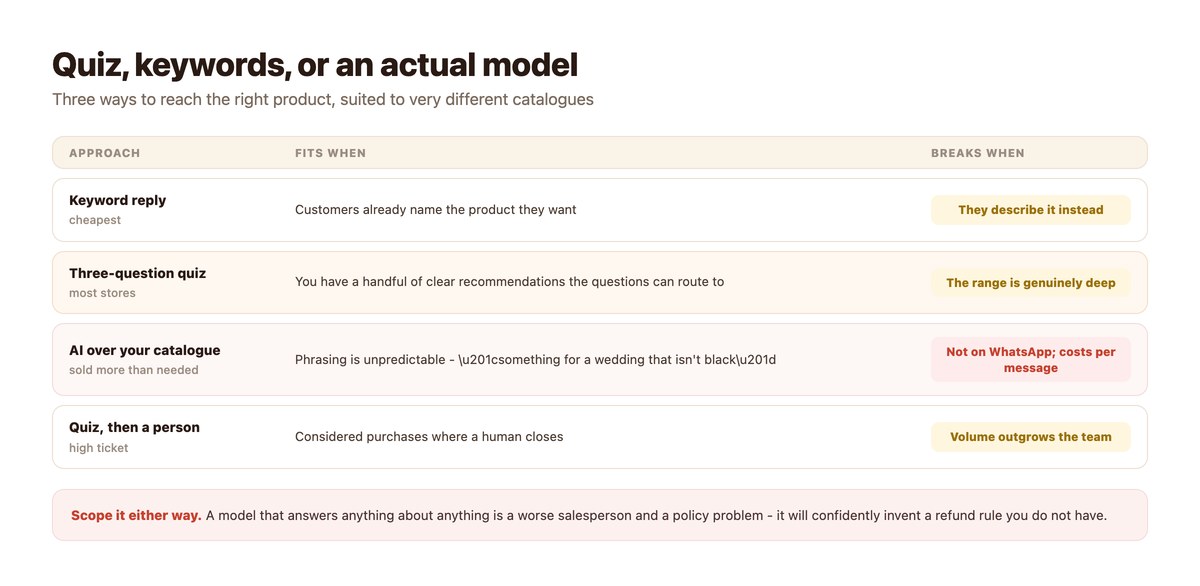
Three ways to get someone to the right product, suited to different catalogues.
| Approach | Fits when | Breaks when |
|---|---|---|
| Keyword reply | People already name the product | They describe it instead of naming it |
| Three-question quiz | A handful of clear recommendations exist | The catalogue is genuinely wide |
| AI over your catalogue | Phrasing is unpredictable, range is deep | Not available on WhatsApp; costs per message |
| Quiz then human | High ticket, considered purchase | Volume outgrows the team |
For how the handoff in row four should be built, see AI to human handoff.
Building the Flow
An afternoon, assuming the store is already connected.
- Write the three questions on paper first. If you cannot recommend something decent from the three answers, change the questions before building anything.
- Group your catalogue into five or six recommendations. These are the endings. The questions route to them.
- Build buttons, not free text. Four options maximum, in the customer’s words.
- Add both exits to every question. Show me everything, and talk to someone.
- End on a real product card. From the connected store, so price and availability are current.
- Wrap the destination in a tracking link. Otherwise you will know the quiz ran but not whether it sold anything.
- Watch the drop-off for a fortnight. The question people abandon is the question to rewrite.
When an Actual Model Helps
Having argued for the simple version, here is the honest case for the other one.
Wide Catalogues and Odd Phrasing
If you sell thousands of items, or customers describe what they want rather than naming it – “something for a wedding in October that isn’t black” – a quiz cannot route that and keywords certainly cannot. That is where a model earns its cost.
DMpro supports an AI response step on Instagram, TikTok, Telegram and Discord.
Not on WhatsApp
The AI response block is not wired for the WhatsApp channel, so WhatsApp recommendation flows are quizzes and keywords. Given that catalogue sends do work there, a three-question quiz ending in a product card is the right shape for WhatsApp regardless.
Scope It Either Way
A model that will answer anything about anything is both a worse salesperson and a policy problem. Keep it to your products, your stock and your policies, and hand everything else to a person.
Who the Quiz Is Really For
The same flow performs very differently depending on what you sell, and the differences are predictable.
Considered Purchases Benefit Most
Where the customer genuinely does not know which variant suits them – skincare, furniture, equipment, anything with a fit or a spec – a quiz is doing the job a salesperson would. Conversion goes up because the recommendation reduces risk, not because it reduces clicks.
Where the customer already knows exactly what they want, the quiz is an obstacle. That is why the “show me everything” exit matters as much as the questions.
It Travels Well Between Industries
The structure is identical whether you sell supplements or services. A clinic asking three questions before suggesting a treatment, a studio qualifying a project, a school routing an enquiry to the right course – all the same flow with different nouns. The vertical playbooks go into this: salons, gyms and studios and coaches each have a version where the “product” is a booking.
The Multilingual Problem Arrives Early
Button-based quizzes break the moment customers answer in a language your options are not written in, and for a store shipping internationally that happens almost immediately. Buttons help – a tap needs no translation – but the trigger that opens the quiz is still a keyword, and that is language-specific.
How to handle that without translating anything is covered in multilingual customer support.
Three Questions Beats a Filter Menu
Customers who ask “which one should I get” are ready to buy and are asking to be helped. Sending them a category link is the one answer that guarantees they leave.
DMpro asks the two or three questions that matter, sends the real product back with its price, and brings in a person for the ones that need judgement.
Conclusion
A recommendation chatbot is a short quiz with a good ending. The questions are the product; the technology is almost incidental.
Keep it to three questions, use buttons, branch to five or six real recommendations rather than a path per SKU, and always leave both exits open. End on an actual product card from the connected store so the customer can act without going anywhere.
Reach for a model when the catalogue is genuinely too wide to route by hand – and note it will not be available if the channel is WhatsApp, where the quiz is the answer.
Frequently asked questions
What is a product recommendation chatbot?
A short flow that asks two or three qualifying questions and ends by sending a real product from your store in the chat, with its photo and price.
How many questions should it ask?
Three at most. Each question loses people, and a fourth rarely improves the recommendation. If three good answers would not let a human recommend something, the questions are wrong.
Should the answers be buttons or free text?
Buttons, with at most four options worded the way customers speak. Free text has to be interpreted and is where simple flows fail.
Do I need AI for this?
Usually not. A quiz handles most catalogues. AI earns its cost when the range is deep or customers describe rather than name what they want – but it is not available on the WhatsApp channel.
What should the last step send?
An actual product card from your connected store, not a link to a filtered category page. Sending a category URL hands back the work the customer came to avoid.
How do I know if it is working?
Wrap the final destination in a tracking link so clicks are counted, and watch which question people abandon. Consistent drop-off at one question means rewrite that question.