
A glossary is only worth writing if it corrects something. Most terms in this field are used accurately by the people who built the systems and loosely by everyone else, and the loose version is the one that reaches whoever is making the decision.
So each entry below gives the meaning and then the boundary: what the term excludes, or what it is routinely sold as and is not. The boundaries are where projects go wrong, and none of them is hidden – they are simply left off the slide.
Grouped by the thing they describe, and each links on to the page that covers it properly.
Key takeaways
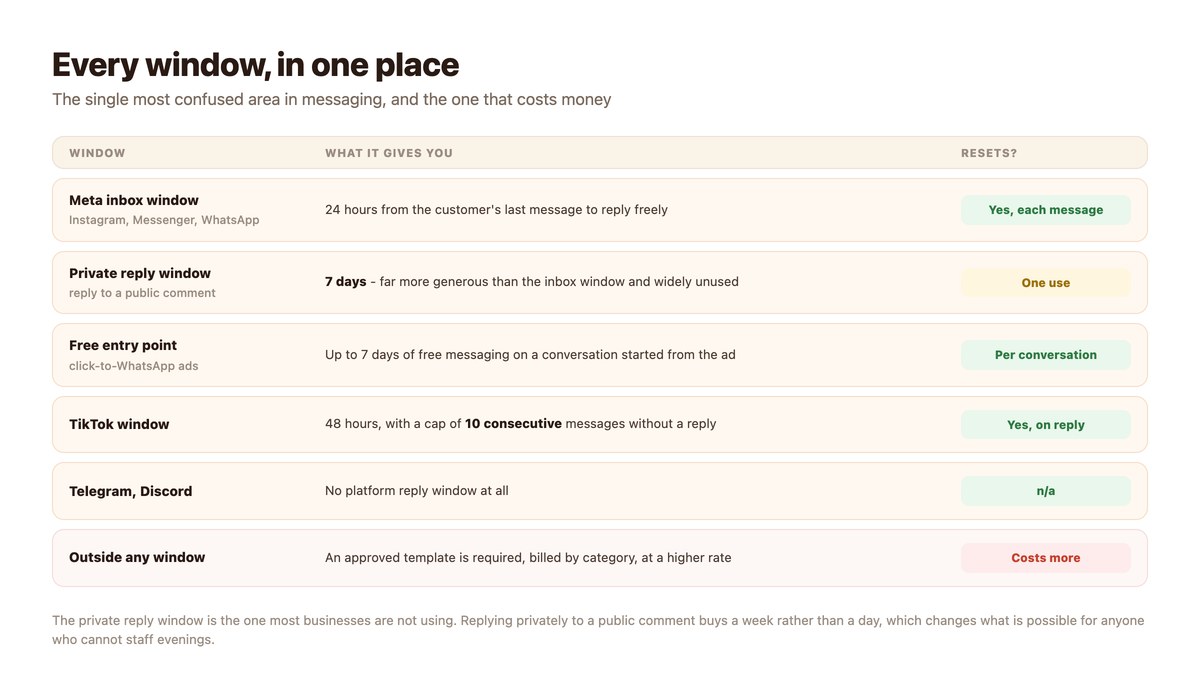
- Window – the period you can message freely. 24 hours on Meta inboxes, 7 days for a private reply to a comment, 48 hours on TikTok.
- Service message – a non-template message not powered by Meta’s own agent. The first 1,000 a month per number are free.
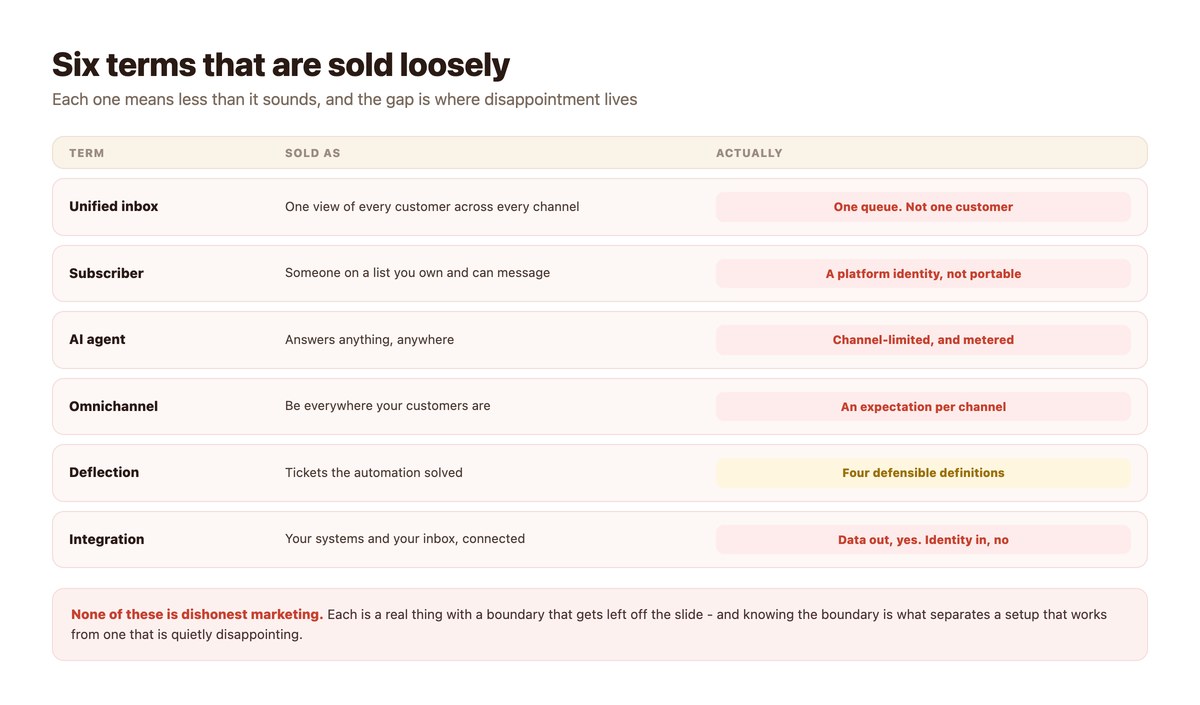
- Subscriber – a platform identity, not a list you own. It does not port between tools.
- Unified inbox – one queue, one set of rules. Never one customer.
- Deflection – has four defensible definitions from the same month’s data, so publish yours alongside the number.
- Integration – data out works, round trips work, writing identity back does not.
- Private reply – the most underused mechanism in messaging, and the one with the longest window.
Windows and Timing
The most confused area, and the one where confusion costs money.
Window
The period during which you can message someone freely, without an approved template. On Meta inboxes it is 24 hours from the customer’s last message and it resets each time they write again. TikTok gives 48 hours and caps you at ten consecutive messages. Telegram and Discord impose none.
The boundary: the window belongs to the conversation, not to your shift or your assignment. Handing a conversation over at hour twenty passes on four hours.
Private Reply
A private message sent in response to someone’s public comment. It opens a seven-day window rather than a 24-hour one, which makes it the most generous mechanism on the Meta channels.
The boundary: one private reply per comment, and it has to be a reply to that comment. It is not a way to start a conversation with someone who has not interacted.
Free Entry Point
A conversation that began when someone tapped a click-to-WhatsApp ad. It carries up to seven days of free messaging.
The boundary: free of message charges, not free of everything – Meta’s own AI agent is still billed inside it.
Template
A pre-approved message format required to reach someone outside any open window, categorised as marketing, utility or authentication.
The boundary: approval is per template and billing is per category, at higher rates than service messages. The numbers are in DM automation pricing compared.
Messages and Money
Four terms that decide what you are billed.
Service Message
Meta’s definition: a non-template message that is not powered by Meta’s own agent – and Meta states it may be powered by third-party AI or by people. The first 1,000 each month are free, per business phone number.
The boundary: the test is whose agent wrote it, not whether a machine did. A third-party automation’s reply inside the window is a service message.
Per-Message Billing
Since 1 July 2025 WhatsApp charges per message rather than per conversation, on delivery, and only on messages the business sends.
The boundary: inbound is free at any volume, so a long conversation where the customer does most of the talking is cheap. Splitting one answer across four sends costs four times as much.
AI Credits
A tool-side meter: the allowance your subscription includes for generated replies. Entirely separate from anything the platform charges.
The boundary: distinct from Meta’s own agent pricing, which applies only if you use Meta’s agent and has no free tier.
Conversation
Used to mean a billing unit and now mostly means a thread. The billing meaning is largely historical since the move to per-message charging.
The boundary: when a vendor quotes a price “per conversation”, ask which meaning they mean and over what window.
Triggers and Flows
The building blocks, and the settings that change behaviour silently.
Trigger
The event that starts an automation: a comment on a post, an incoming message, a story reply or mention, a Lead Ad submission.
The boundary: every trigger is something the customer did. There is no trigger for “someone followed us”, and nothing lets you start a conversation with a stranger.
Keyword Match Mode
How a trigger decides whether a message matched: word matches a whole word, contains matches anywhere in the text, exact requires the entire message to match. Word is the usual default.
The boundary: this is the setting that silently changes behaviour when you move between tools, and the commonest cause of post-migration breakage – see migrating from ManyChat.
Comment-to-DM
A public comment triggers a private message. The strongest acquisition mechanic in messaging, because the post does the reach and the DM does the work.
The boundary: it is a private reply, so it carries the seven-day window and can only be sent to someone who commented.
Handoff
The moment an automation stops and a person takes over.
The boundary: a handoff with no named destination is just a stop. The shapes that work are in the handoff to a human.
Identity, Records and People
The terms where the gap between sold and real is widest.
Subscriber or Contact
A platform identity that has messaged you – an account id on one channel, a phone number on another.
The boundary: not a list you own. It cannot be exported as people, it does not port between tools, and the same human on two channels is two of them. Why, in the unified social inbox.
Unified Inbox
One place to work every channel, with one set of escalation rules, one ownership model and one way of measuring.
The boundary: it unifies the work, never the customer. No platform exposes an identity that crosses channels.
Integration
A connection between the inbox and your other systems – natively for stores and calendars, or through a webhook for everything else.
The boundary: data out works, round trips work, and writing identity back does not exist anywhere. The three directions are in connecting your other systems.
Assignment
Recording who is working on a conversation.
The boundary: different from escalation, which is about who may decide. Assignment without a hand-back time is storage – assigning conversations to a team.
Terms to Challenge in a Demo
Each question has a correct answer. A vendor who cannot give it has told you something.
| If they say | Ask | The honest answer |
|---|---|---|
| “One view of the customer” | Across channels? | No – one queue, per-platform identities |
| “Export your subscribers” | As what, exactly? | Not as a portable, messageable list |
| “AI on every channel” | Including WhatsApp? | No – nor Messenger |
| “Deflection rate of X%” | Which denominator? | Four are defensible; publish the definition |
| “Automated LinkedIn DMs” | Under whose terms? | Not available, and restricted by LinkedIn |
| “Unlimited messages” | Unlimited on whose meter? | The tool’s, never the platform’s |
If a channel decision is what prompted the demo, the constraints that actually decide it are in picking the right channel.
Doing It With DMpro
The same terms, mapped to what exists.
What the Words Map To
In DMpro, a trigger is a comment, a message, a story reply or mention, or a Lead Ad submission. Actions are sending a DM, replying on a comment, sending products, calling a webhook or an AI response. Conversations are the inbox, grouped by the person on each platform.
Delays run from seconds to fifteen days, keyword matching offers word, contains and exact, and a per-recipient cooldown stops the same person being contacted repeatedly.
The Boundaries, Stated
AI responses run on Instagram, TikTok, Telegram and Discord – not WhatsApp, not Messenger. Product cards do not send on TikTok. LinkedIn is comment-trigger only with no DM sending. There is no follow trigger on any channel, and no per-conversation assignee field.
Each of those is a platform or product fact rather than a plan tier, which is why none of them can be unlocked by paying more.
Know Where Each Term Stops
Most disappointment with messaging automation comes from a term that was true with a boundary attached, and the boundary was left off the slide.
DMpro is explicit about its limits – which channels run AI, which send products, what no tool can do – so what you build is what you get.
Conclusion
Most of these terms are accurate and incomplete. A window is real and belongs to the conversation rather than your shift. A subscriber is real and is not a list you own. An integration is real in two directions out of three.
The two worth memorising are the private reply window, because seven days is a different business from 24 hours and most companies are not using it, and the service message definition, because the first thousand a month are free and a third-party automation’s replies count.
And when a demo uses one of these words, ask where it stops. The answers are not secret – they are just not on the slide.
Frequently asked questions
What is a messaging window?
The period during which you can message someone without an approved template. 24 hours from the customer’s last message on Meta inboxes, seven days for a private reply to a public comment, 48 hours on TikTok, and no limit on Telegram or Discord.
What counts as a service message?
Meta defines it as a non-template message that is not powered by Meta’s own agent, and says it may be powered by third-party AI or by people. The first 1,000 each month are free, per business phone number.
Is a subscriber list something I own?
No. Subscribers are platform identities that messaged you through a particular tool’s connection. They cannot be exported as a messageable list and they do not transfer when you change tools.
What is a private reply?
A private message sent in response to someone’s public comment. It opens a seven-day window rather than 24 hours, which makes it the most generous mechanism on Meta channels – and the most underused.
What does keyword match mode mean?
How a trigger decides a message matched: word matches a whole word, contains matches anywhere in the text, and exact requires the whole message to match. It is the commonest cause of automations behaving differently after a migration.
Does ‘unlimited messages’ mean no message costs?
No. A tool can offer unlimited sends on its own plan while the platform still bills per message – WhatsApp charges on delivery for everything your business sends beyond the free allowance.