
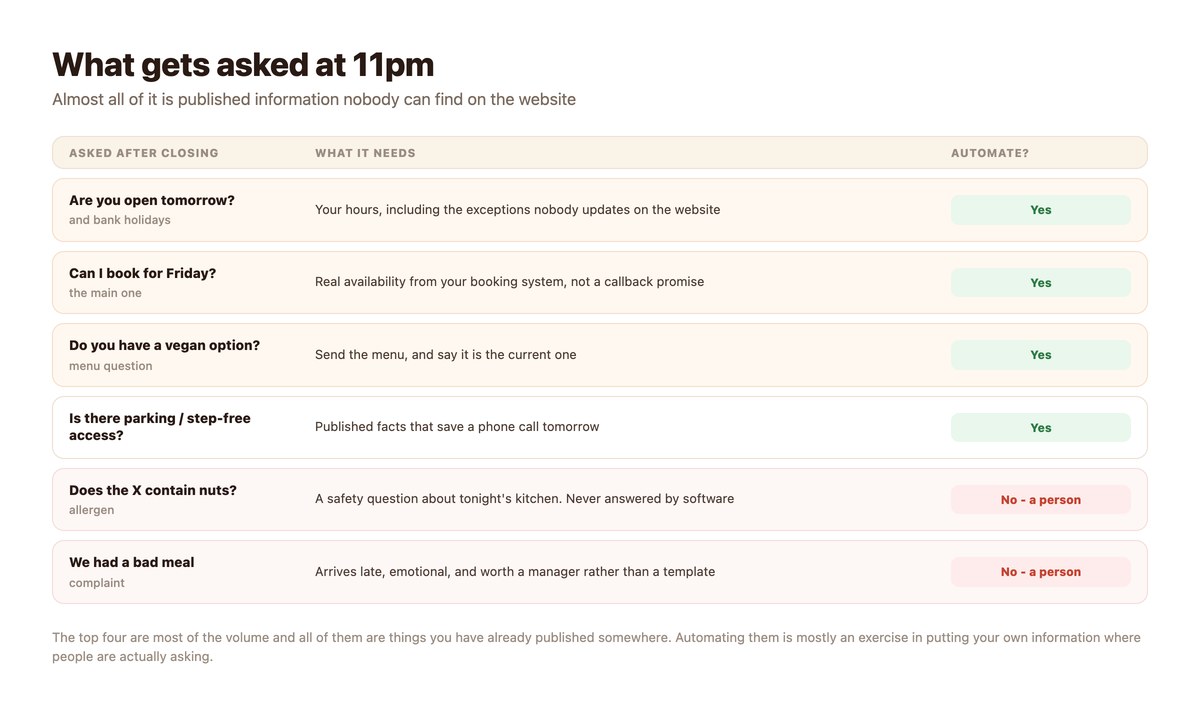
Restaurant Instagram DMs are overwhelmingly logistics. Are you open, can I book, is there parking, do you do a vegan option, can we bring the dog. All of it is information you have already published, asked by people who could not find it, mostly after you have closed.
That makes this one of the easiest flows in the cluster and one of the few with a genuine safety line running through it – because one category of question in a restaurant inbox must never be answered by software.
The flow shape is standard, see DM automation by industry. Below are the two questions a booking needs, and the line.
Key takeaways
- Most restaurant DMs are published facts asked after closing. Automating them is mostly putting your own information where people ask.
- Two questions are all a booking needs: how many, and which day and rough time.
- Connect the booking system so the flow ends in a real table, not a callback.
- Allergen questions must always route to a person. No partial answer, no “usually”.
- Complaints arrive late and emotional – route them to a manager, never a template.
- Keep your hours in the flow, including bank holidays, because that is the question nobody can find online.
The Allergen Line
First, because it is the one thing in this article that is not a preference.
Why Software Cannot Answer It
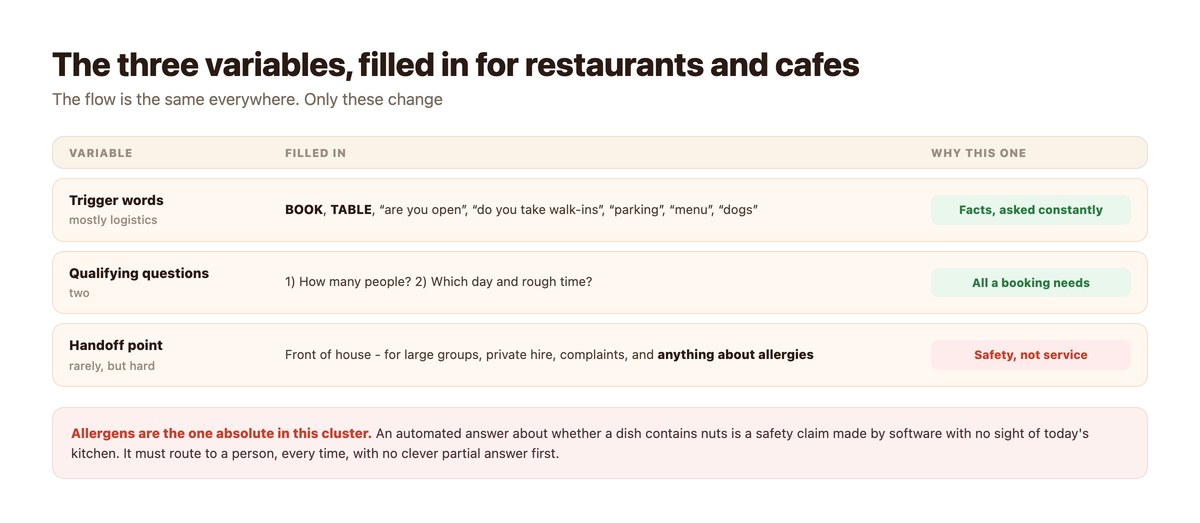
Whether a dish contains a given allergen depends on tonight’s ingredients, tonight’s supplier substitutions, and tonight’s kitchen. An automated answer is a safety claim made by a system with no sight of any of that.
It does not matter how accurate your menu data is. The risk is not that the data is wrong; it is that the data is not the same thing as the plate.
Route It Without a Clever Partial Answer
The tempting design is to answer from the menu and add a caveat. Do not. A caveat attached to a specific “no nuts” is read as the answer, not as the caveat.
The correct flow is one sentence – that you take this seriously and are putting them through to someone who can check – and then a person. During service that person is front of house; outside it, an honest time.
Make It a Hard Keyword List
Allergy, allergic, coeliac, gluten, nuts, peanut, shellfish, dairy, intolerance, anaphyl-. Written down, matched broadly on purpose, and escalating before any other branch runs.
This is the one place in the whole cluster where a deliberately greedy keyword is correct.
The Easy Majority
Having dealt with the hard part, most of this inbox is genuinely simple.
Two Questions for a Booking
How many people, and which day and rough time. That is everything a table booking needs, and both are buttons – party size as numbers, timing as a window rather than an exact slot.
The calendar then offers real times. Connecting the booking system is what turns this from a message you have to action into a table that is booked.
Hours, Including the Exceptions
“Are you open tomorrow” is the single most common restaurant DM and the one most often wrong on the website, because bank holidays and private events never get updated there.
Put the real hours in the flow and keep them current. It takes a minute a month and removes a question asked daily.
The Logistics Nobody Publishes Well
Parking, step-free access, whether dogs are welcome, whether you do high chairs, how long you hold a table. Each one is trivial and each one is asked constantly, often by somebody deciding between you and somewhere else.
A flow that answers them at eleven at night is competing well against a website nobody is reading.
Group Size Changes the Answer
The one place where party size should change the route rather than just the booking.
| Party size | What the flow does | Why |
|---|---|---|
| 1-4 | Books it | Standard, no judgement needed |
| 5-8 | Books it, flags the deposit policy if you have one | Still routine |
| 9+ | Takes details, routes to front of house | Needs a table plan and often a menu |
| Private hire or event | Routes immediately | A sales conversation, not a booking |
| Anything with a time constraint | Routes if tight | “We have a show at 8” is a promise |
The pattern – higher value means earlier handoff – is the same rule set out in DM automation by industry.
Building It
A morning. The allergen list comes first, before anything else.
- Write the allergen escalation list and test it. Before any other branch exists. Match broadly, escalate immediately, no partial answer.
- Put your real hours into the flow. Including bank holidays and private events. Set a monthly reminder to check them.
- Add the two booking questions as buttons. Party size, then day and rough time window.
- Connect the booking system. So the flow ends in a real table rather than a message someone has to action in the morning.
- Add the logistics answers. Parking, access, dogs, high chairs, how long you hold a table. Ten minutes, asked daily.
- Route 9+ and private hire to a person. These are your most valuable bookings and the easiest to lose to an automated ‘sorry, fully booked’.
Where This Connects
Two things that follow directly.
Complaints Arrive Late
A bad meal is messaged about that night, not the next morning, and it is the one conversation where an automated reply makes things measurably worse. Route it to a manager with an honest time attached – after-hours DM support covers how to say that without pretending to be awake.
The Rules Should Be Written Down
Allergens, large groups, complaints and private hire are four hard routes, and they should exist as a written rule set with named owners rather than as something the flow does by habit – support escalation rules.
Answer the 11pm Question Before Someone Books Elsewhere
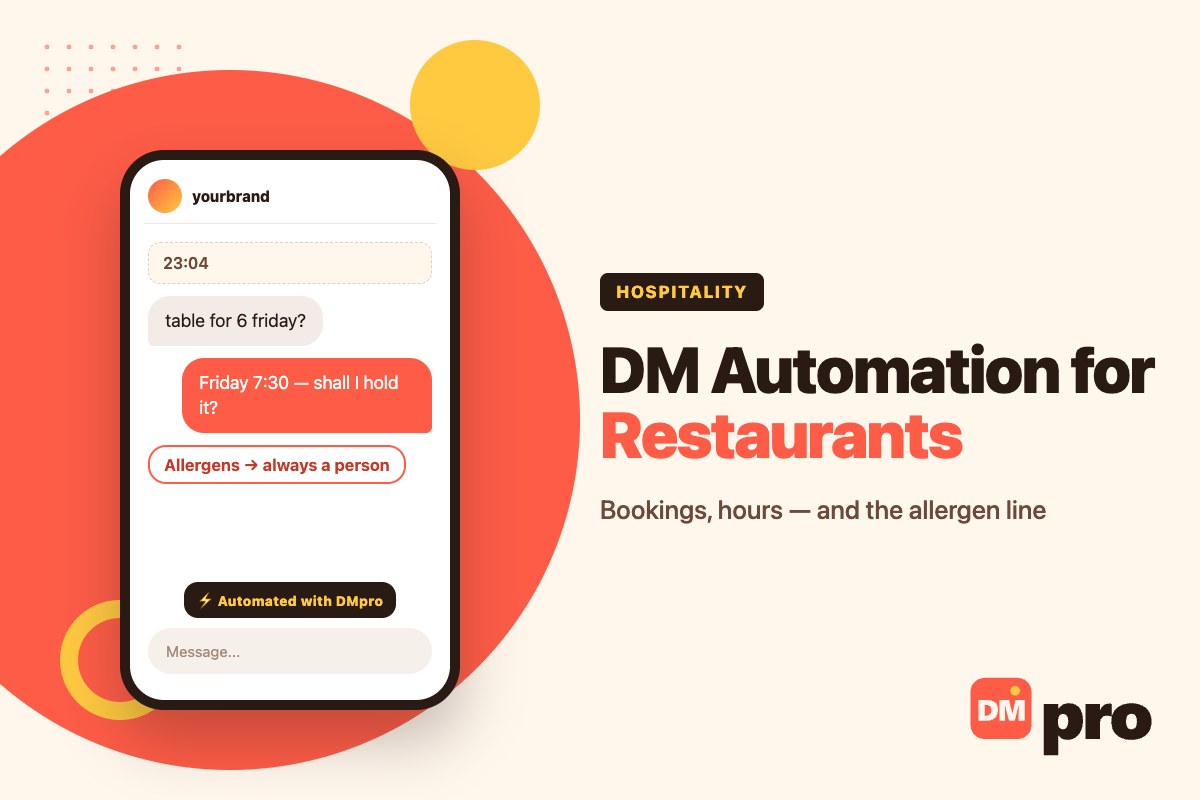
“Are you open tomorrow?” and “can I book for six on Friday?” arrive long after you have closed, from people deciding between you and somewhere else.
DMpro answers them instantly from your own hours and booking system, and routes allergen questions, large groups and complaints straight to a person – because those are not questions for software.
Conclusion
Most of a restaurant inbox is information you have already published, asked by people who could not find it, at hours when nobody is there to point them at it. Two questions and a connected booking system handle the majority.
The exception is absolute. Allergen questions depend on tonight’s kitchen, and an automated answer is a safety claim made by software that cannot see the plate. Build that escalation list first, match it broadly, and never let a partial answer go out ahead of it.
Then route large groups and complaints to a person too – the first because they are your most valuable bookings, the second because an automated reply to an unhappy diner at midnight makes it worse.
Frequently asked questions
Can a bot answer allergen questions?
No. Whether a dish contains an allergen depends on tonight’s ingredients, substitutions and kitchen, none of which software can see. Route every allergen question to a person, with no partial answer first.
What should a restaurant DM flow ask?
Two things for a booking: how many people, and which day and rough time. Both as buttons, with the calendar offering real times inside the window they pick.
What do people actually ask restaurants on Instagram?
Mostly logistics – opening hours, bookings, parking, step-free access, whether dogs are welcome, and whether there is a vegan option. Nearly all of it is published somewhere they could not find.
Should large group bookings be automated?
Take the details automatically but route nine or more to a person. They need a table plan and often a set menu, and they are your most valuable bookings to lose to an automated refusal.
How should complaints be handled?
By a manager, never a template. They arrive late at night and emotional, and an automated reply at that moment makes the situation measurably worse. Give an honest time instead.
What is the easiest win for a restaurant?
Putting your real opening hours – including bank holidays and private events – into the flow. It is the most common question and the one most often out of date on the website.