
A nonprofit social media DM inbox contains four conversations at once: people who want to give, people who want to volunteer, press and partners, and people who need help. They arrive through the same channel, often in the same hour.
Three of those are straightforward to automate. The fourth is not, and getting it wrong is not a poor customer experience – it is a person in difficulty being handled by software.
So this article is organised around that fork rather than around donations. The flow shape is standard, see DM automation by industry; what follows is where the line sits and how to make sure the automation stays on the right side of it.
Key takeaways
- Ask the fork question first: are you looking to support us, or looking for support?
- Anyone seeking help reaches a trained person – never a flow, never a form.
- Match help-seeking language broadly and err towards routing. A false escalation costs nothing.
- Donations automate completely: a working link, where money goes, Gift Aid.
- Volunteering automates as far as the facts, then stops at suitability and safeguarding.
- Publish your crisis signposting in the flow, accurately, and keep it current.
- Do not use urgency or guilt framing in an automated message – you cannot see who is reading it.
The Fork, and Why It Comes First
Everything in this vertical depends on getting one question right at the top.
Ask It Before Anything Else
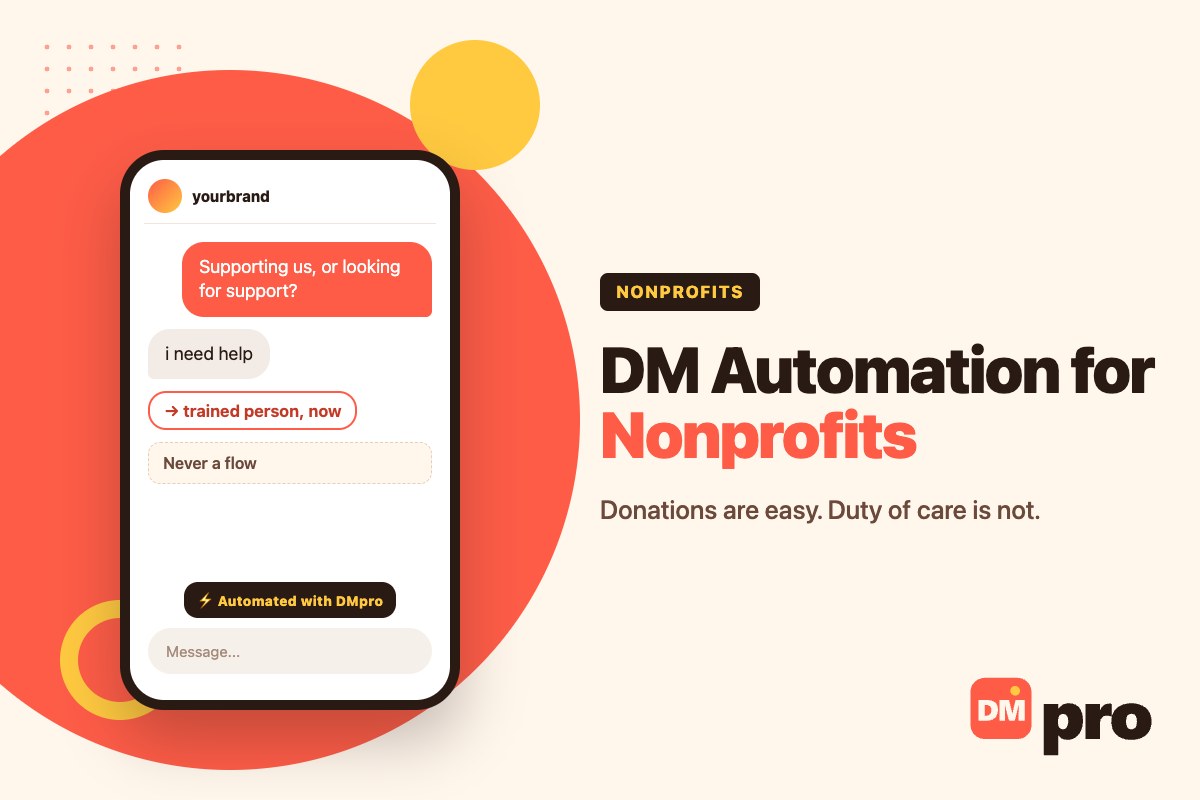
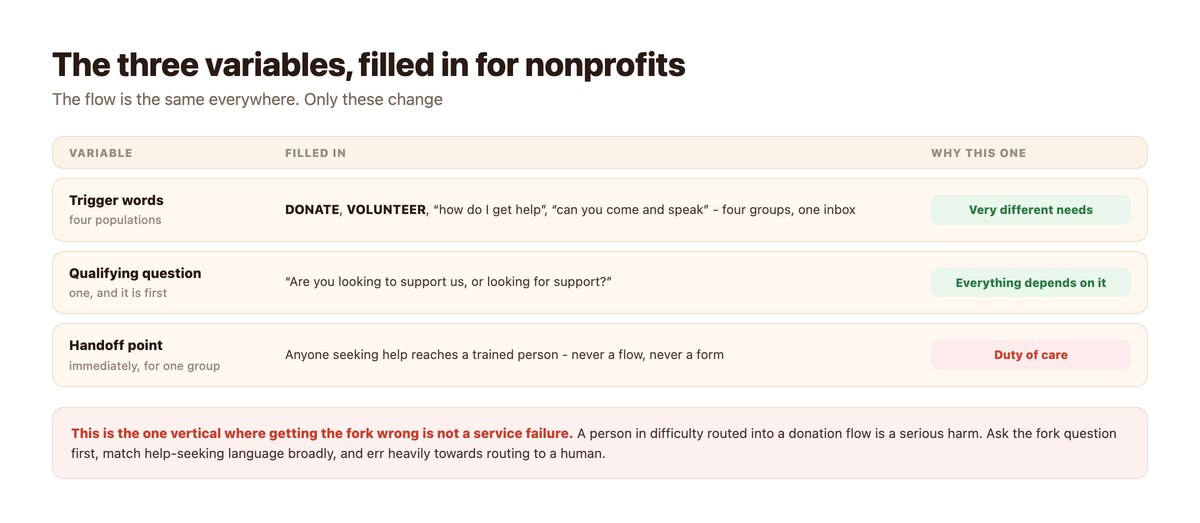
“Are you looking to support us, or looking for support?” – two buttons, before any donation content appears. It reads as ordinary signposting and it is the most important routing decision in the whole flow.
A charity flow that opens with a donation ask, to somebody who messaged because they are in difficulty, is a failure of a different order from a bad support experience.
Match Help-Seeking Language Broadly
Do not rely on the button alone. People in difficulty often describe the situation rather than selecting a category, and they may not use the words your service uses.
Match broadly and deliberately over-escalate. In every other article in this cluster a greedy keyword is a defect; here it is the correct setting, for the same reason as the allergen list in the restaurant flow.
Route to a Trained Person
Not to a general inbox, not to whoever is on, and not into a form. The destination for help-seeking messages should be someone trained for it, with a named fallback and a real response time stated honestly.
If that is not available out of hours, say so plainly and signpost to a service that is. An honest “we are not here until 9am, and here is who is” is responsible; silence is not.
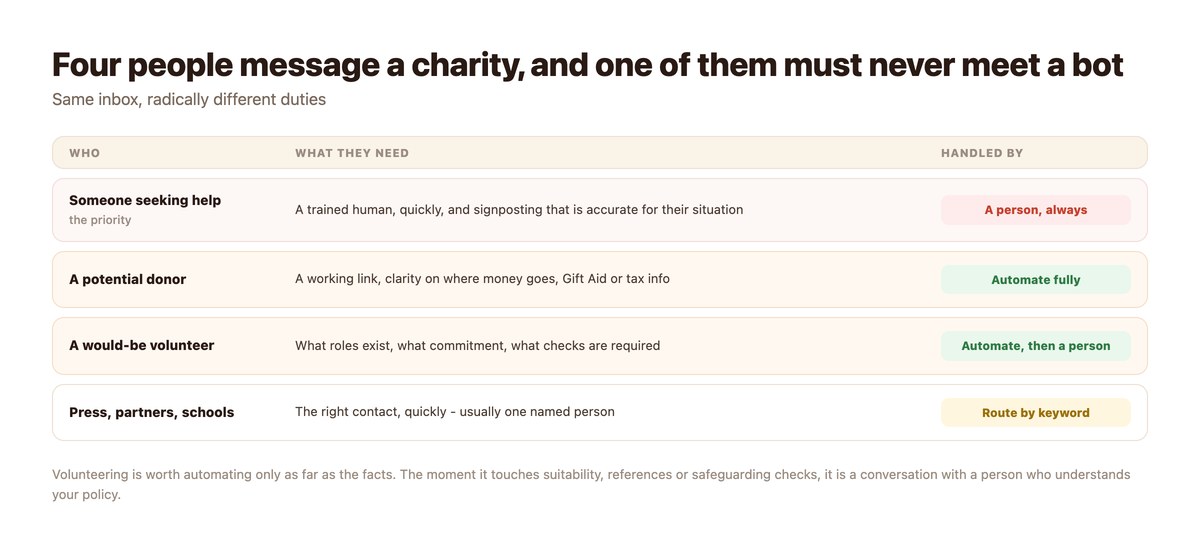
What Automates Well
Having drawn the line, three of the four groups are genuinely easy.
Donations
A working link, a plain statement of where the money goes, and whatever tax mechanism applies in your country. Those three things answer most donor messages completely.
The common failure is a broken or outdated link – check it monthly. A donation flow that sends people to a dead page is worse than no flow.
Volunteering, Up to a Point
Which roles exist, what the commitment is, what checks are required, and when the next induction runs. All facts, all asked constantly, all safely automated.
Then it stops. Suitability, references and safeguarding checks are a conversation with somebody who knows your policy, and the flow should hand over rather than collect personal detail.
Press, Schools and Partners
Usually one named contact each, and a keyword route is enough. The value here is speed – a journalist on a deadline who waits two days writes the piece without you.
What to Automate
The bottom rows are not preferences.
| Message | Automate? | Why |
|---|---|---|
| How do I donate / Gift Aid? | Yes | Facts and a link |
| Where does the money go? | Yes | Published, and asked often |
| What volunteer roles are there? | Yes | Facts |
| Can you speak at our school? | Route by keyword | One named contact |
| Press enquiry | Route immediately | Deadlines |
| I need help / I am struggling | No – a trained person, fast | Duty of care |
| Anything about a child at risk | No – safeguarding lead, now | Statutory |
They belong in a written rule set with named owners and a fallback, not in anyone’s memory – support escalation rules.
Building It
Build in this order. The first two steps come before any donation content exists.
- Write the help-seeking escalation first. Broad matching, trained destination, named fallback, honest out-of-hours signposting. Test it before anything else is live.
- Add the fork question at the top. Support us, or looking for support. Two buttons, before any ask.
- Check your donation link, then automate donations. Link, where the money goes, tax mechanism. Set a monthly reminder to re-check the link.
- Automate volunteering facts only. Roles, commitment, checks, next induction. Hand over at suitability.
- Route press and partnerships to named people. Speed is the whole value.
- Review escalations monthly with someone trained. Not just for coverage – to check the flow is not catching people it should have routed.
Two Things Not to Do
Both are common in charity marketing and both are wrong in an automated DM.
No Urgency or Guilt Framing
Countdown language and emotionally loaded appeals are standard in campaigns where you know the audience. In a DM flow you do not know who is reading – it may be somebody who contacted you for help.
Keep automated messages plain and factual. Save the campaign voice for channels where the audience is chosen.
No Collecting Sensitive Detail in a Flow
Do not build a form that asks a person in difficulty to describe their circumstances to an automation, however well-intentioned the triage logic is. Route first; let a trained person ask.
The same applies to volunteer safeguarding information, which belongs in your proper process rather than in a chat thread.
Where This Connects
Two neighbours.
Out of Hours Is the Risk Window
Help-seeking messages arrive disproportionately at night. If you cannot staff that, the flow must say so plainly and signpost accurately to a service that can – the models and the honest wording are in answering DMs outside business hours.
Measure Coverage, Not Deflection
Deflection is actively the wrong metric for a charity inbox: a help-seeking message handled without a human is a failure, not a success. Measure time to a trained person instead – the argument against deflection is in what deflection hides.
Answer the Donor. Reach the Person Who Needs Help.
Four conversations arrive in a charity inbox and three of them are facts you have already published. The fourth needs a trained person, quickly, and must never be handled by software.
DMpro answers donations and volunteering instantly, routes press and partnerships to the right person, and sends anyone asking for help straight to a named human with the whole conversation attached.
Conclusion
The whole design of a nonprofit DM flow follows from one question asked at the top: are you looking to support us, or looking for support. Get that fork right and the rest is ordinary automation.
Donations, volunteering facts and press routing all automate cleanly and remove real load. Help-seeking does not – it goes to a trained person, matched broadly enough that the flow over-escalates rather than under-escalates, with honest signposting when nobody is available.
And keep the campaign voice out of it. Urgency and guilt framing work when you know who is reading; in an inbox where one of the four audiences is in difficulty, you do not.
Frequently asked questions
What should a nonprofit DM flow ask first?
Whether the person is looking to support you or looking for support. Two buttons, before any donation content appears – it is the most important routing decision in the whole flow.
Can help-seeking messages be automated?
No. They should reach a trained person quickly, with a named fallback and an honest response time. Match help-seeking language broadly and over-escalate deliberately – a false escalation costs nothing.
What automates well for a charity?
Donations – a working link, where the money goes, and the relevant tax mechanism. Volunteering facts such as roles, commitment and required checks. And routing press or school enquiries to a named contact.
Where does volunteer automation stop?
At suitability. Roles, commitment, checks and induction dates are facts. References, safeguarding and whether somebody is right for a role are a conversation with a person who knows your policy.
Should we use urgency in automated messages?
No. Countdown and guilt framing work in campaigns where you know the audience. In a DM flow you cannot see who is reading, and it may be someone who contacted you for help.
What metric should a charity inbox use?
Time to a trained person, not deflection. For this inbox a help-seeking message handled without a human is a failure rather than a success, which makes deflection actively misleading.