
DM automation for dropshipping starts from one constraint, and it changes everything downstream: you do not control the two facts customers ask about most. Stock is somebody else’s number and delivery is somebody else’s promise.
Most DM automation advice assumes you own both. Copy it and your flow will confidently state a delivery date you cannot keep, which converts well this week and generates chargebacks next month.
This is how to build flows that are honest about what you do and do not know, and still answer fast enough to be worth having. For the underlying rules, see e-commerce DM automation.
Key takeaways
- Never let a flow state a delivery date you cannot verify. Give a range, say where it comes from, and say when it firms up.
- Stock from a supplier feed is a snapshot. An automated “in stock” is a claim you may not be able to keep.
- Set the shipping expectation before the sale, in the flow that answers pre-purchase questions – not after.
- Tracking handoff is the single highest-value automation here, because it is the question that repeats most.
- Build the “it has not arrived” branch early. On long lead times you will need it.
- Honest, slightly conservative estimates produce fewer refunds than optimistic ones.
The Two Facts You Do Not Own
Everything specific to dropshipping comes from these.
Stock Is a Snapshot
A supplier feed tells you what was true when it was generated. Between that moment and the customer’s order, the item can be gone – and if your automated reply already said “yes, in stock”, you have made a promise on a number you did not control.
The honest formulation costs nothing and protects you: say it is available rather than guaranteed, and that you confirm on order. Customers accept this when it is said up front and resent it when it appears after payment.
Delivery Is a Range, Not a Date
Supplier dispatch time plus carrier transit plus customs, none of which you control. A flow that answers “Tuesday” is inventing precision.
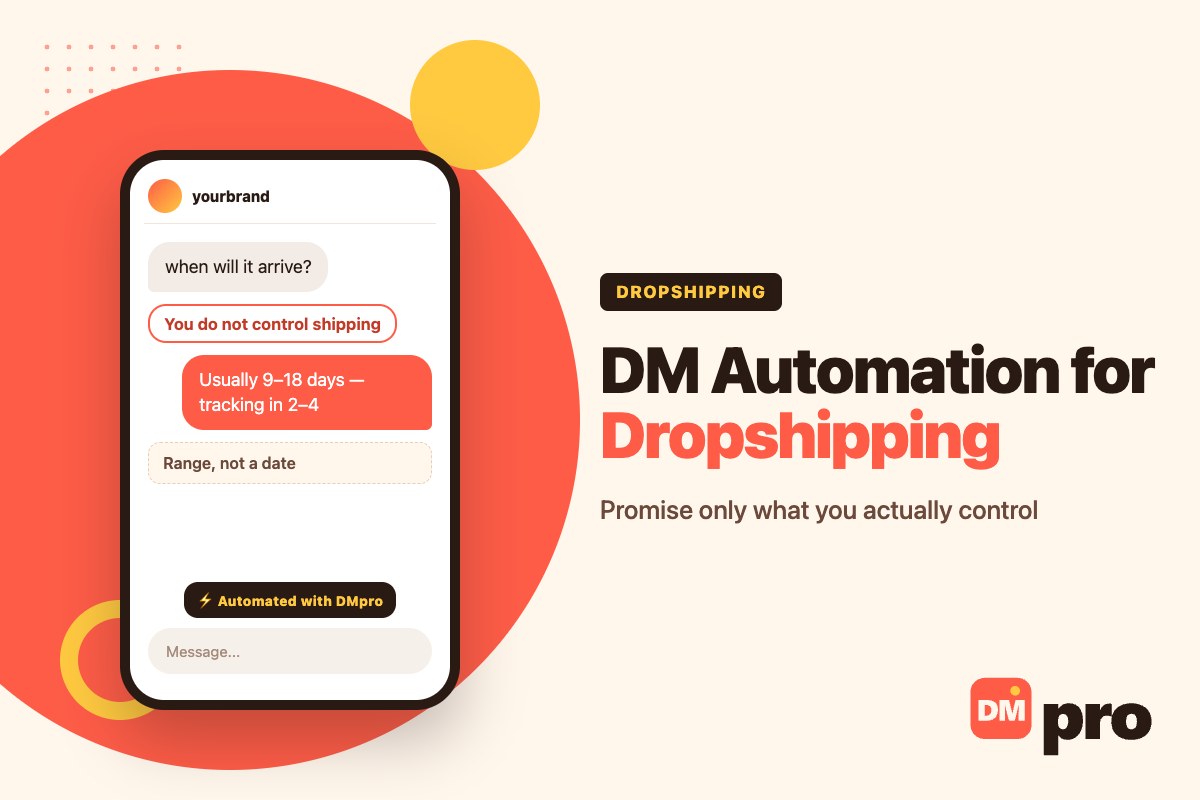
Give a range, name what it depends on, and say when it becomes firm – usually when tracking is issued. That single sentence prevents most of the follow-up.
Quote the slow end
If it is 9 to 18 days, lead with the longer figure. Arriving early is a pleasant surprise; arriving late is a dispute.
Say where the estimate comes from
“Our supplier dispatches in 2-4 days, then shipping is 7-14” is credible in a way that a bare number is not.
The Flows That Matter Here
Different priorities from a store that holds its own stock.
Pre-Purchase Shipping Expectations
The most valuable flow in a dropshipping store is the one that answers “how long does delivery take” before the order exists. Answered honestly, it loses a few impatient buyers and prevents most of your refund requests.
This is a straight keyword flow and costs nothing within the free monthly service allowance.
Tracking Handoff
Once tracking exists, the question repeats until delivery. A lookup flow that takes the order number and returns the current carrier status removes the entire category – the same build as order status automation, with one difference: your webhook may need to query the supplier or a tracking aggregator rather than your own store.
The Long Wait Branch
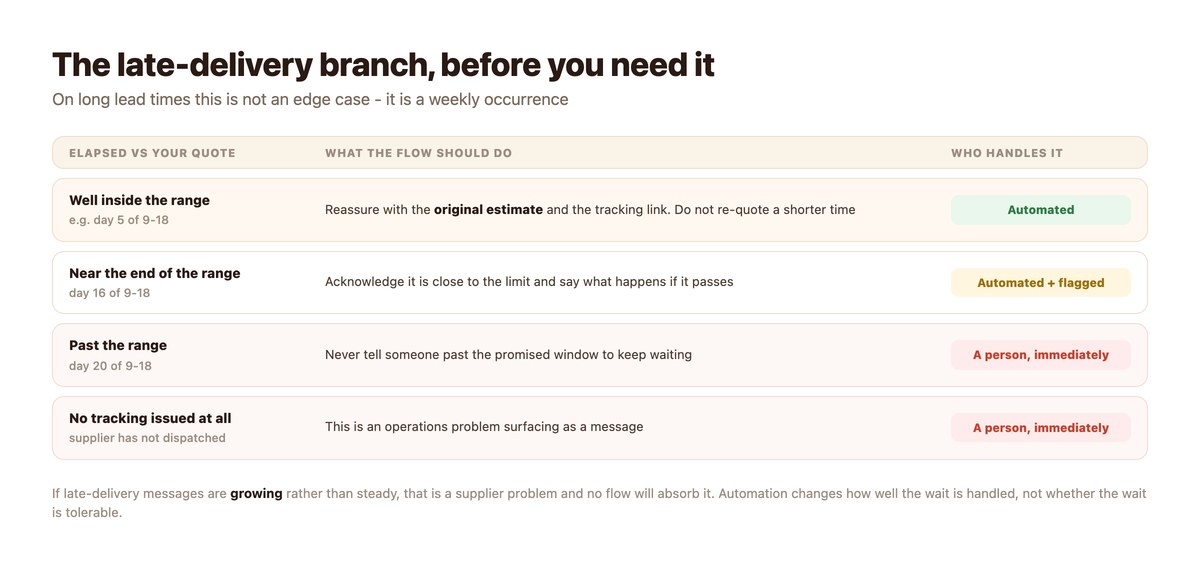
With long lead times, “it still has not arrived” is guaranteed. Build that branch before you need it: check the elapsed time against the quoted range, and if it is still inside, say so with the original estimate and the tracking. If it is outside, route to a person immediately.
Never let an automation tell someone past the promised window to keep waiting. That is the message that becomes a chargeback.
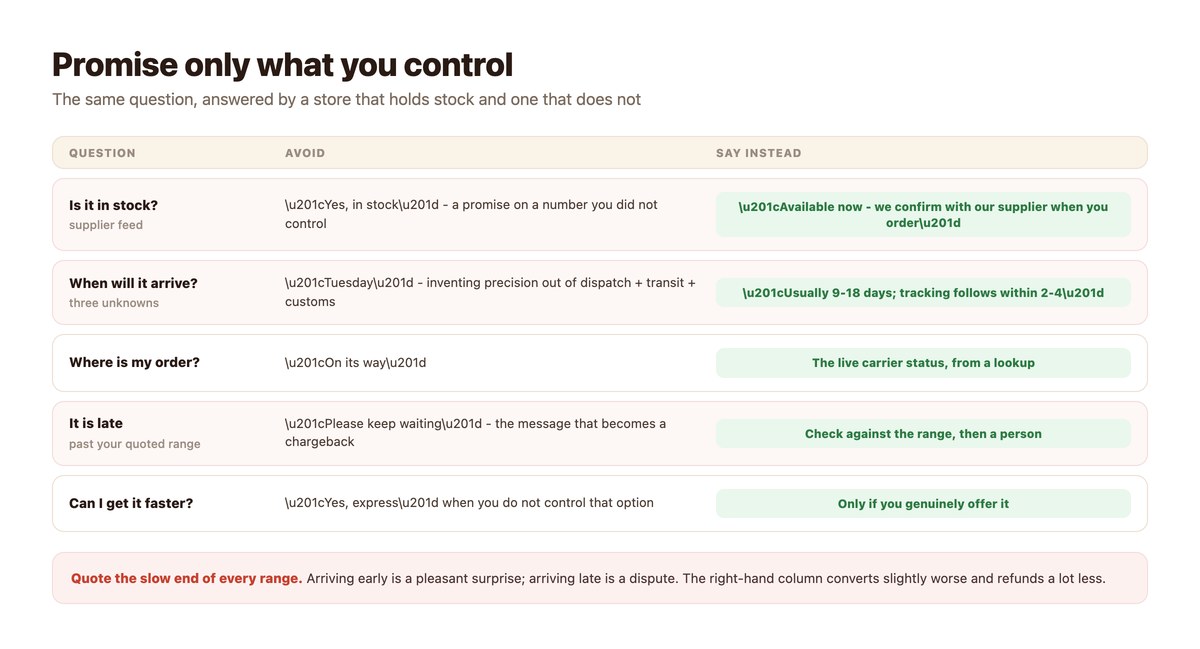
What to Say When You Do Not Know
The same question, answered by a store that holds stock and one that does not.
| Question | Avoid | Say instead |
|---|---|---|
| Is it in stock? | “Yes, in stock” | “Available now – we confirm with our supplier when you order” |
| When will it arrive? | “Tuesday” | “Usually 9-18 days; tracking follows within 2-4” |
| Where is my order? | “On its way” | The live carrier status from a lookup |
| It is late | “Please keep waiting” | Check against the quoted range, then a person |
| Can I get it faster? | “Yes, express” | Only if you actually control that option |
If the volume of late-delivery messages is growing rather than steady, that is a supplier problem and no flow will absorb it.
Building It
Shortest list in this cluster, because fewer promises means fewer branches.
- Write your real ranges down, from actual orders. Not the supplier’s marketing figure. Pull your last fifty orders and measure.
- Build the pre-purchase expectation flow first. It is the one that reduces refunds, and it runs before any money changes hands.
- Phrase stock as availability, not a guarantee. One word of hedging, said up front, prevents an argument later.
- Add the tracking lookup. Your webhook may need the supplier’s API or an aggregator rather than your store.
- Build the late branch with a real threshold. Inside the quoted range: reassure with the original estimate. Outside it: a person, immediately.
- Review refund reasons monthly. If they cluster on delivery time, the fix is the estimate or the supplier, not the copy.
Where Automation Stops Helping
Worth saying plainly, because this is the model where tooling gets blamed for operations.
It Cannot Fix a Slow Supplier
If delivery genuinely takes six weeks, no amount of fast, friendly messaging makes that acceptable to most buyers. Automation changes how well the wait is handled, not whether the wait is tolerable.
It Cannot Message Buyers First
A proactive “your order has shipped” to someone who has not written to you is outbound, which means an approved utility template with opt-in – the same constraint covered in abandoned cart DMs.
It Should Not Make Claims You Have Not Checked
Shipping times, authenticity, warranty, country of origin. If your flow states them, you own them, regardless of what the supplier’s listing said.
The Operational Truth Behind the Messaging
Messaging makes a dropshipping operation legible. That is useful and occasionally unwelcome.
Your Inbox Is a Supplier Monitor
Late-delivery messages are a leading indicator of supplier performance, and they arrive weeks before the data does. If messages about one product line start climbing while everything else stays flat, you have found a problem with that supplier before your refund rate shows it.
Tag escalations by product or supplier from the start. It costs nothing and it turns the support queue into an early warning system.
Honest Estimates Compound
Quoting the slow end of your range feels like leaving money on the table on each individual sale. Across a quarter it does the opposite, because refunds, chargebacks and the time spent on angry messages all fall. The cost of an optimistic estimate is paid later, by someone on your team, at a worse moment.
This is the single highest-leverage decision in dropshipping support and it is a copywriting choice, not a tooling one.
Volume Changes the Answer
At low volume one person can absorb the exceptions. Past a few dozen conversations a day they cannot, and the queue becomes the bottleneck rather than the flows – which is the point at which assigning conversations to a team and choosing between a shared inbox and a helpdesk stop being premature.
Build for where you are. Most stores reach for the team tooling two months later than they should and the warning sign is always the same: escalations waiting overnight.
Answer Honestly, Fast, Every Time
In a dropshipping store the questions are relentless and the answers are the same: how long, where is it, is it really coming. Answered quickly and honestly they are routine. Answered late they become refunds.
DMpro handles the repeats with your real ranges, looks up live tracking through your own webhook, and escalates to a person the moment an order passes the window you quoted.
Conclusion
The whole discipline of DM automation for dropshipping is promising only what you control. You do not control stock and you do not control delivery, so flows that state either as fact are writing cheques your supplier has to cash.
Give ranges, name what they depend on, quote the slow end, and confirm stock on order rather than in the chat. Build the pre-purchase expectation flow before anything else, because it is the one that prevents the refunds.
Then build the late branch with a real threshold and a real human behind it. On long lead times that path is not an edge case – it is a weekly occurrence.
Frequently asked questions
How is DM automation different for dropshipping?
You do not control stock or delivery, so any flow that states them as fact is making a promise on someone else’s behalf. Flows should give ranges, say what they depend on, and confirm stock when the order is placed.
Should an automated reply say an item is in stock?
Say it is available and that you confirm with the supplier on order. A supplier feed is a snapshot, and customers accept the hedge up front far better than they accept a cancellation after paying.
What delivery estimate should the flow give?
A range built from your own last fifty orders, not the supplier’s marketing figure, and lead with the slow end. Say what it depends on and when it firms up.
How do I handle ‘it still has not arrived’?
Check elapsed time against the range you quoted. Inside it, reassure with the original estimate and the tracking. Outside it, route to a person immediately – never tell someone past the promised window to keep waiting.
Can automation send a shipping notification?
Not to someone who has not messaged you. That is outbound and needs an approved utility template with opt-in.
Will faster replies reduce refunds?
They reduce the refunds caused by uncertainty and silence. They do not fix a genuinely slow supplier – if refund reasons cluster on delivery time, that is an operations problem, not a messaging one.