
Agency DM automation starts from an unusual place: agencies do not have a lead problem. They have a calendar problem: too many enquiries that cannot afford the work, each one absorbing a call from someone senior, while the two prospects who could afford it wait three days for a slot.
So the job of agency DM automation is unusual in this cluster. It is not to convert. It is to qualify out, politely and early, so the calls that do happen are worth having.
The flow shape is standard – see DM automation by industry. Below are the three questions, the one that does the real work, and the rule about prices.
Key takeaways
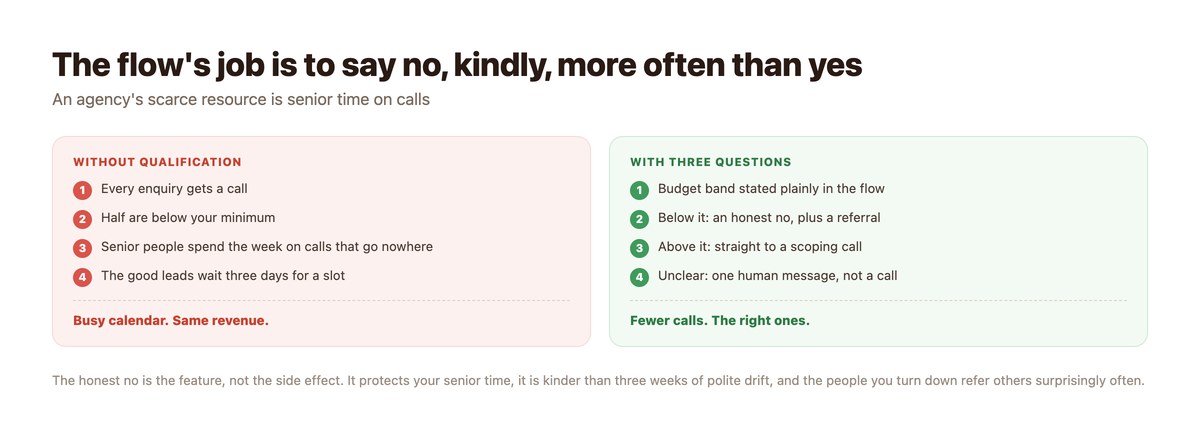
- The flow’s job is to say no kindly, more often than yes. Senior time on calls is the scarce resource.
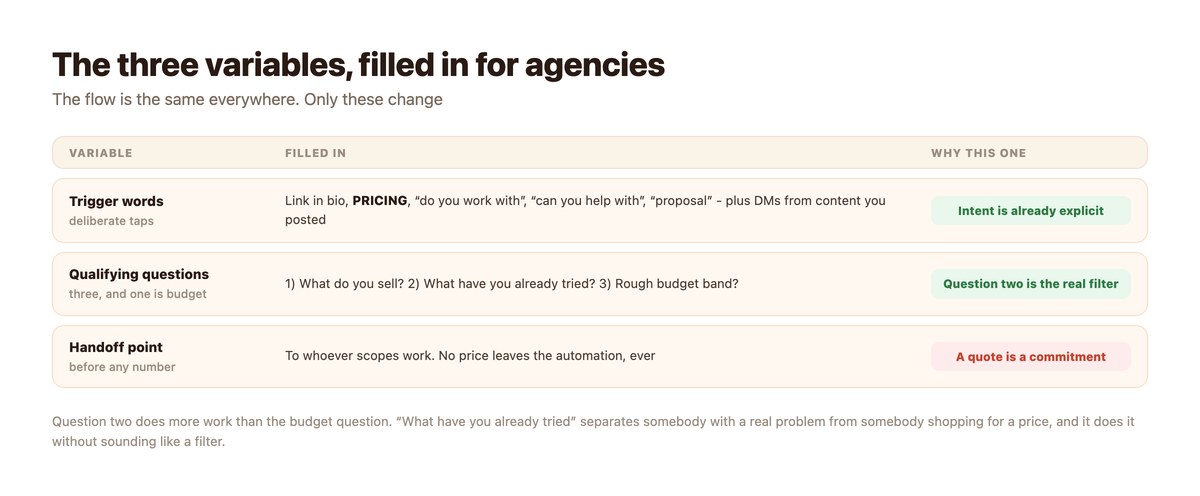
- Three questions: what you sell, what you have already tried, and a rough budget band.
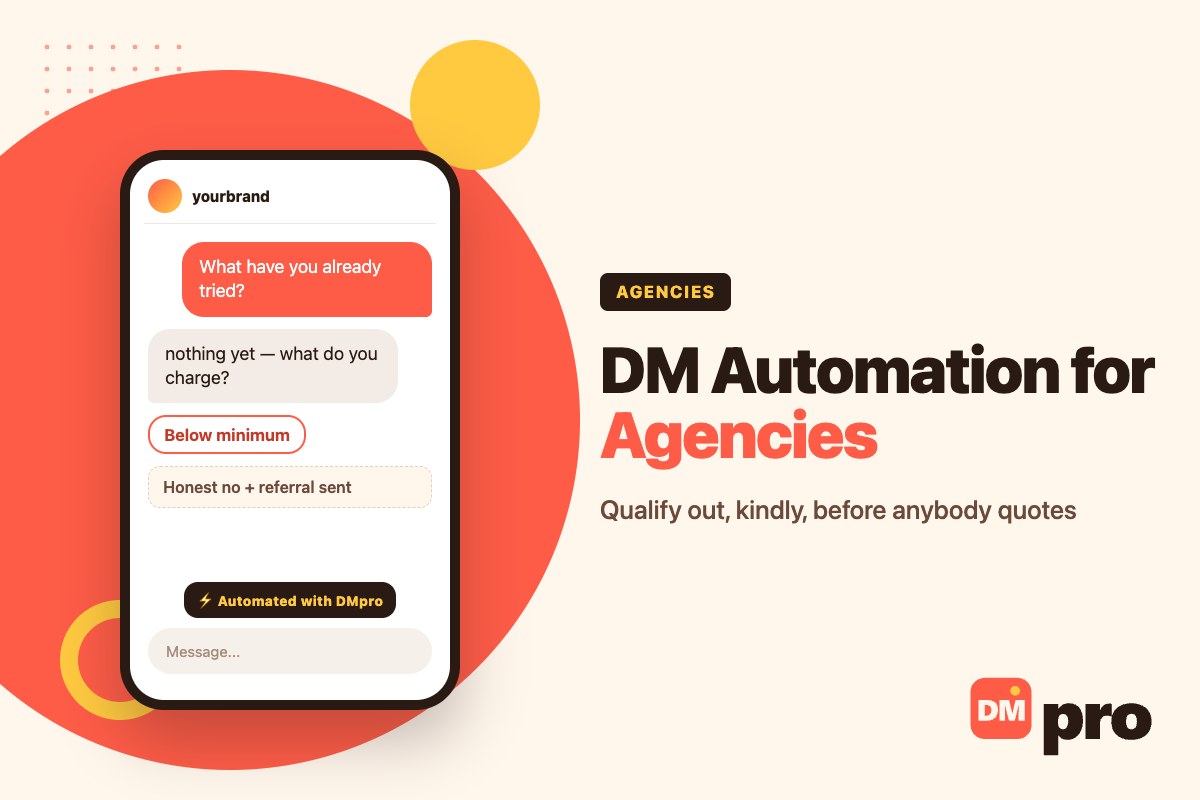
- “What have you already tried” filters better than budget and sounds less like a filter.
- State your minimum plainly in the flow – hiding it produces calls that waste everyone’s time.
- No price or scope ever leaves the automation. A quote is a commitment.
- An honest no, with a referral where you can, is kinder than three weeks of polite drift.
Why Qualifying Out Is the Goal
The opposite of every other vertical in this cluster, and it follows from the economics.
The Scarce Thing Is Senior Attention
An agency sells the judgement of experienced people, which means the same people who do the work are the ones taking the calls. Every unqualified call costs an hour of exactly the resource you sell.
A retail flow that filters too hard loses revenue. An agency flow that filters too little loses the week.
Unqualified Leads Are Slow to Die
They rarely say no. They go quiet, then come back with a smaller scope, then ask for a proposal anyway, then disappear – consuming attention the whole time.
An honest early no costs one message and saves that entire sequence, which is why it is kinder as well as cheaper.
People You Turn Down Refer Others
This is the part that makes the honest no easy to adopt. A clear “we start at X, and here is someone good who works below that” is remembered warmly, far more than a slow fade.
Keep a referral or two ready for exactly this.
The Three Questions
The middle one does most of the work.
What Do You Sell?
Sector and model, as buttons where you can. It tells you whether the work is something you are good at, and it is an easy opening question that nobody resents.
It also catches the mismatches early – the enquiry that is technically in your service line but in an industry you have no evidence in.
What Have You Already Tried?
The most useful question an agency can ask and the one most often skipped. Someone who has tried three things and can describe why each failed has a real problem, a budget and realistic expectations. Someone who has tried nothing is usually shopping for a price.
It is also diagnostically useful on the call, which means asking it in the flow is not just a filter – it is prep.
Rough Budget Band
Bands, as buttons, with your actual minimum as the bottom one. Hiding your minimum does not protect anything; it just moves the disappointment to a call that both parties have now paid for.
Unlike coaching, where the budget question poisons the conversation, agency buyers are usually procurement-aware and expect it.
The Rule About Prices
One rule, no exceptions, and it is the main thing to get right.
No Number Leaves the Automation
A price from a bot reads as a quote, and a quote is a commitment. Even “projects typically start around X” gets screenshotted and quoted back during negotiation.
A band – “we work with budgets from X” – is different and is fine, because it is a qualifying statement rather than an estimate for their job.
And No Scope Either
“That would take about three weeks” is the same mistake in a different unit. Timelines and deliverables are scoping output, and scoping is what the call is for.
Say What You Can Instead
What you do, who you do it for, your minimum engagement, and when somebody can talk to you. All four are facts, all four help a serious buyer self-select, and none of them is a commitment.
What Each Answer Should Trigger
Four outcomes. Only one of them is a call.
| Answers suggest | Flow sends | Who |
|---|---|---|
| Good fit, budget above minimum | Scoping call slots from your calendar | Senior, directly |
| Good fit, budget unclear | One human message to clarify | Anyone – not a call yet |
| Below minimum | Honest no, plus a referral | Nobody – this is the win |
| Outside what you do | Honest no, plus who does it | Nobody |
| Asking for a price only | Your band, and the three questions | Nobody yet |
If you also do outbound, note it is a different product and method – contactID handles contact-form outreach, and nothing here lets you message a company first.
Building It
Half a day, and writing the no is the part worth time.
- Decide your minimum and say it. In the flow, in a band. Hiding it costs you calls, not leads.
- Write the three questions as buttons. Sector, what they have tried, budget band. Keep ‘something else’ on the first.
- Write the honest no before the yes. One sentence on the fit, one referral if you have one. If you cannot write it warmly, the flow is not ready.
- Connect the calendar for qualified enquiries only. A call slot is the reward for clearing the bar, not the default response.
- Keep every price and timeline out. Band yes, number no. Scope is the call’s job.
- Review who you turned away monthly. If you are declining a pattern repeatedly, that is either a productised offer waiting to be built or a referral partnership.
Where This Connects
Two adjacent things.
Your Own Clients Will Ask For This
Agencies setting this up for themselves usually end up building it for clients, and the per-industry versions are the rest of this cluster – the shared skeleton and the three variables are in DM automation by industry. The two most commonly requested are DM automation for coaches and SaaS social media support.
Measuring It Is Unusual Here
The success metric is calls avoided as much as calls booked, which does not fit a normal funnel report. Count hours of senior time not spent, which is the same hours-removed argument as the support cost case. Writing down who picks up an enquiry the flow could not place is covered in support escalation rules.
Fewer Calls. The Right Ones.
Most agency enquiries cannot afford the work, and each one costs an hour of the person who would have done it. The good prospects wait three days for the slot.
DMpro asks the three questions in the DM, states your minimum plainly, sends an honest no with a referral where it does not fit, and books a scoping call only when it does.
Conclusion
Agency DM automation is the one case in this cluster where the flow should say no more often than yes. The scarce resource is senior attention, and an unqualified call costs exactly the thing you sell.
Three questions do it: what you sell, what you have already tried, and a rough budget band. The middle one is the real filter – somebody who can describe three failed attempts has a real problem, and somebody who has tried nothing is price-shopping.
Keep every number out of the automation. A band is a qualifying statement and a price is a commitment, and the difference between them gets screenshotted.
Frequently asked questions
What should an agency DM flow ask?
Three things: what they sell, what they have already tried, and a rough budget band. The middle question filters better than the budget one and doubles as preparation for the call.
Should we state our minimum budget publicly?
In the flow, yes, as a band. Hiding it does not protect anything – it moves the disappointment to a call that both sides have now paid for with their time.
Can the bot give a price?
No. A price from an automation reads as a quote and a quote is a commitment, and it gets screenshotted during negotiation. A band – ‘we work with budgets from X’ – is a qualifying statement and is fine.
Is it rude to turn people down automatically?
Less rude than three weeks of polite drift. A clear ‘we start at X, and here is someone good below that’ is remembered warmly, and those people refer others surprisingly often.
How do we measure this?
Partly by calls avoided rather than booked, which does not fit a normal funnel report. Count hours of senior time not spent on unqualified calls.
Can we use this for outbound to prospects?
No – nothing here lets you message a company that has not contacted you. Outbound through contact forms is a separate product and a separate method.