
Everything about Black Friday DM marketing is volume. The questions do not change – stock, delivery cut-off, discount code, where is my order – they just arrive three or four times as often, from people with less patience, during the days your team most wants off.
Which makes Black Friday DM marketing a capacity problem rather than a campaign problem, and capacity has to be built in October. A flow you ship on the Wednesday is a flow nobody has tested.
This covers what breaks first, the arithmetic of the free message allowance at peak, and the short list worth building. For the rules it all runs under, see e-commerce DM automation.
Key takeaways
- Peak week is a capacity problem. The questions are the same; there are simply far more of them.
- The free 1,000 service messages a month cover a small store normally and will not cover peak week – know what the overage costs before it happens.
- Build and test in October. Templates need approval time you will not have in November.
- Publish the delivery cut-off date everywhere and make a flow answer it – it is the question of the week.
- Stock answers must come from the live store, not an uploaded sheet, or you will sell what you do not have.
- Keep one human on the escalation queue. Peak week is when the handoff matters most.
What Actually Breaks
In the order it tends to go wrong.
The Cut-Off Question Swamps Everything
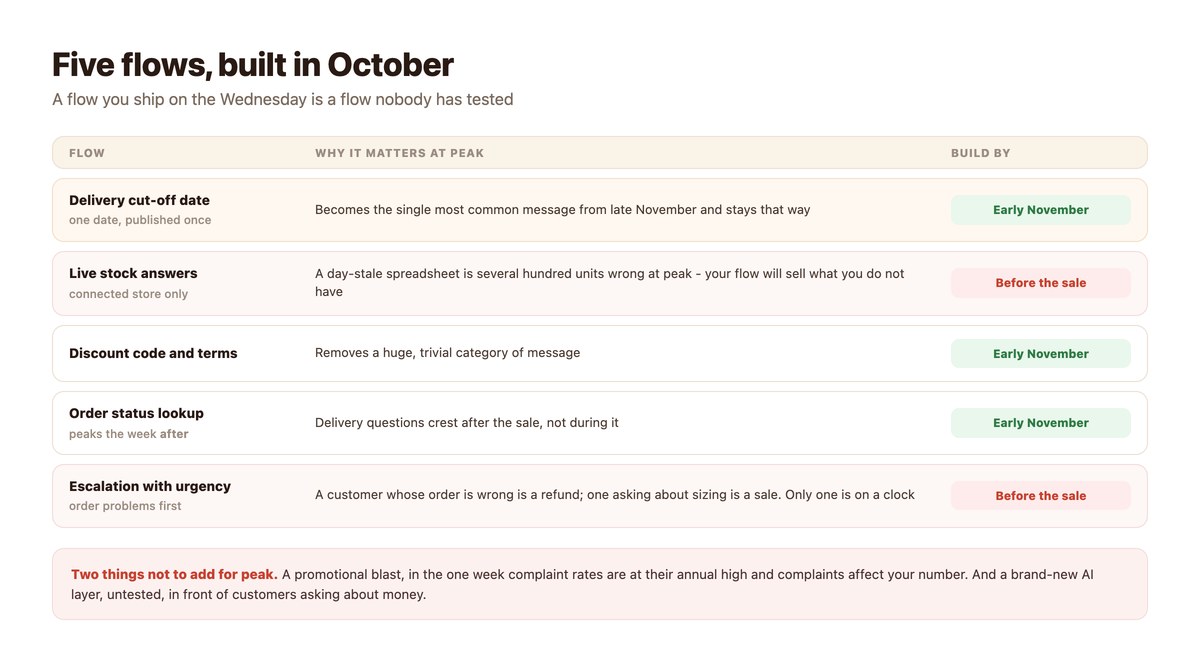
From about the third week of November, “will it arrive before Christmas” becomes the single most common message, and it stays that way. It is also the easiest to automate because it is one date, published once.
Stores that do not answer it automatically spend peak week answering it manually, one message at a time, while the actual sales questions wait.
Stale Stock Data Starts Selling Air
At normal volume an uploaded catalogue that is a day out of date rarely causes a problem. At peak, a day is several hundred units. If your automated replies are answering stock questions from a spreadsheet, switch them to the live connected store before the sale – see Shopify DM automation.
The Human Queue Gets Buried
Escalations scale with volume too. If one person normally handles the overflow, peak week needs a named person on it each day, and a flow that marks urgency rather than dumping everything into one list.
Order problems before pre-sales questions
A customer whose order is wrong is a refund; a customer asking about sizing is a sale. Both matter, but only one is on a clock.
Expect the Monday after to be worse
Delivery questions peak after the sale, not during it.
The Arithmetic Nobody Does
Worth five minutes in October rather than a surprise invoice in December.
What the Free Allowance Covers
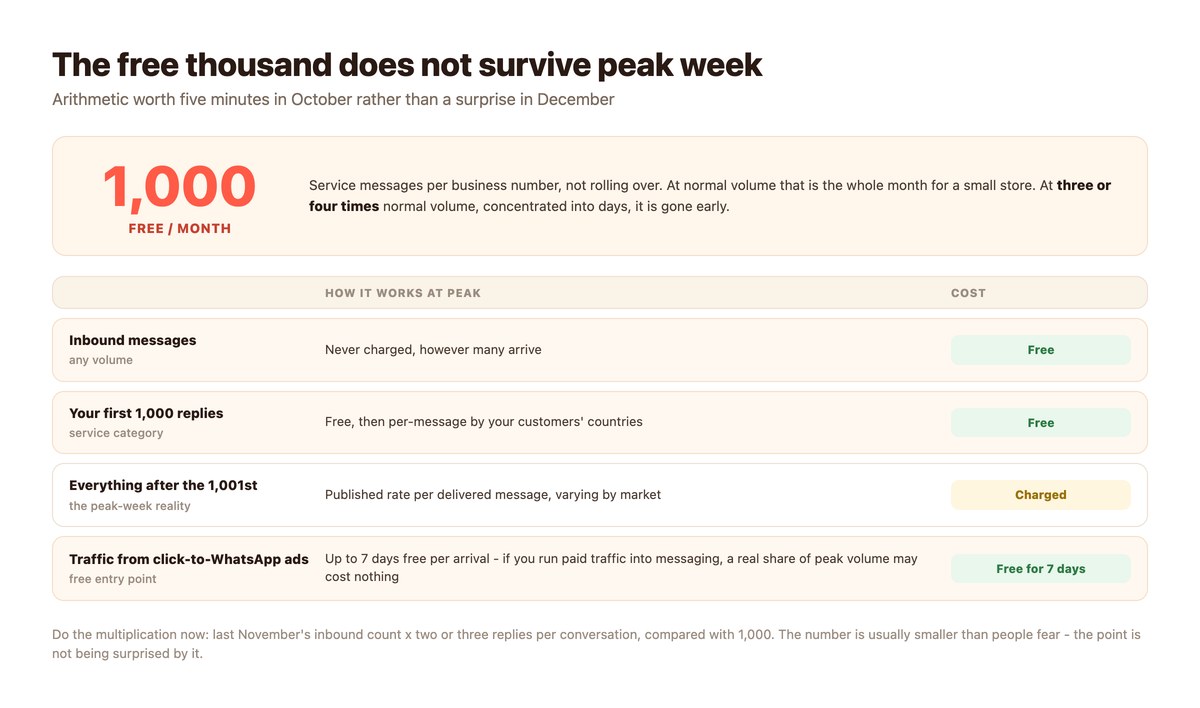
Every business phone number gets 1,000 free service messages a month, which do not roll over. In a normal month, for a store handling a few dozen conversations a day, that is the whole month and the bill is zero.
Peak week does not respect that. Three or four times the normal volume, concentrated into days, will pass the thousand early and everything after it is charged at the published per-message rate for your customers’ countries.
Do the Multiplication Now
Take last November’s inbound message count, multiply by the number of replies an automated conversation sends – usually two or three – and compare with 1,000. If you are well over, look up the rates for your main markets and you will have a number before the month starts.
It is usually smaller than people fear. The point is not the cost; it is not being surprised by it.
Ads Change the Maths
A customer arriving from a click-to-WhatsApp ad opens a free entry point window of up to seven days where most message categories are not charged. If you are running paid traffic into messaging during the sale, a meaningful share of peak volume may cost nothing.
The October Build List
Five flows. Everything else can wait until next year.
| Flow | Why it matters at peak | Build by |
|---|---|---|
| Delivery cut-off date | The most asked question of the season | Early November |
| Live stock answers | Stops you selling what you do not have | Before the sale |
| Discount code and terms | Removes a huge, trivial category | Early November |
| Order status lookup | Peaks the week after, not during | Early November |
| Escalation with urgency | Order problems must not sit in a queue | Before the sale |
The order lookup is the same build as order status automation, and the escalation is AI to human handoff.
The Timeline
Working backwards from the sale.
- October: pull last year’s numbers. Message volume by day, the top ten questions, and how many went unanswered for more than an hour. That is your spec and your baseline.
- October: build and test the five flows. On a real phone, with a colleague sending awkward messages. Test the wrong-input paths, not the happy ones.
- Early November: submit any templates. Approval takes time and rejections happen. A template you submit in late November is a template you do not have.
- Mid November: publish the cut-off date everywhere. Site, bio, flow. One date, stated the same way in all three.
- Sale week: watch the escalation queue daily. The flows will hold. The queue is where the damage happens.
- December: read the escalations. They are a free list of what to automate before next year.
What Not to Add for Peak
Two temptations that reliably backfire in exactly the week you cannot afford it.
A Promotional Blast
Messaging your whole opted-in list with a sale announcement is a marketing template send, and it arrives in the same app as their family. In the one week everybody else is doing it too, the complaint rate is at its annual peak, and complaints affect your number rather than your campaign.
A Brand New AI Layer
Peak week is the worst possible time to put an untested model in front of customers asking about money. If you want AI in the mix, run it from September so you know how it behaves. Note it is not available on WhatsApp in any case.
The Week After Is Worse Than the Week Itself
Almost all peak planning targets the sale. The volume that breaks teams arrives later.
Delivery Questions Crest in December
Sale week generates orders; the fortnight after generates questions about them. Order status, delivery dates, changed addresses and the first wave of returns all land while half the team is on holiday and carrier networks are at their least predictable.
If you build one thing for peak and it is not the cut-off date, make it the order lookup, because it is the only flow whose demand keeps rising after the discounts stop.
Returns Season Follows Immediately
January is the heaviest returns month in most of retail, and the conversations are harder than usual because a share of them involve gifts, which means the person messaging is not the person who bought. Your eligibility lookup keys on the order; they may not have the number.
Build the gift path before December. It is a different branch of the same flow described in returns and exchanges automation.
Protect the People, Not Just the Queue
Peak week burns out support teams more reliably than it breaks software. The practical defence is coverage planning rather than tooling: named owners per day, an explicit rule for what can wait until morning, and permission to leave the non-urgent queue alone.
Where coverage genuinely cannot stretch, the honest options are narrower hours clearly stated or after-hours support that sets a real expectation. Both beat silence.
Build It in October, Not on the Wednesday
Peak week does not bring new questions. It brings the same five, several times an hour, from people who will buy elsewhere if nobody answers within the hour.
DMpro handles the cut-off date, the discount terms, live stock and order status automatically, and escalates the ones that are actually a problem – so your team spends the week on those.
Conclusion
Black Friday messaging is capacity planning. The questions are the ones you already get, so there is nothing to invent – there is only the work of making sure the answers arrive without a person, at four times the rate, on the days nobody wants to be working.
Do the arithmetic on the free thousand in October so the cost is a number rather than a surprise, switch stock answers to the live store, and get templates submitted while approval queues are still short.
Then keep a named human on escalations every day of the sale. The flows will hold. The queue is where peak week is won or lost.
Frequently asked questions
What should I automate before Black Friday?
Five things: the delivery cut-off date, live stock answers, the discount code and its terms, order status lookup, and an escalation path that marks urgency. All of them keep working after the sale.
Will peak week cost me money in message fees?
Probably some. Every business number gets 1,000 free service messages a month and they do not roll over, so three or four times normal volume will pass that. Work the number out in October from last year’s volume rather than being surprised.
When should I build the flows?
October, and test them on a real phone with awkward inputs. Templates in particular need approval time you will not have in late November.
Should I send a sale announcement to my messaging list?
Be careful. It is a marketing template send arriving in the same app as people’s family messages, in the one week everybody else is doing it. Complaint rates peak, and complaints affect your number rather than just the campaign.
Can I answer stock questions automatically at peak?
Yes, but only from a live connected store. An uploaded catalogue that is a day stale is a few hundred units wrong at peak volume, and your flow will sell things you do not have.
Is peak week a good time to try AI replies?
No. It is the worst week to put an untested model in front of customers asking about money. Run it from September if you want it, and note it is not available on the WhatsApp channel at all.