
After-hours customer support exists because a large share of messages arrive when nobody is working – evenings, weekends, and the hours after a promotion goes out. For most businesses that is not a small overflow; it is a third of the inbox.
The thing customers mind is not the wait. Nobody expects a person at two in the morning. What they mind is being left to guess whether a reply is coming at all, which is what silence communicates and what most businesses accidentally choose.
There are four honest ways to cover it, each with a real cost. This is the comparison, plus what actually arrives overnight – which turns out to be the easiest part of the inbox to automate. For the wider picture, see customer support automation.
Key takeaways
- Silence is a choice, and it is the only option with no upside. Stated hours cost nothing and are experienced as service.
- Four honest models: stated hours, AI answering from your docs, an on-call rota, or follow-the-sun.
- Most overnight volume is order status, shipping and stock – all answerable without a person.
- The holding message must contain a time, not a “soon”.
- Queue what cannot be answered, with a named owner for the morning, not a shared pile.
- Refunds and complaints should wait for a person rather than get an automated attempt.
What Arrives After Dark
Worth looking before deciding, because the mix is friendlier than people assume.
Mostly Questions With Answers
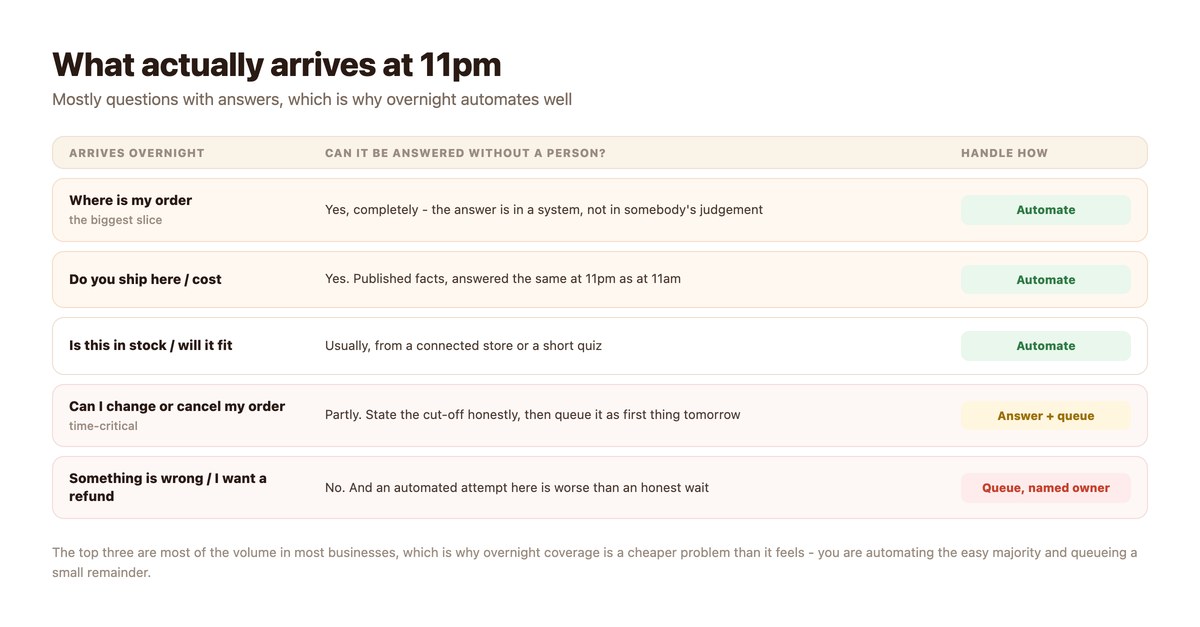
Pull a month of overnight messages and sort them. In most businesses the top three are order status, shipping questions and stock or sizing – all of which have factual answers sitting in systems you already own.
That is the useful discovery here: the overnight inbox is disproportionately the automatable part. The judgement-heavy conversations tend to arrive in working hours when people are at their desks.
A Small, Genuinely Urgent Slice
Change or cancel an order before dispatch, a delivery arriving tomorrow, something going wrong with an event. Small in volume and real in consequence.
This is the slice that justifies an on-call arrangement if you have one, and the slice that most needs an honest cut-off stated rather than a hopeful silence.
And the Ones to Leave Alone
Refunds, damage, complaints. An automated attempt at these overnight is worse than an honest wait, because the customer is already unhappy and a bot reply reads as being fobbed off at the worst moment.
Queue them to a named person for the morning. The rules for which these are belong in the escalation rules themselves.
The Four Models
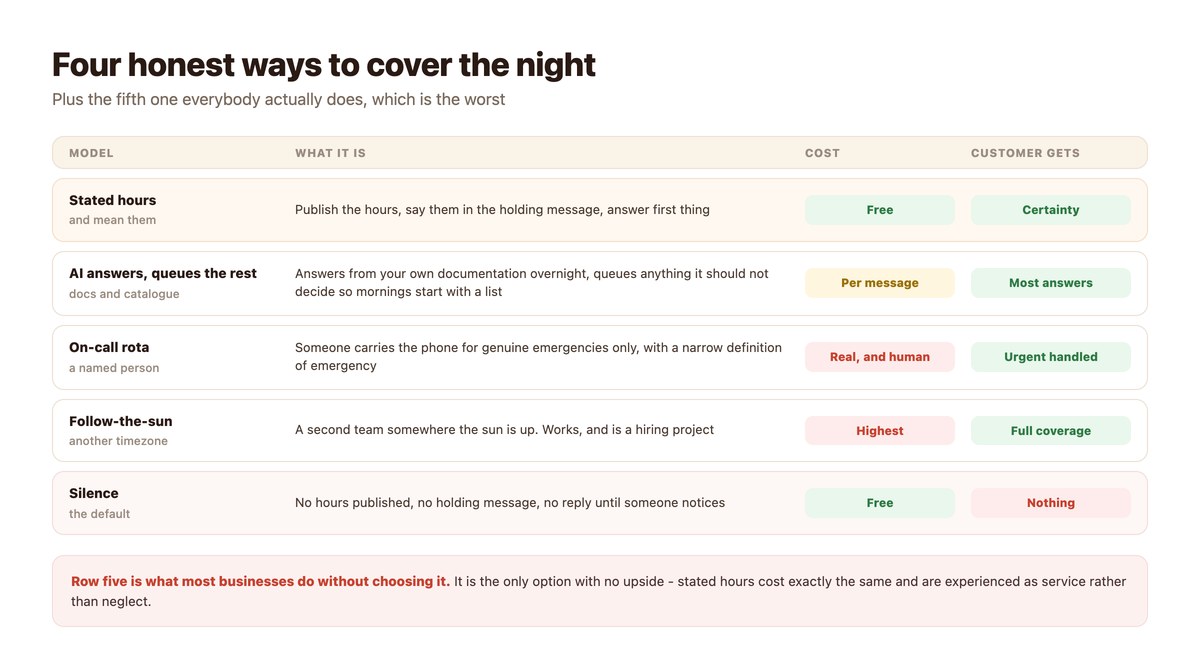
In increasing order of cost. Most businesses should be on the first or second and are accidentally on none of them.
Stated Hours, Honoured
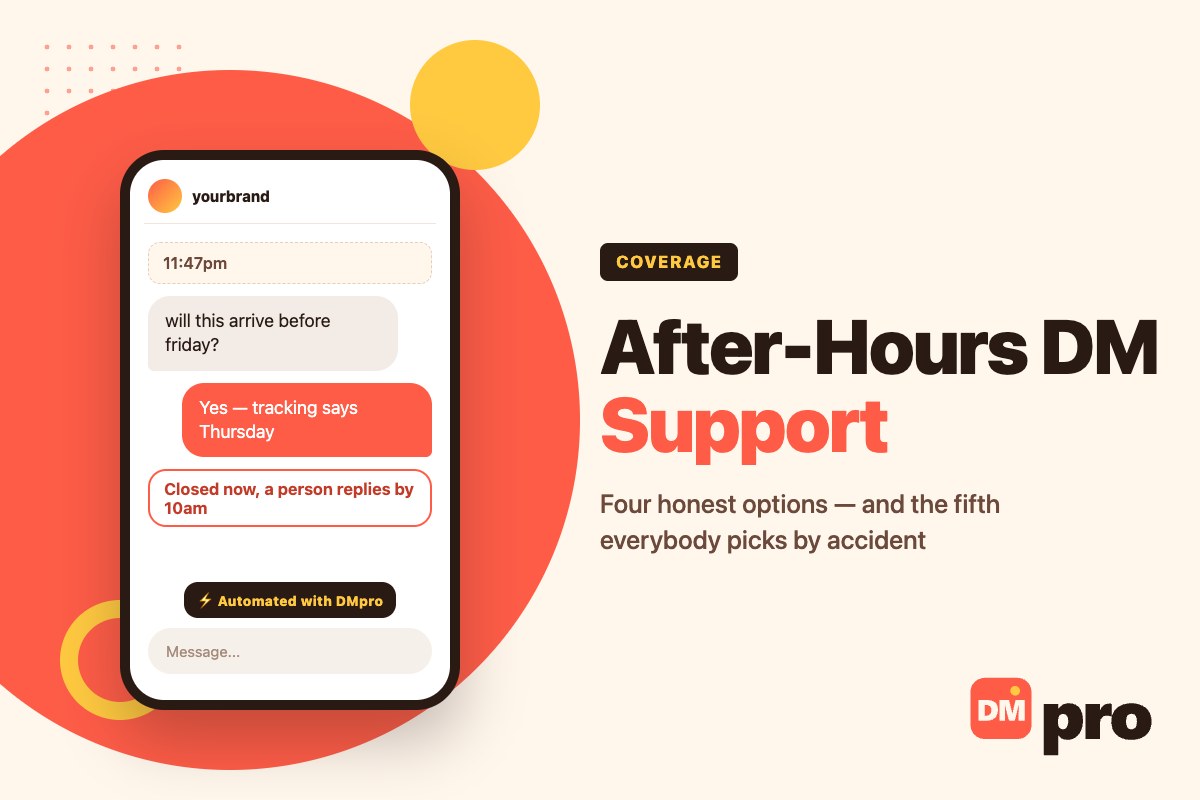
Publish your hours, repeat them in the automatic holding message, and reply first thing. This is free, it is honest, and it is reliably experienced as better service than vague availability.
The only requirement is meaning it. Stated hours you miss are worse than no stated hours, because you have now set and broken an expectation.
AI Answering From Your Own Material
Overnight the automation answers from your documentation and catalogue, and queues anything it should not decide, so the morning starts with a list instead of a mess. This covers the majority of what arrives.
Costs per message rather than per hour, which makes it cheap at small volume. Note it is not available on the WhatsApp channel – there the overnight layer is keyword-driven, which handles order status and shipping perfectly well.
An On-Call Rota
A named person carries the phone for genuine emergencies, with a narrow written definition of emergency. Real cost, and not only in money – on-call wears people down and should be rotated and compensated.
Worth it when overnight failures are expensive: events, perishables, travel, anything time-critical.
Follow-the-Sun
A second team in a timezone where the sun is up. It works completely and it is a hiring project rather than a configuration change, so it belongs to a different conversation about scale.
If you are considering it mainly for coverage rather than volume, the first two options will usually get you most of the benefit for none of the cost.
Writing the Holding Message
The highest-leverage sentence in this entire subject, and it is usually written badly.
It Must Contain a Time
“We will get back to you soon” tells the customer nothing and invites them to ask again somewhere else. “We are closed now and will reply before 10am” is a different message entirely, and it costs the same.
If you genuinely do not know, say the worst case. An honest “within one working day” beats an optimistic “shortly” because it can be met.
It Should Say What It Can Do Now
Before the apology, offer the thing that is available: tracking, the returns process, the shipping page. A good share of overnight messages end there and never need the morning at all.
On the free app layer the away message is one unconditional text for everyone, which is why pairing it with keyword answers matters – the distinction is in WhatsApp Business auto reply.
It Should Not Pretend
Nothing erodes trust faster than an overnight message written as though a person sent it, followed by nine hours of nothing. Be plainly automatic and plainly honest; people are entirely comfortable with that.
Choosing Between Them
By what your business actually is, rather than by what sounds thorough.
| If your business… | Start with | Add later |
|---|---|---|
| Has normal retail urgency | Stated hours + keyword answers | AI for the long tail |
| Sells internationally | AI answering overnight | Timezone-aware hours |
| Is time-critical (events, travel) | Stated hours + on-call | Narrow emergency definition |
| Ships perishables | On-call rota | Follow-the-sun at scale |
| Is one person | Stated hours, honoured | Nothing – protect the hours |
Whichever you pick, the overnight numbers should be reported separately from daytime or they blend into something unactionable – see social media response time.
Setting It Up
Half a day, most of which is reading your own inbox.
- Pull a month of overnight messages and sort them. You are looking for the top three. They are almost always answerable without a person.
- Pick a model and write it down. Including what overnight does NOT cover. Undefined scope is how on-call becomes all-call.
- Automate the top three. Order status especially – it is the biggest overnight slice and the answer is in a system.
- Write the holding message with a real time in it. And offer what is available now before apologising for what is not.
- Queue the rest to a named person, not a pile. “The morning team” is not an owner. Name who opens the queue.
- Measure overnight separately for a month. Volume, what got answered automatically, and what was still waiting at 9am.
Where This Connects
Three places the overnight decision shows up elsewhere.
To the Rules
Every escalation rule needs an out-of-hours version, and deciding that afterwards means deciding it during an incident. The rule set and its overnight behaviour belong in the same document – support escalation rules.
To the Cost Case
Overnight is where automation has its cleanest argument, because the alternative is either a salary or nothing at all. That makes it the easiest section of the cost case to defend.
To Timezones You Did Not Plan For
“After hours” stops being a single period the moment you sell internationally – somebody’s afternoon is always your night, and they will not be writing in your language either. Multilingual customer support covers that half.
The Night Shift Is Mostly Order Status
A third of your messages arrive when nobody is working, and most of them are questions with answers already sitting in your systems. The expensive part is the silence, not the volume.
DMpro answers them as they land, says honestly when a person will pick up the rest, and hands the morning team a list rather than a backlog.
Conclusion
Overnight coverage is a choice, and most businesses make it by accident. Silence is the only one of the five options with no upside – stated hours cost exactly the same and read as a business that has its act together.
Start by looking at what actually arrives. In most inboxes the overnight mix is disproportionately order status, shipping and stock, which means the night is the easiest part of the day to automate well.
Then write a holding message with a real time in it, queue what cannot be answered to somebody named, and leave refunds and complaints for a person. An honest wait beats a bot reply to an unhappy customer at midnight, every time.
Frequently asked questions
Do customers expect a reply out of hours?
No. What they resent is not knowing whether one is coming. A holding message with a real time in it – “we will reply before 10am” – is experienced as service; silence is experienced as neglect.
What should an out-of-hours message say?
What you can do right now first – tracking, returns, shipping information – then when a person will reply, with an actual time rather than “soon”. And it should be plainly automatic rather than pretending to be a person.
What arrives overnight?
Mostly order status, shipping questions and stock or sizing – all answerable from systems you already have. The judgement-heavy conversations tend to arrive in working hours.
Should a bot handle complaints at night?
No. An automated attempt at a refund or damage complaint is worse than an honest wait, because the customer is already unhappy. Queue it to a named person for the morning.
Is an on-call rota worth it?
Only if overnight failures are genuinely expensive – events, travel, perishables. It costs real money and wears people down, so it needs a narrow written definition of what counts as an emergency.
Can AI cover the night?
It can answer from your own documentation and catalogue and queue what it should not decide, which covers most overnight volume. Note it is not available on the WhatsApp channel, where the overnight layer runs on keyword flows instead.