
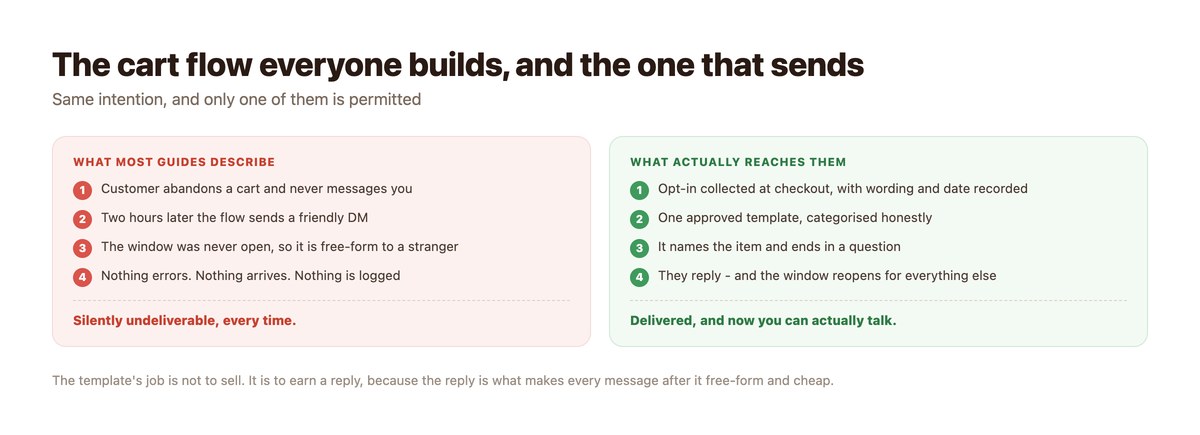
Almost every guide to abandoned cart messaging on WhatsApp or Instagram describes something you are not permitted to do. The flow is always the same: customer leaves a cart, two hours pass, a friendly DM arrives. That message is not allowed, and the reason is structural rather than a technicality.
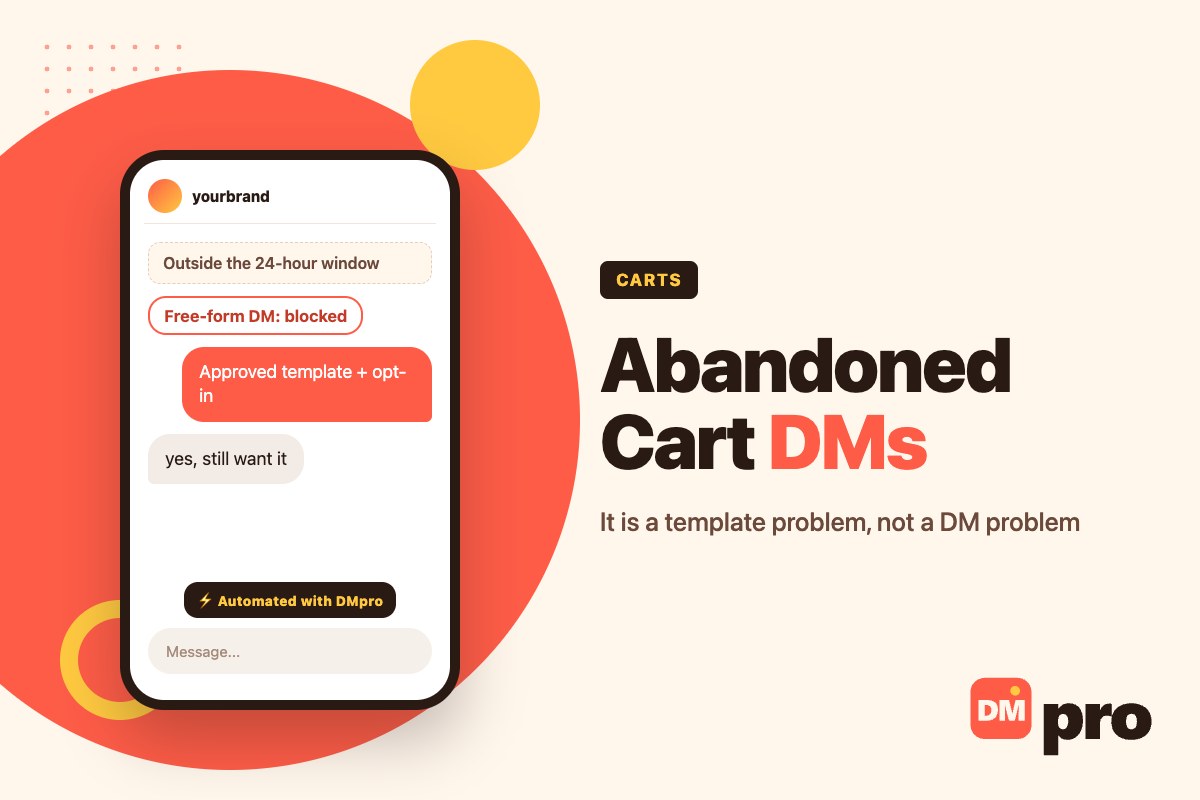
If the customer has not written to you in the last 24 hours, you are outside the messaging window. Outside it, free-form messages are blocked and only a pre-approved template may be sent, with opt-in on file. So an abandoned cart message is a template problem, and treating it as a DM problem is why so many of them silently never send.
This covers the compliant route end to end. For the window itself and the wider rules, see e-commerce DM automation.
Key takeaways
- A cart abandoned hours ago puts you outside the 24-hour window, where only approved templates are permitted.
- Templates are submitted for review before use and are categorised – marketing or utility, priced differently.
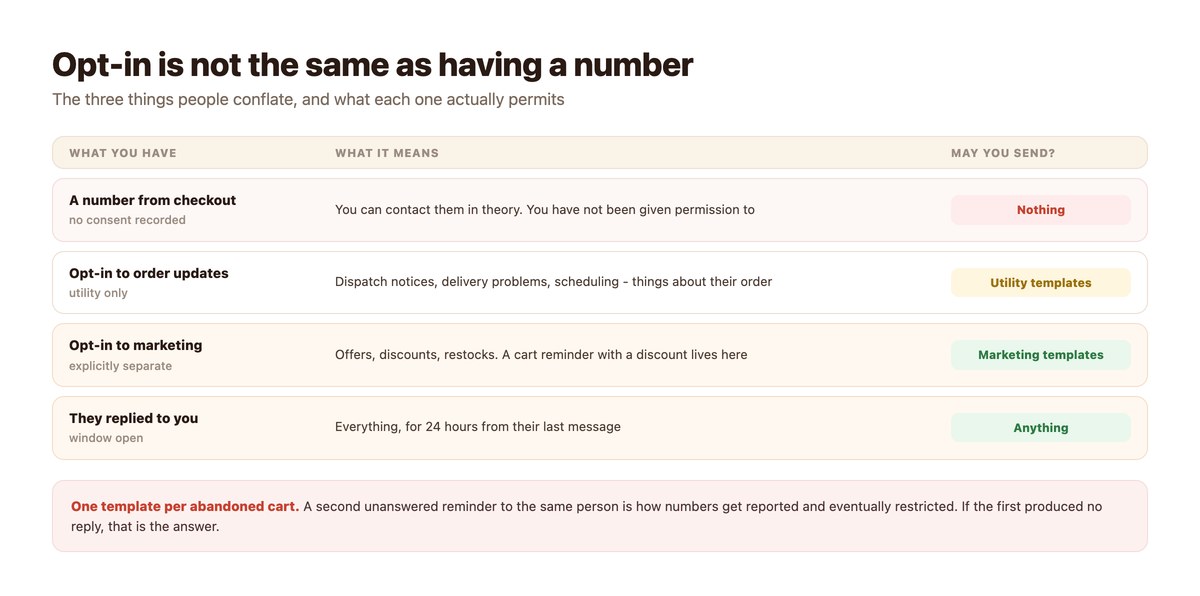
- You need opt-in on file. Having someone’s number from checkout is not the same as permission to message them.
- The window reopens the moment they reply, and from then on you can answer freely.
- A cart recovery flow that works is usually two messages, not five.
- If the customer is already messaging you, none of this applies – you are inside the window and can simply help.
Why the Obvious Version Does Not Work
Worth being precise, because the failure is silent – nothing errors, the message simply never arrives.
The Window Has Already Closed
The customer service window opens when the customer messages your business and resets every time they message again. Abandoning a cart is not messaging you. Browsing, adding to basket and leaving generates no message at all, so for most abandoned carts the window was never open in the first place.
Which means the free-form DM your flow is trying to send has nowhere to go.
Opt-In Is a Separate Thing From Having the Number
Collecting a phone number at checkout gives you a number. It does not give you permission to send marketing to it on WhatsApp. Opt-in has to be obtained and recorded – usually a checkbox at checkout that says, specifically, that you will message them there.
This is the step that gets skipped, and it is the one that gets numbers reported and eventually restricted.
The Compliant Build
Three moving parts. None of them is the DM you were planning.
Collect Opt-In Where the Cart Is Created
At checkout, in the same step where you take the number, with wording that says what you will send and where. Keep the record – the date, the wording they saw, and the order it attached to.
A customer who ticked a box about order updates has not agreed to a discount reminder. The category you send under has to match what they agreed to.
Write and Submit the Template
Templates are submitted for review before they can be used, and they are categorised. A cart reminder that offers a discount is marketing. One that confirms something about an order they placed is utility, and utility is cheaper.
Write it as a single, specific message with a variable for the product. Vague templates get rejected and generic ones get ignored.
Leave room for a reply
The template’s job is to reopen the window. Ending with a question the customer can answer in two words is worth more than a link.
One template, not a sequence
A second unanswered template to the same person is how you get reported. If the first produced nothing, that is your answer.
Handle the Reply Properly
The moment they answer, the window is open and everything is available – free-form messages, product cards, a person. This is where the sale is actually recovered, not in the template.
So the flow behind the template matters more than the template. If they reply “is it still available”, the answer should carry the product, which needs the store connected – see Shopify DM automation.
What You May Send, and When
The same message is allowed or blocked depending entirely on what happened last.
| Situation | Allowed | Not allowed |
|---|---|---|
| They messaged you in the last 24h | Anything – text, products, images | – |
| They abandoned a cart, never messaged | Approved template, with opt-in | A free-form DM |
| They replied to your template | Anything, window is open again | – |
| They ignored your template | Nothing further | A second reminder |
| No opt-in on file | Nothing | Any outbound message |
The related flows that run inside the window instead – and therefore need none of this – are order status and post-purchase messages.
Building It
In order. The first two are paperwork and they are the whole job.
- Add opt-in at checkout and record it. Explicit wording, stored against the order. If you cannot show when and how someone agreed, you do not have opt-in.
- Decide the category honestly. Discount offer is marketing. A genuine order-related notice is utility. Miscategorising to pay less gets templates rejected.
- Write one template with a product variable. Specific, short, and ending in a question rather than only a link.
- Submit it and wait. Review takes time and rejections happen. Build this before the week you need it, not during it.
- Build the reply flow behind it. This is where the recovery happens. Stock question, size question, a discount if you offer one, and a person for anything else.
- Send it once, then stop. One template per abandoned cart. Measure replies, not deliveries.
What Actually Recovers Carts
Having said what is not allowed, here is what works inside the rules.
Catch Them While They Are Still Talking
The highest-converting cart recovery is not a reminder at all – it is answering the question that caused the hesitation, while the customer is still in the conversation. Someone asking about delivery time has not abandoned anything yet. They are deciding.
That is inside the window, needs no template, and costs nothing within the free monthly service allowance.
Make the First Message Worth Replying To
A template that says “you left something behind” is a notification. One that says which item and asks whether they want it held is a conversation. The second reopens the window; the first usually does not.
Accept the Ceiling
Cart recovery over messaging works, and it does not work on everybody. A flow that recovers a modest share of carts and never gets your number reported is worth more than an aggressive one that works for a month.
What to Do With the People Who Never Reply
The template reaches everybody once. Most will not answer, and what you do next decides whether this stays a sustainable channel.
Silence Is a Signal, Not a Gap
A customer who received a well-written, specific reminder and said nothing has told you something. The temptation is a second message, and it is the single most reliable way to turn a quiet non-buyer into a complaint – which on messaging does not just lose the customer, it degrades the standing of your number.
The correct response is to stop, and to put that person back into the channels where being ignored is free. Email and retargeting exist for exactly this.
Fix the Cause, Not the Symptom
A high abandonment rate is usually three things: an unexpected shipping cost, an unclear delivery date, or a checkout that asks too much. All three are visible in your inbox before they show up in analytics, because people ask about them.
If delivery uncertainty is driving it, answering that question before the cart is built is worth more than any reminder after it – which, if you do not hold your own stock, is most of the work covered in DM automation for dropshipping.
The Hours Nobody Is Watching
A meaningful share of abandonment happens outside working hours, when the question that would have saved the sale goes unanswered. That is not a cart problem; it is a coverage problem, and it is addressed by after-hours DM support rather than by any template.
Measure it before assuming: if your abandonment clusters between 8pm and midnight, you have a staffing answer available that costs nothing per message.
Recover the Cart While They Are Still Typing
The best moment to save a sale is not two hours after the customer left. It is the moment they ask whether it ships by Friday and nobody answers.
DMpro answers that question as it arrives, with the real product and the real delivery information, and brings in a person when the answer is not simple.
Conclusion
Abandoned cart messaging is allowed, and it is not the flow people describe. Outside the 24-hour window you may send an approved template to someone who opted in, once. Everything else – the follow-up sequence, the free-form reminder, the message to somebody who merely gave you their number – is either blocked or a good way to lose the number.
The work is front-loaded and unglamorous: opt-in at checkout, honest categorisation, one well-written template, and a real flow waiting behind the reply.
And the highest-return version of cart recovery is not recovery at all. It is answering the question that would have caused the abandonment, while the customer is still there asking it.
Frequently asked questions
Can I send an abandoned cart message on WhatsApp?
Only as a pre-approved template, and only to someone who opted in. A cart abandoned hours ago puts you outside the 24-hour customer service window, where free-form messages are not permitted.
Why did my abandoned cart DM never send?
Almost always because it was built as a free-form message to someone outside the window. Nothing errors – the message simply has nowhere to go.
Is a phone number from checkout enough?
No. Having the number is not permission to message it. You need recorded opt-in, with wording that matches what you intend to send.
How many reminders can I send?
One. A second unanswered template to the same person is how numbers get reported and eventually restricted. If the first produced no reply, that is the answer.
What happens if they reply to the template?
The window reopens and everything becomes available – free-form messages, product cards, a human. That is where the sale is actually recovered.
Is a utility template cheaper than a marketing one?
Yes, the categories are priced differently, but the category has to match the content. A discount offer is marketing however it is labelled, and miscategorising gets templates rejected.