
Every flow built to recover lost sales by DM is supposed to make money, and almost nobody can show that it does. The reporting that comes out of the box counts messages sent and links clicked, which are activity metrics – they go up when you are busy, not when you are effective.
That gap matters beyond vanity. If you cannot attribute revenue to DM conversations, the programme gets cut the first time someone reviews costs, regardless of whether it was working.
This covers how to attribute honestly, which numbers mislead, and what a realistic result looks like. For the flows themselves, see e-commerce DM automation.
Key takeaways
- A click is not a sale. Tracking links prove interest; only the store can prove revenue.
- Tag the destination so the order can be traced back to the conversation that produced it.
- Compare against a holdout or a before-and-after period, or you are measuring seasonality.
- Reply rate is the leading indicator worth watching weekly; revenue is the lagging one.
- Recovered-sale claims that assume every click would otherwise have been lost are fiction.
- The flow with the clearest measurable return is usually order status, because it removes cost rather than adding revenue.
The Numbers You Already Have
And exactly how far each one can be trusted.
Messages Sent
Pure activity. It rises with traffic, with a promotion, with a problem on your website. On its own it tells you the flow is running and nothing else.
Useful for one thing: cost. It is what the free thousand is measured against.
Clicks on Tracking Links
Better. When a product destination is wrapped as a tracking link, the click is logged before the customer is redirected, and the counts appear in campaign analytics. That tells you which of your answers actually moves people.
It is still interest rather than money. The honest way to read it is comparatively – which of two phrasings gets more clicks – not absolutely.
Reply Rate
The most underrated number here. A flow whose messages produce replies is a flow that reopened the window, started a conversation and has a chance of selling something. One that produces none is a broadcast.
It also moves faster than revenue, which makes it the number to watch weekly while you are still tuning copy.
Connecting a Conversation to an Order
Two methods, both imperfect, one much easier than the other.
Tag the Destination
Put campaign parameters on the product URL the flow sends, so the store’s own analytics records where the session came from. The order then appears in your store reporting attributed to that campaign, which is a revenue number rather than a click.
This is the practical method for most stores. It inherits all the usual limitations – last click, cross-device loss, cookie lifetime – but it is consistent, and consistency is what lets you compare months.
Use one scheme and never change it
A tagging scheme that changes mid-quarter destroys the comparison you were building.
Expect undercounting
Someone who reads a DM on their phone and buys on a laptop is invisible to this. Treat your number as a floor.
Match on the Customer
More accurate and more work: match the phone number or handle in the conversation against the order record. It catches the cross-device case that tagging misses.
Worth doing for high-ticket items where the volume is low enough to be practical, and rarely worth it otherwise.
Always Compare Against Something
A number with nothing to compare it to is a story. Either hold back a portion of traffic from the flow for a few weeks, or compare the same weeks against last year. Without one of those you are measuring the season, not the flow.
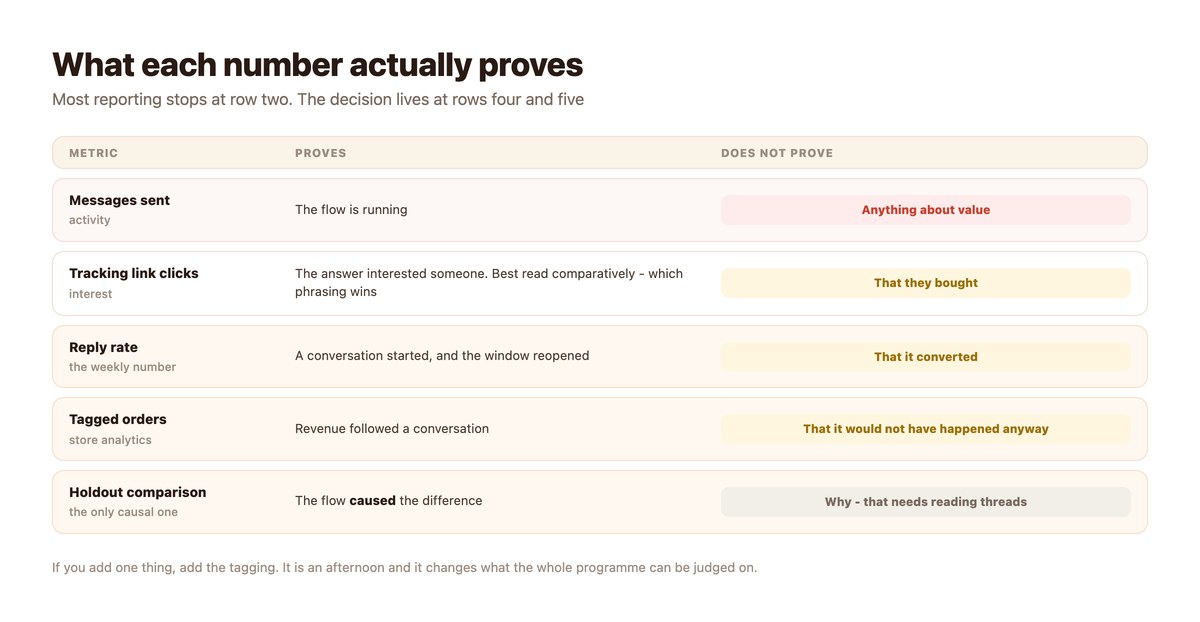
What Each Metric Actually Proves
Read left to right: the further down, the harder to get and the more it is worth.
| Metric | Proves | Does not prove |
|---|---|---|
| Messages sent | The flow is running | Anything about value |
| Tracking link clicks | The answer interested someone | That they bought |
| Reply rate | A conversation started | That it converted |
| Tagged orders | Revenue followed a conversation | That it would not have happened anyway |
| Holdout comparison | The flow caused the difference | Why – that still needs reading the threads |
If you only ever add one thing, add the tagging in row four. It is an afternoon and it changes what the programme can be judged on.
Setting Up Honest Measurement
An afternoon, then fifteen minutes a week.
- Decide what counts as a recovered sale. Write the definition down before you measure anything, or you will pick the one that flatters the result later.
- Wrap every product destination in a tracking link. Clicks per campaign is the baseline, and it is nearly free to add.
- Add campaign tags to the destination URLs. So the store’s analytics attributes the order, not just the click.
- Record a baseline before you launch anything. Four weeks of conversions and response times. Without this, nothing afterwards is interpretable.
- Hold something back if you can. Even a small percentage of traffic excluded from the flow turns a story into a comparison.
- Review reply rate weekly, revenue monthly. Copy changes show up in replies within days and in revenue within months.
What Realistic Looks Like
Said plainly, because the numbers quoted in this category are usually marketing.
Be Suspicious of Recovery Percentages
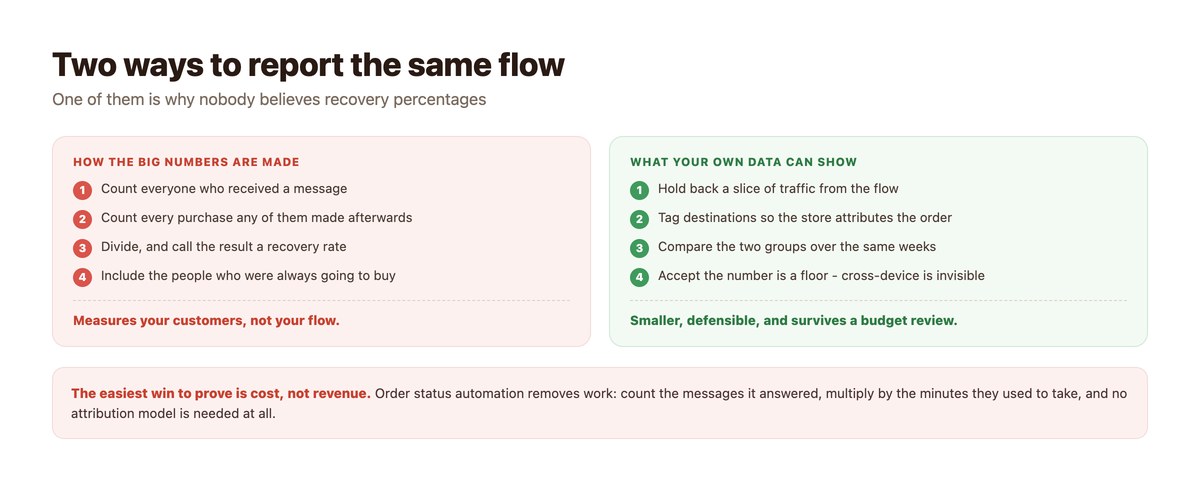
Claims that a flow recovers some large share of abandoned carts almost always count every subsequent purchase by anyone who received a message, including the people who were going to buy regardless. That is not recovery, it is attribution of normal behaviour.
Your own holdout comparison will give you a smaller and far more useful number.
The Clearest Win Is Cost, Not Revenue
Order status automation is the easiest flow in this cluster to prove, because it removes work rather than adding sales. Count the messages it answered, multiply by the minutes they used to take, and the result needs no attribution model at all – see order status automation.
Speed Is the Variable That Moves
Across every flow here the thing that changes outcomes most is how fast the first useful reply arrives. If you track one thing beyond revenue, track median time to a useful answer – the two clocks that matter are separated in social media response time.
The single biggest source of recoverable orders is the cart that was never followed up, and the compliant way to do that is in the abandoned cart DM.
Making the Case Internally
A measured programme still gets cut if nobody can explain it in one slide.
Lead With Cost Removed
Revenue attribution invites argument, because every number in it can be questioned. Hours removed cannot. Start any internal case with the volume the automation absorbed and the time that would have taken, then present revenue as the upside rather than the justification.
This framing survives scrutiny from people who do not believe in attribution models, which is most finance teams. Reducing support costs with automation goes through the arithmetic.
Report the Same Three Numbers Every Month
Volume handled, median time to a useful reply, and tagged revenue. Resist the urge to add metrics when a month looks bad – a changing scorecard is read, correctly, as special pleading.
Pair them with one qualitative item: a conversation that went well and one that did not. People remember the examples and forget the chart.
Know What You Would Switch Off
The strongest position in any review is having already turned something off. A flow that fires constantly and produces nothing should be retired by you, visibly, before anyone else notices it.
That also tells you where the ceiling is. If every flow is earning, you have not built enough of them yet; if two of eight are, the honest move is to concentrate rather than expand.
Know Which Answers Are Selling
Most stores can tell you how many DMs they answered and none of them can tell you which answer made money. That is the difference between a programme that survives a budget review and one that does not.
DMpro counts clicks per campaign, carries the real product so the click goes somewhere buyable, and lets you tag destinations so your store’s own analytics closes the loop.
Conclusion
Measuring DM-driven sales is not hard, it is just usually skipped. Tracking links give you clicks, campaign tags give you orders, and a holdout gives you causation. Each step is an afternoon and each one makes the previous number mean more.
Be sceptical of recovery rates, including your own. If a number assumes every click would otherwise have been lost, it is not measuring the flow – it is measuring your customers.
And if you want one unarguable win to start with, measure the cost removed by order status automation. It needs no attribution model and nobody argues with it.
Frequently asked questions
How do I know if DM automation is making money?
Tag the destination URLs so your store’s analytics attributes the order, not just the click, and compare against a holdout group or the same period last year. Clicks alone prove interest, not revenue.
What is a tracking link?
A wrapped product destination. The customer’s click is logged before they are redirected to the real URL, and the counts appear in campaign analytics – so you can see which of your answers actually moves people.
Are published cart recovery rates reliable?
Usually not. Most count every later purchase by anyone who received a message, including people who were always going to buy. A holdout comparison gives a smaller and far more useful number.
What should I track weekly?
Reply rate and median time to a useful answer. Both move within days of a copy change, whereas revenue takes months to say anything.
Which flow is easiest to prove?
Order status automation, because it removes cost rather than adding revenue. Count the messages answered, multiply by the minutes they used to take, and no attribution model is needed.
Will tagging catch every sale?
No. Someone who reads a DM on a phone and buys on a laptop is invisible to it. Treat the tagged number as a floor rather than a total.