
This comparison is usually written as B2B against B2C, which is both lazy and increasingly inaccurate – a great deal of B2B now happens on Instagram, particularly where the buyer is a founder, an agency or a small business.
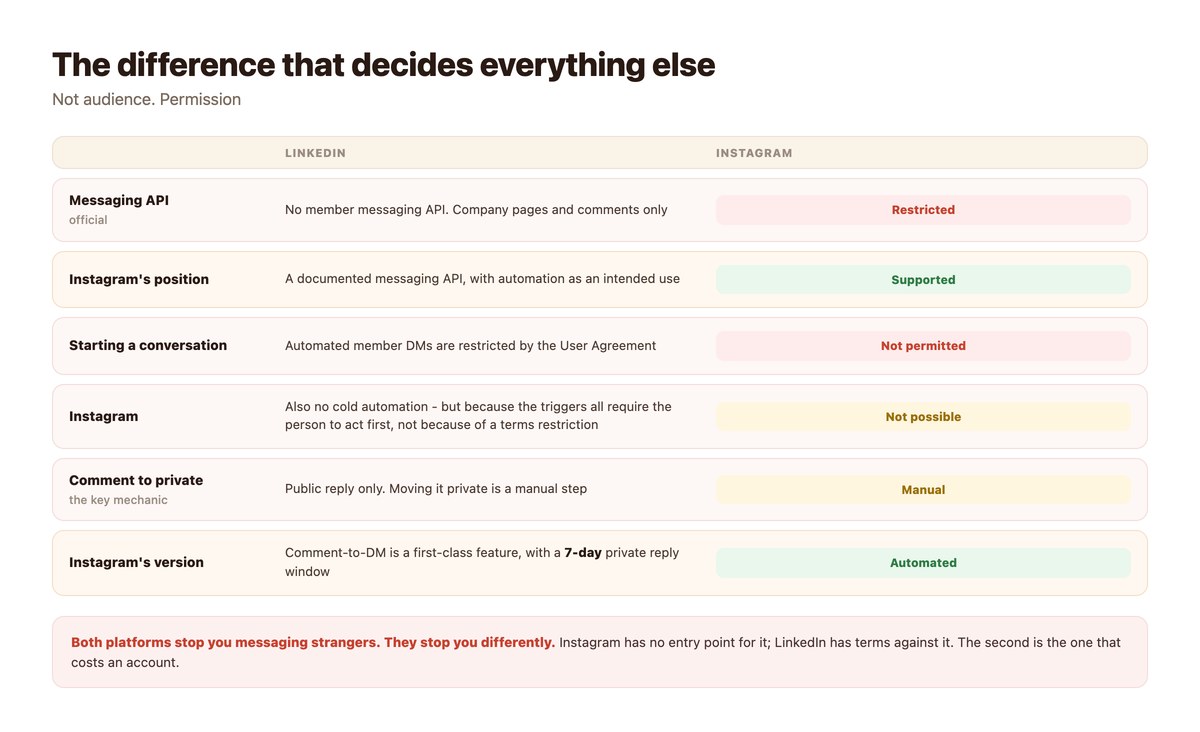
The difference that actually matters is permission. Instagram publishes a messaging API and treats automation as an intended use of it. LinkedIn restricts automated member messaging and offers company page comment management instead. Everything else in the comparison follows from that.
Which means the two platforms suit different parts of the same campaign rather than different businesses. Below: the rule difference, the same campaign run on each, and how to choose.
Key takeaways
- The difference is permission, not audience. Instagram supports messaging automation; LinkedIn restricts it.
- Neither lets you message strangers – but Instagram has no entry point for it while LinkedIn has terms against it.
- Instagram’s comment-to-DM is a first-class feature with a seven-day private reply window.
- LinkedIn’s equivalent is a public reply, which is a limitation and also reaches everybody reading the thread.
- Instagram suits throughput: qualification and booking continue automatically after the first reply.
- LinkedIn suits credibility: the valuable exchange is visible to an audience that never commented.
- Most B2B teams should run both, for different jobs – not choose one.
The Rule Difference
One paragraph that explains every other row in the comparison.
Instagram Publishes a Messaging API
Meta documents a messaging API for Instagram professional accounts and treats automated handling of conversations as an intended use. Comment triggers, message triggers, story replies and mentions are all supported entry points, and building on them is ordinary.
The constraint is that the customer must act first. That is an architectural limit rather than a prohibition, and inside it the platform is generous.
LinkedIn Restricts Member Messaging
LinkedIn’s User Agreement restricts automated activity, which covers automated member-to-member messaging and connection requests. What it publishes instead is a Community Management API for company pages: publishing, and replying to comments on your own posts.
So the limit here is not architectural, it is a rule – and the consequence of ignoring it falls on an account rather than producing an error.
Why That Distinction Matters
On Instagram, attempting cold outbound through automation simply is not possible; there is no trigger for it and nothing happens. On LinkedIn it is possible and restricted, which is a far more dangerous combination because the tooling works right up until enforcement.
A thing that cannot be done is safer than a thing that can be done and should not.
The Same Campaign, Run on Each
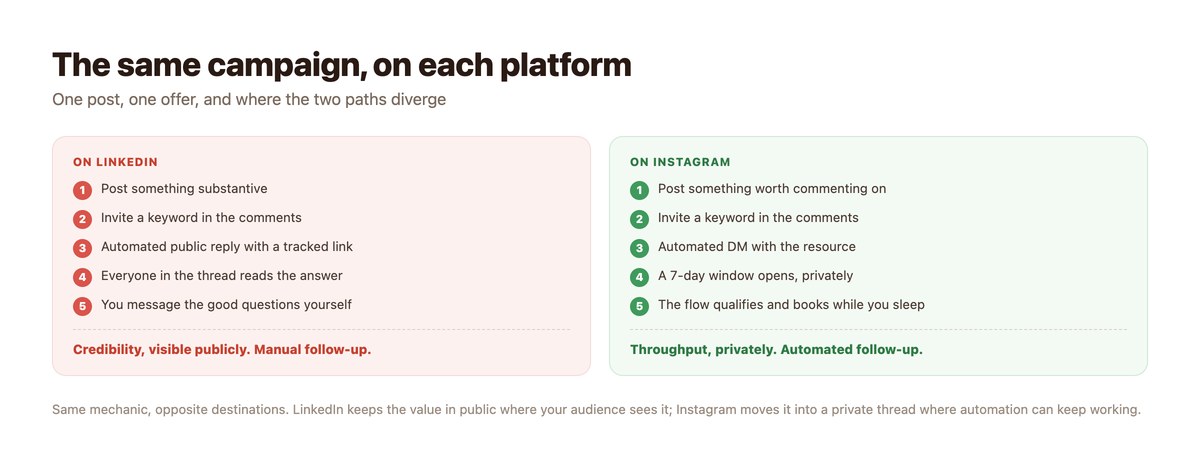
One post, one offer, and the paths diverge at the comment.
Up to the Comment, Identical
Publish something substantive, invite a keyword, let the post do the reach. The mechanic is the same on both platforms and the quality of the post decides the outcome in both cases.
The automation amplifies; it does not substitute. That holds everywhere.
LinkedIn: It Stays Public
The reply is a public comment, visible to everyone reading the thread including the large majority who never comment. A useful reply therefore does double duty – it serves the person who asked and demonstrates competence to everybody else.
Moving to a private conversation is manual, and should be reserved for the genuine questions, as set out in LinkedIn content to DM.
Instagram: It Goes Private, and Keeps Going
The reply is a DM, which opens a seven-day private reply window. Inside it the flow can qualify, answer follow-up questions, send a booking link and hand off to a person – all without anybody being awake.
That is throughput the LinkedIn version cannot match, in exchange for the public visibility it cannot provide.
Where Each One Wins
They are complements more often than alternatives.
LinkedIn for Credibility
A thoughtful public exchange under your company post is read by people who will never interact with it, and that readership is the point in B2B. The comment thread is a shop window rather than a delivery mechanism.
It is also where named people at named companies engage under their real identities, which makes even a small number of comments informative.
Instagram for Throughput
Where the buyer is a founder, an agency or a small business, Instagram both reaches them and lets the conversation continue automatically. Qualification, booking and product information all work inside the window.
For enterprise buyers it reaches the wrong accounts entirely, and no amount of automation fixes that.
Running Both
The practical split: LinkedIn for reach and credibility with named professionals, Instagram for conversations that need to continue without you. Same content, adapted; different follow-through.
One queue across both, plus the other channels, is the operational half – covered in the unified social inbox.
Side by Side
The rows that actually differ. Audience is not one of them any more.
| Messaging automation | Restricted | Supported |
| Comment trigger | Yes, company pages | Yes |
| Reply destination | Public comment | Public comment or DM |
| Private reply window | n/a | 7 days |
| AI replies | No | Yes |
| Product cards | No | Yes |
| Cold outbound | Restricted by terms | No entry point exists |
| Best at | Credibility, in public | Throughput, in private |
The full six-channel version of this grid, for when the question is broader than these two, is in the channel decision.
Running One Campaign Across Both
A fortnight, and most of it is adapting the post rather than the automation.
- Write one substantive piece. The same argument, adapted in length and register for each platform.
- Set the same keyword on both. Consistency helps an audience that follows you in two places.
- On LinkedIn, write the reply as content. Useful to the silent readers, with a tracked link.
- On Instagram, write the reply as a conversation opener. It is private and a seven-day window just opened – use it.
- Let Instagram qualify and book automatically. That is the throughput advantage; not using it wastes the channel.
- Follow up LinkedIn’s good questions by hand. That is the credibility advantage; automating it would waste that one.
Doing It With DMpro
One workspace, two very different capability sets.
Instagram: The Full Set
DMpro supports comment triggers, message triggers, story replies and mentions on Instagram, with DM sends, product cards, AI responses, webhooks and booking integrations behind them.
Which is why the Instagram side of a campaign can run end to end while the LinkedIn side cannot.
LinkedIn: Comments and Public Replies
A company page connection through the Community Management API: comment triggers, public replies, tracked links and webhooks. No DM sending, no AI responses, no cards.
DMpro does not send LinkedIn DMs. The connection is comment-trigger only, DM sending is switched off in configuration, and LinkedIn is the one platform shipped disabled by default.
And Outbound, Separately
Neither platform permits cold automation. contactID covers contact-form outreach and the Chrome extension covers Instagram outbound from your own account – different products because they are different motions.
Credibility on One, Throughput on the Other
The same post, the same keyword, two different follow-throughs: a public reply that demonstrates competence to everyone reading, and a private thread that qualifies and books while you sleep.
DMpro runs both – the full Instagram set, and LinkedIn company page comments through LinkedIn’s own API.
Conclusion
The comparison is about permission. Instagram publishes a messaging API and intends automation; LinkedIn restricts automated member messaging and offers comment management on company pages instead. Audience stopped being the dividing line some time ago.
Neither lets you message strangers, and the difference in how they stop you matters: Instagram has no entry point, so nothing happens; LinkedIn has terms, so everything works until it does not.
Run both for different jobs. LinkedIn keeps the valuable exchange public where your audience reads it; Instagram moves it private where automation can carry it to a booking. Choosing between them is usually a mistake.
Frequently asked questions
Is LinkedIn or Instagram better for B2B outreach?
They do different jobs. LinkedIn is better for credibility, because the valuable exchange happens publicly under named professionals. Instagram is better for throughput, because the conversation can continue automatically after the first reply.
Why can I automate DMs on Instagram but not LinkedIn?
Instagram publishes a messaging API and treats automated conversation handling as an intended use. LinkedIn’s User Agreement restricts automated member messaging and offers a company page comment API instead.
Can I send cold DMs on Instagram?
No. Every trigger requires the person to act first – a comment, a message, a story reply. There is no entry point for someone who has not interacted, so the attempt simply does nothing.
What is comment-to-DM?
A public comment triggers a private message. On Instagram it is a first-class feature that opens a seven-day private reply window. On LinkedIn the reply stays public and moving private is manual.
Should B2B companies use Instagram at all?
If the buyers are founders, agencies or small businesses, often yes – they are frequently more responsive there. For enterprise procurement it reaches the wrong accounts.
Can one campaign run on both?
Yes, and it should. Same post and keyword, adapted – a public reply written as content on LinkedIn, and a private reply written as a conversation opener on Instagram.