
If you have accepted that automated LinkedIn outreach is not a route worth taking, the next question is practical: what replaces the pipeline it was supposed to produce.
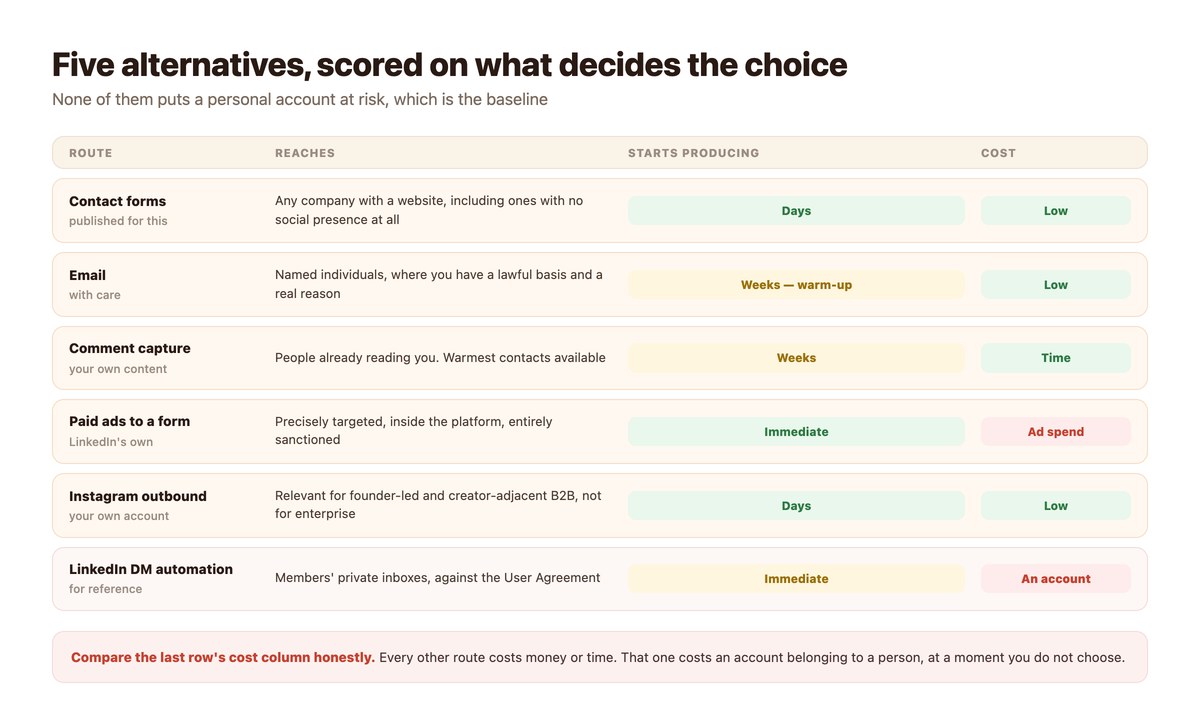
There are five realistic answers. They differ in who they reach, how quickly they start producing and what they cost – and they share one property, which is that none of them places an individual’s account in the path of an enforcement decision.
Below, each one on its merits, including where each is genuinely weaker than the thing it replaces. Why the LinkedIn route is closed in the first place is in LinkedIn automation.
Key takeaways
- Contact forms are the strongest replacement: published by companies so strangers can make contact, and far less crowded than an inbox.
- Email works with a lawful basis and a real reason, and needs weeks of warm-up before volume.
- Comment capture produces the warmest contacts – people already reading you – and takes weeks to build.
- LinkedIn’s own Lead Gen Forms are immediate, sanctioned, and cost ad spend.
- Instagram outbound from your own account suits founder-led B2B and does not suit enterprise.
- Contact forms punish mail-merge visibly, which is a quality filter rather than only a limitation.
- Every alternative costs money or time. The route they replace costs an account, at a moment you do not choose.
Contact Forms
The most underrated channel in B2B, largely because it is unglamorous.
They Exist For This
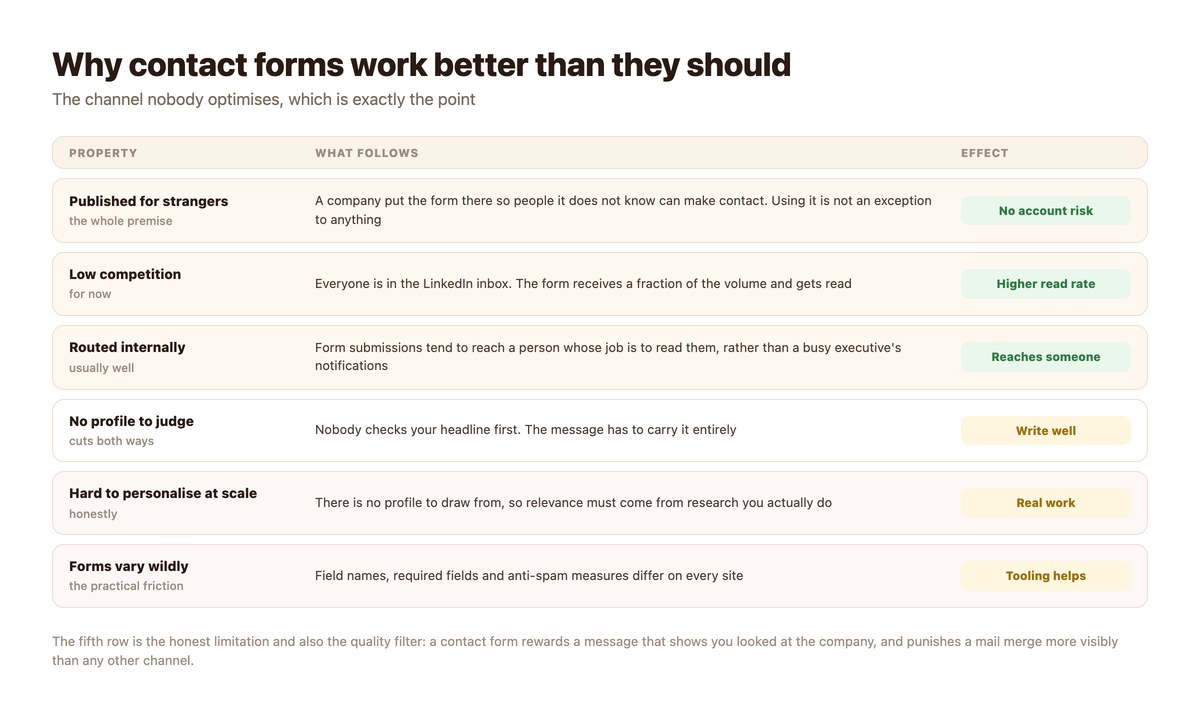
A company publishing a contact form is stating that people it does not know may use it to get in touch. There is no terms question, no account at risk and nothing to disguise – you are using a channel for its stated purpose.
That is a materially different position from every tool in the LinkedIn automation category, and it is worth more than any feature.
Less Crowded, Better Routed
Everyone has moved to the LinkedIn inbox, so the form receives a fraction of the volume. Submissions also tend to reach somebody whose job includes reading them, rather than competing with notifications in a busy executive’s feed.
The combination – low volume, attentive recipient – produces read rates that surprise people the first time they try it.
And They Punish Laziness
There is no profile to pull a first name from, so relevance has to come from research you actually did. A generic message is more obviously generic here than anywhere else.
Treat that as the quality filter rather than the obstacle: it means the channel rewards exactly the behaviour that works and resists the behaviour that ruined the inbox.
The Friction Is Real
Every site’s form is different – field names, required fields, anti-spam measures – which is why doing this by hand caps out quickly. contactID exists for this part: finding the form, filling it correctly, and tracking what was sent where.
Email, Comment Capture and Paid Forms
Three routes with very different timescales.
Email, With a Real Basis
Still the backbone of B2B outreach where you have a lawful basis for contacting someone and an actual reason to. The rules differ by jurisdiction and are worth getting right rather than assuming.
Practically, email needs patience: a new domain requires weeks of warm-up before volume, and skipping that is how a sending domain gets burned. Budget the time before promising the pipeline.
Comment Capture
The warmest contacts available, because they read your content and responded to it in public. Slower to build, and it compounds – a library of posts keeps producing after it is written.
This is the one alternative that also improves everything else, since people who know your name respond better on every other channel. The mechanics are in LinkedIn comment automation.
Paid Forms
LinkedIn’s own Lead Gen Form ads are immediate, precisely targeted and entirely sanctioned – the platform’s intended answer to this problem.
The cost is ad spend and the catch is that one-tap pre-filled submissions carry variable intent. Qualify before anybody calls, which is covered in LinkedIn lead generation.
Instagram Outbound, and Who It Suits
Narrower than the others and genuinely effective inside its range.
Founder-Led and Creator-Adjacent B2B
If your buyers are founders, agencies, creators or small-business owners, they are often more reachable and more responsive on Instagram than in a professional inbox – and the register is less formal, which helps a first message.
The DMpro Chrome extension handles outbound from your own account for this. It is a separate product from the inbound platform because it is a separate motion.
Who It Does Not Suit
Enterprise procurement, regulated industries and anybody whose buyers keep a strict separation between professional and personal accounts. Messaging those people on Instagram reads as a boundary violation rather than as initiative.
Judge by where your actual buyers are, not by where outreach is easiest.
Choosing Between Them
By constraint, which is usually what decides it.
| Your constraint | Start with | Why |
|---|---|---|
| No budget, some time | Contact forms | Low cost, low competition, starts within days |
| Budget, need results now | LinkedIn Lead Gen Forms | Immediate and sanctioned |
| Something worth publishing | Comment capture | Warmest contacts, and it compounds |
| An existing list, lawful basis | Allow weeks for warm-up first | |
| Founder-led, SMB buyers | Instagram outbound | Where those buyers actually reply |
| Enterprise buyers | Contact forms plus content | The others do not reach them |
Whichever you pick, everything after the reply – qualification, booking, lookups – is permitted and automatable, as in webhooks and integrations.
Replacing a LinkedIn Sequence in Thirty Days
Realistic, and the volume will dip before it recovers.
- Week one: stop the sequence and say so internally. Including the expected dip. Better stated now than discovered in the forecast.
- Week one: build a target list from research, not scraping. Companies and reasons, not names and job titles.
- Week two: start contact-form outreach. Short, specific, obviously written for that company. It starts producing in days.
- Week two: begin publishing, weekly. The compounding route has to start now to matter in month three.
- Week three: add comment capture to the posts. One keyword, a useful public reply, a tracked link.
- Week four: run paid forms if the gap still hurts. Immediate volume to bridge, with qualification before anyone calls.
Which DMpro Product Does What
Three products, three motions, stated plainly.
Outbound to Companies
contactID works published contact forms – finding the form, filling it correctly and tracking what was sent. That is the replacement for cold LinkedIn outreach, on a channel built for it.
Outbound on Instagram
The DMpro Chrome extension handles Instagram outbound from your own account, which suits founder-led and SMB-facing B2B and does not suit enterprise.
Everything After the Reply
DMpro handles inbound across Instagram, TikTok, WhatsApp, Messenger, Telegram and Discord, plus LinkedIn company page comments – one queue, keyword flows, booking integrations and webhooks.
DMpro does not send LinkedIn DMs. The connection is comment-trigger only, DM sending is switched off in configuration, and LinkedIn is the one platform shipped disabled by default.
Replace the Pipeline, Not the Risk
Every alternative here costs money or time. The route they replace costs an account belonging to a person, forfeited at a moment somebody else chooses.
contactID works the channel companies publish for exactly this, and DMpro handles every conversation that comes back, across six channels.
Conclusion
Five routes, and the strongest is the least fashionable. Contact forms are published so that strangers may use them, they are far less crowded than a professional inbox, and submissions usually reach somebody whose job is to read them.
Email works with a lawful basis and weeks of warm-up. Comment capture produces the warmest contacts and compounds. Paid forms buy immediate volume. Instagram outbound fits founder-led B2B and nothing else.
Run two: one that produces this month and one that compounds into next quarter. Then put the effort into what happens after someone replies, which is the part every platform permits and most teams neglect.
Frequently asked questions
What is the best alternative to LinkedIn outreach?
Contact-form outreach for most B2B. Companies publish those forms so people they do not know can get in touch, they are far less crowded than a LinkedIn inbox, and no account is at risk.
Do contact forms actually get read?
More often than people expect. They receive a fraction of the volume a professional inbox does, and submissions are usually routed to someone whose job includes reading them.
Is cold email a safe replacement?
It is permitted where you have a lawful basis and a genuine reason, with rules that differ by jurisdiction. Allow weeks of domain warm-up before volume, or the sending domain suffers.
How long before these alternatives produce?
Contact forms and paid forms start within days. Email needs weeks of warm-up. Comment capture takes weeks and then compounds. Expect a dip before recovery.
Is Instagram outreach appropriate for B2B?
For founder-led, agency and small-business buyers, often yes. For enterprise procurement or anyone separating professional and personal accounts, it reads as a boundary violation.
Can DMpro send LinkedIn messages for me?
No. The LinkedIn connection is comment-trigger only with DM sending switched off. Outbound belongs on published channels – contactID for contact forms, the Chrome extension for Instagram.