
The usual answer to LinkedIn lead generation is a messaging sequence, and it is the one route on this page that cannot be recommended, because automated member messaging is restricted and the account carrying the risk is usually an employee’s own.
The useful version of this question is therefore: what produces leads from LinkedIn without touching anybody’s inbox. There are four answers, they all work, and two of them are better than the thing they replace.
One of the four ends with the conversation moving off LinkedIn entirely. That is not a concession – it is the structurally correct answer, because the platforms built for messaging permit messaging and this one does not.
Key takeaways
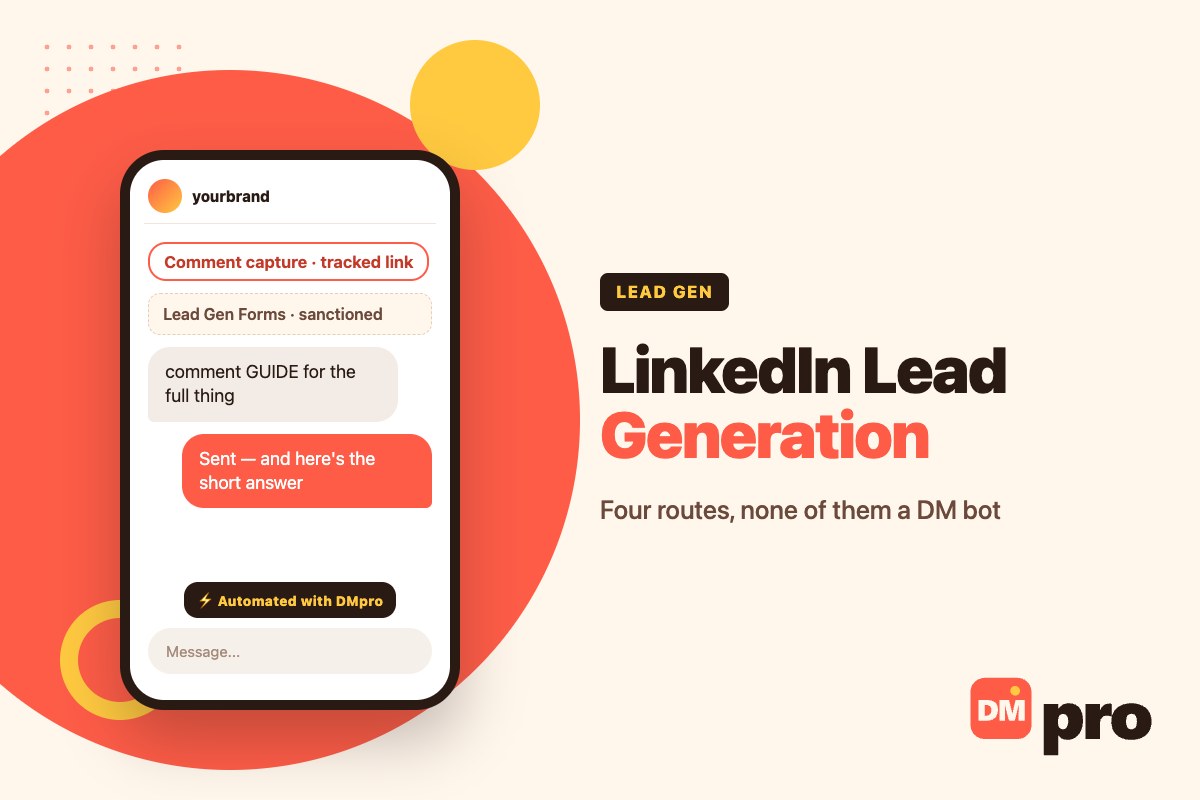
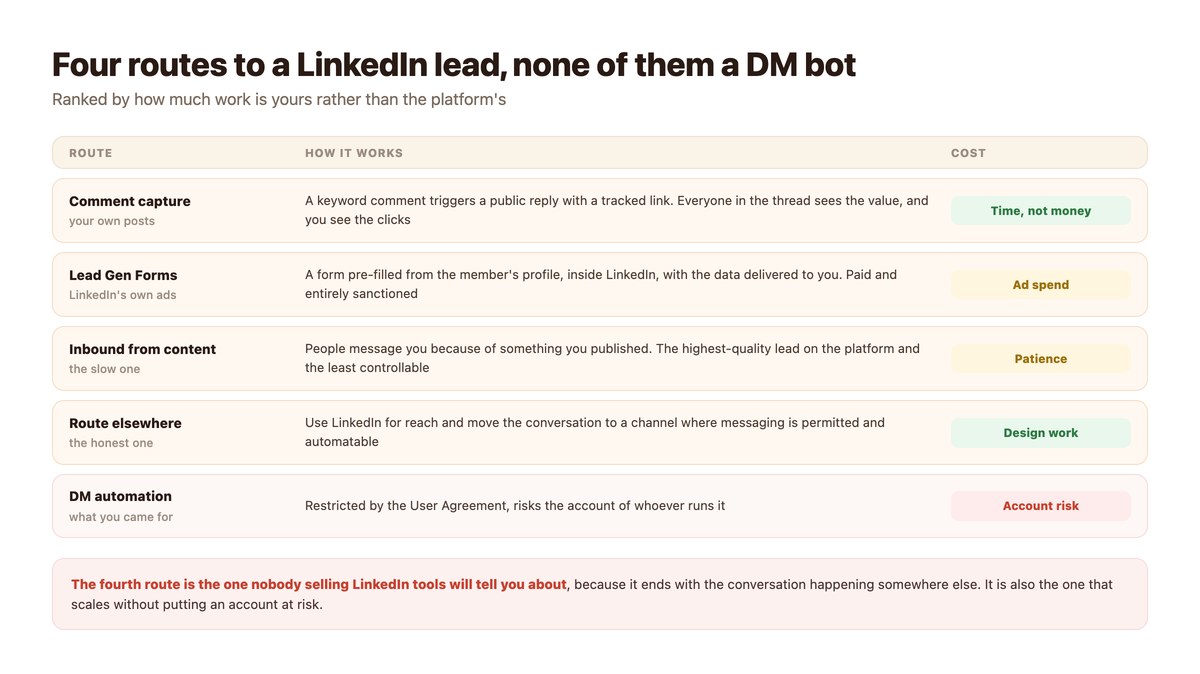
- Four permitted routes: comment capture, LinkedIn’s own Lead Gen Forms, inbound from content, and routing to another channel.
- Comment capture is the best value – a keyword comment triggers a public reply with a tracked link, on your own page, through LinkedIn’s API.
- Lead Gen Forms are sanctioned and paid, and pre-filled submissions are easy enough that intent varies – qualify before calling.
- Inbound from content is the highest-quality lead on the platform and the least controllable.
- Routing to a channel that permits messaging is the route nobody selling LinkedIn tools mentions, and the one that scales safely.
- Automated DM sequences produce volume until enforcement, then nothing, with no warning.
- People who commented on your posts are the warmest invitations and follow-ups you will get.
Route One: Comment Capture
Permitted, measurable, and the best ratio of result to effort.
How It Produces a Lead
You post something substantive, invite a keyword in the comments, and an automation replies publicly with a tracked link to the full resource. The comment is a public, attributable expression of interest from a named person at a named company.
That is a better qualified signal than most form fills, and it arrives with context – you know which post prompted it.
The Tracked Link Is the Measurement
B2B content attribution is usually inference. Here it is not: clicks attach to the post that produced them, so you learn which subjects generate interest rather than which generate applause.
Over a quarter that reshapes the content calendar more usefully than any engagement metric.
Then a Person Reads the Thread
The automation serves everyone who wanted the resource. The valuable part is the handful who asked a real question, and following those up is manual – deliberately, and well, as set out in LinkedIn content to DM.
Route Two: LinkedIn’s Own Lead Gen Forms
Paid, entirely sanctioned, and frequently overlooked by people buying bots instead.
What They Are
An ad format where the form opens inside LinkedIn, pre-filled from the member’s own profile, and the submission is delivered to you. No landing page, no typing, no leaving the feed.
It is LinkedIn’s intended answer to lead generation, which is worth weighing against the amount of effort the market puts into unsanctioned alternatives.
The Catch Is Ease
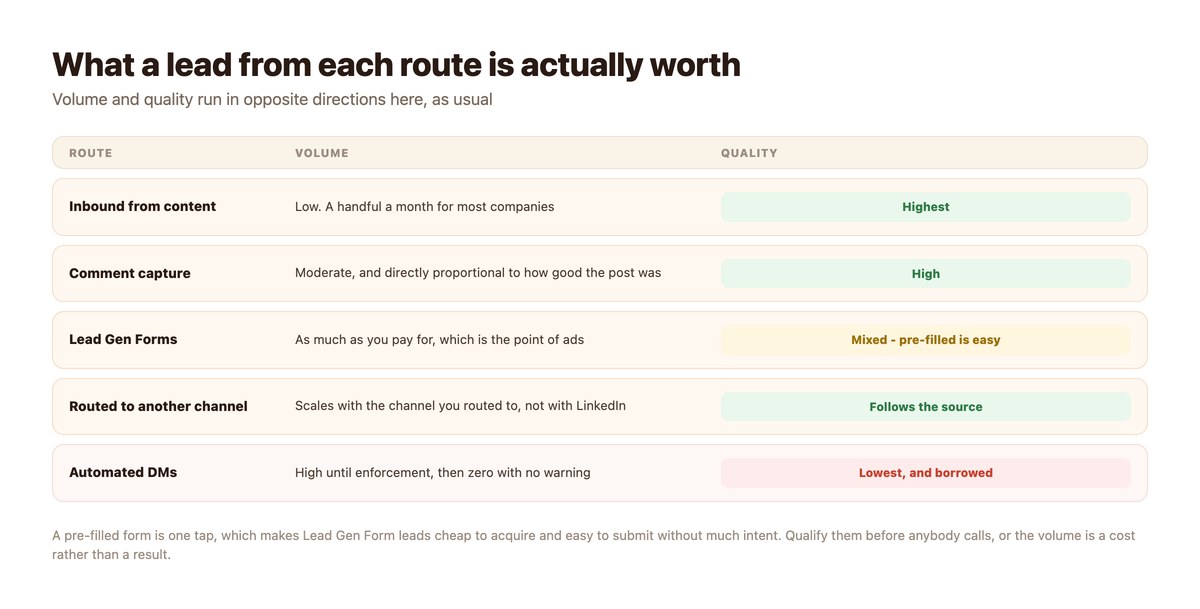
A pre-filled form is one tap, so submitting costs almost nothing and intent varies accordingly. Volume is real and quality is mixed.
Qualify before a human calls. A short automated follow-up that asks one disqualifying question saves more time than it costs – and on channels where messaging is permitted, that follow-up can be automatic.
Get the Data Out
A lead sitting in an ad platform is not a lead anybody is working. Push it into whatever system your team actually opens, on the day it arrives.
The general mechanics of getting conversation data into your own systems are in the integration options.
Routes Three and Four
The slowest and the most scalable, which happen to be the two least discussed.
Inbound From Content
People who message you because of something you wrote are the best leads the platform produces. They arrive informed, they have self-selected, and the conversation starts at a sensible point.
There is no mechanism to accelerate this beyond publishing things worth reading, which is why it gets left out of tool comparisons. It remains the highest-quality route and the one that compounds.
Route the Conversation Elsewhere
Use LinkedIn for what it is good at – reach, credibility, a named audience – and move the conversation to a channel where messaging is permitted and can be automated. A link in a post or a public reply, pointing at a channel that allows a real exchange.
This is the structurally correct answer and the one no LinkedIn tool vendor will give you, because it ends with the conversation happening on their competitor’s surface. It is also the only route here that scales without putting an account at risk.
And Reaching Companies That Have Never Heard of You
If the requirement is genuinely cold outbound at volume, LinkedIn is the wrong instrument regardless of tooling. Published contact forms exist for exactly that purpose – contactID works that channel, and the comparison with other routes is in the alternatives to LinkedIn outreach.
Choosing a Route
By what you actually have: time, budget, or an audience.
| You have | Start with | Then add |
|---|---|---|
| Something worth publishing | Comment capture | Inbound follows on its own |
| Budget, no audience yet | Lead Gen Forms | Qualification before anyone calls |
| An audience, no budget | Comment capture | Route engaged readers to a messaging channel |
| Neither, and a target list | Contact-form outreach | It is a different motion entirely |
| Pressure for volume this quarter | Lead Gen Forms | Do not reach for DM automation |
Which channel to route conversations into, once they leave LinkedIn, is a decision with real constraints – choosing a messaging channel goes through them.
A Quarter That Works
Three months, no automation of anybody’s inbox.
- Publish something substantive weekly. The automation amplifies posts; it does not create them. This is the work.
- Add one keyword and a public reply worth reading. Written for the silent readers, with a tracked link.
- Read every thread and follow up by hand. Only the specific questions. One message each, no sequence.
- Run Lead Gen Forms if you have budget. With a qualifying question before anybody calls.
- Give engaged readers a route to a real conversation. A channel where messaging is permitted, linked from the post or the reply.
- Measure clicks per post, not impressions. The tracked link is the only honest attribution available here.
Doing It With DMpro
Which parts it covers and which it does not.
The Comment Capture Half
DMpro connects your LinkedIn Company Page through the Community Management API: keyword comment triggers, public replies on the comment, tracked links and webhooks. That is route one in full.
A webhook means the public reply can be drawn from your own data, and the lead can land in your CRM at the same moment.
And the Channel You Route To
If you move conversations to Instagram, WhatsApp, Messenger, Telegram or Discord, the same workspace handles those – with the automation that LinkedIn does not permit, because those platforms do.
That is the practical version of route four: LinkedIn earns the attention, another channel holds the conversation.
What It Will Not Do
DMpro does not send LinkedIn DMs. The connection is comment-trigger only, DM sending is switched off in configuration, and LinkedIn is the one platform shipped disabled by default. If automated LinkedIn messaging is the requirement, no honest tool meets it.
Leads From LinkedIn, Without the Account Risk
A post worth reading, a keyword, a public reply with a tracked link – and the people who asked real questions followed up by hand. That is the permitted route, and it produces better conversations than any sequence.
DMpro runs the comment half through LinkedIn’s own API, and handles the channel you move the conversation to, where automation is actually allowed.
Conclusion
LinkedIn lead generation without DM automation is not a compromise, it is four distinct routes. Comment capture gives the best ratio of result to effort, Lead Gen Forms give volume for budget, inbound from content gives the best leads and the least control.
The fourth route is the one worth taking seriously: use LinkedIn for reach and hold the conversation on a channel that permits messaging. No vendor in this category will suggest it, and it is the only option here that scales without betting an account.
If what you actually need is cold outbound at volume, be honest that LinkedIn is the wrong instrument. Published contact forms exist for that, and using a channel for its intended purpose outperforms fighting one that was built for something else.
Frequently asked questions
How do I generate leads on LinkedIn without automation tools?
Four permitted routes: keyword comment capture on your own company posts, LinkedIn’s own Lead Gen Form ads, inbound from content you publish, and routing engaged readers to a channel where messaging is permitted.
Can I automate LinkedIn DMs for lead generation?
No. Automated member messaging is restricted by LinkedIn’s User Agreement, and the account carrying the risk is usually an employee’s own. The public comment reply can be automated; the private message cannot.
Are LinkedIn Lead Gen Forms worth it?
They are sanctioned, they scale with budget, and submissions are one tap from a pre-filled profile – so volume is real and intent varies. Add a qualifying step before anybody calls.
What is the highest-quality LinkedIn lead?
Someone who messages you because of something you published. They arrive informed and self-selected, and the only way to produce more is to publish more worth reading.
Should I move conversations off LinkedIn?
Often yes. LinkedIn is strong for reach and credibility and does not permit automated messaging, so holding the conversation on a channel built for messaging is the structurally correct answer.
How do I measure which posts produce leads?
Use a tracked link in the automated comment reply. Clicks then attach to the post that produced them, which is rare in B2B content and reshapes a content calendar quickly.