
On every other platform this article would be a tutorial: comment triggers DM, here is the flow. On LinkedIn it cannot be, because automated member messaging is exactly what the User Agreement restricts.
Which turns out to be less of a loss than it sounds. The step that matters here is judgement – deciding which of twenty comments is worth a private message, and what that message should say given the person has already spoken publicly. Automation would make that step faster and worse.
So this is the manual version, done properly: which threads qualify, how to write the first message, and when to stop. The automated half – the public reply that handles everybody – is in LinkedIn comment automation.
Key takeaways
- This step is manual and should be. Automated member messaging is restricted, and the judgement is the valuable part anyway.
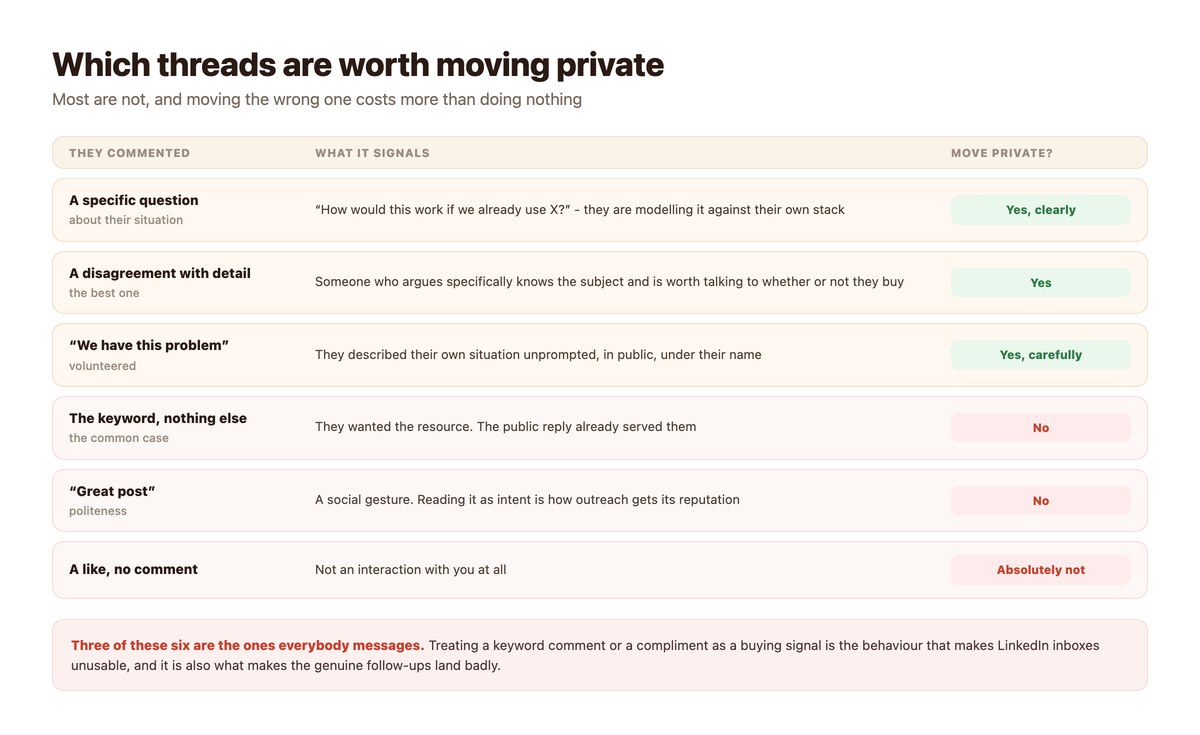
- Three signals justify a private message: a specific question, a detailed disagreement, or a volunteered description of their own problem.
- A keyword comment is not a buying signal. The public reply already served that person.
- “Great post” is politeness. Reading it as intent is why LinkedIn inboxes are the way they are.
- You are not cold – they spoke first, publicly, under their name. Write as though that happened.
- Reference what they actually said, add the detail that did not fit in public, ask at most one question.
- No sequence. One message. Silence is an answer and following up three times converts it into a no.
Which Threads Qualify
Roughly one in twenty, and being strict is what makes the one work.
A Specific Question About Their Situation
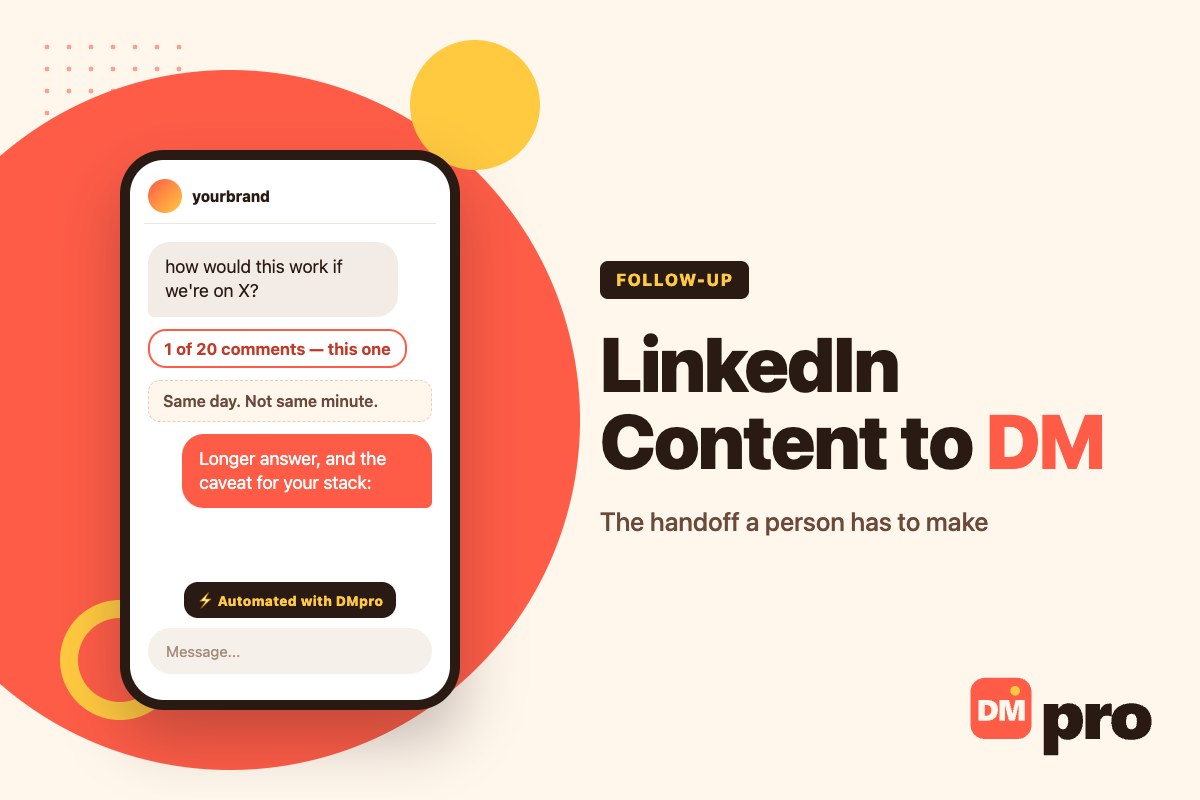
“How would this work if we are already on X?” or “does this hold at our size?”. Someone asking this has done the work of mapping your post onto their own circumstances, which is most of the way to being interested.
It also gives you something to say. The private message writes itself: the longer answer to the question they asked.
A Detailed Disagreement
The most underrated signal on the platform. Somebody who argues with specifics knows the subject, cares about it, and has given you their actual position – which is more than most calls produce.
Message them whether or not they look like a buyer. The conversation is worth having on its own terms, and people remember being engaged with seriously rather than handled.
A Volunteered Problem
“We have exactly this issue and have not solved it.” Said in public, under their real name, next to their employer. That is as clear an invitation as this platform produces.
Handle it carefully: their colleagues can see the thread, so the private message should not make the admission more visible than they intended.
And What Does Not Qualify
The keyword on its own – they wanted the resource and your public reply gave it to them. A compliment – that is a social gesture, not intent. A like – not an interaction with you at all.
Messaging these three is what makes LinkedIn inboxes unusable, and the collateral damage falls on the genuine follow-ups, which now arrive looking identical to the noise.
Writing the First Message
You have an advantage here that cold outreach never has. Most people discard it in the first line.
You Are Not Cold
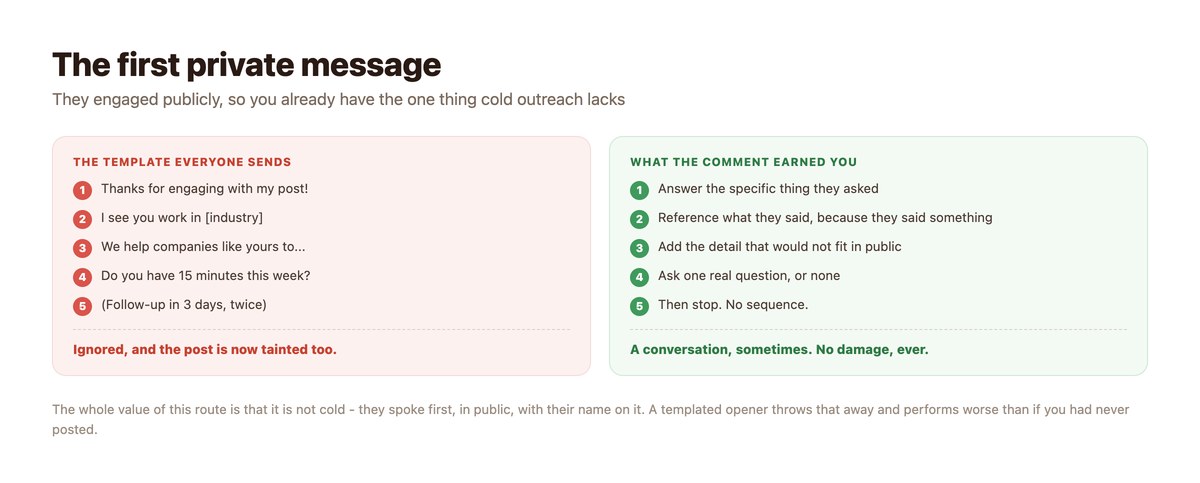
They commented. In public. Under their own name, attached to their employer. That is a voluntary, attributable interaction and it is the entire reason this message has a chance.
Then the standard template opens with “thanks for engaging with my post”, which announces that the comment was processed rather than read, and the advantage is gone by the second sentence.
Answer the Thing They Asked
If they asked a question, the message is the fuller answer. If they disagreed, it is your actual response to their point. If they described a problem, it is the specific thing you would try first.
No pitch. The pitch, if there is one, is that your answer was good.
Add What Did Not Fit in Public
This is the honest justification for going private at all, and it should be true: a number you would not post, a caveat specific to their stack, an example from a client you cannot name publicly.
If you have nothing that belongs in private, the public reply was the right place and you are messaging for your own reasons rather than theirs.
One Question, or None
“Do you have 15 minutes” at the end of a first message converts a reply into a meeting request, which is a much larger ask than the conversation warrants.
Ask something they can answer in a sentence, or end with nothing and let them decide. A good answer earns the next message on its own.
Timing, and Stopping
Two short rules that decide most outcomes.
Same Day, Not Same Minute
Replying privately within seconds of a public comment reads as monitored rather than as interested. Later the same day, or the next morning, reads as somebody who saw it and thought about it – which should also be true.
The public reply can be instant. The private one should not be.
No Sequence
One message. If there is no reply, that is the reply. Following up twice converts a neutral non-answer into an active negative impression, and on LinkedIn the person can see exactly how many times you have messaged them.
Any volume ambition belongs on channels where outbound is permitted and expected – the options are in LinkedIn outreach alternatives.
Keep a Note Where Someone Will See It
Who you messaged, what they said, what you answered. Not because it needs a CRM field, but because the second conversation six months later should not start from nothing.
The general version of this habit – and its limits – is in CRM for social DMs.
Comment to Message, Mapped
What the comment said, and what the private message should be.
| They wrote | Private message is | Opens with |
|---|---|---|
| A question about their stack | The specific answer | The answer itself |
| A detailed objection | Your genuine response | Agreeing with the part that is right |
| “We have this problem” | What you would try first | The suggestion, discreetly |
| The keyword only | Nothing | — |
| “Great post” | Nothing | — |
| A question you cannot answer | An honest referral | “Not our area, but X does this” |
If the thread turns into an actual sales conversation, it has stopped being a LinkedIn question – B2B DM outreach covers where those conversations are permitted to continue.
A Workable Daily Routine
Fifteen minutes, done by a person, not delegated to a tool.
- Read every comment on your recent posts. All of them. The automation handled delivery; this is the part with the value.
- Mark the three signals. Specific question, detailed disagreement, volunteered problem. Ignore the rest.
- Write each message from scratch. If it could be sent to two people, it is a template and it will read like one.
- Send later the same day. Instant reads as monitoring. Same-day reads as attention.
- Send once. No follow-up sequence. Silence is an answer.
- Note what was said, somewhere findable. The next conversation should not start from zero.
Doing It With DMpro
The automated half, and the deliberate boundary.
Automate the Public Half
DMpro handles the part that should be automated: a keyword comment on your company post triggers a public reply, with a tracked link so you know which posts produce clicks.
That serves everybody who just wanted the resource, which is most of them, and leaves you with a short list of threads worth reading properly.
The Private Half Stays Manual
DMpro does not send LinkedIn DMs. The connection is comment-trigger only, DM sending is switched off in configuration, and LinkedIn is the one platform shipped disabled by default.
On this one the limitation and the advice coincide: this step should be manual regardless, because the judgement about which thread deserves a message is the thing that makes the message work.
If You Need Outbound Volume
It does not belong on LinkedIn. contactID reaches companies through their published contact forms, which exist for exactly that purpose, and the Instagram side is handled by the DMpro Chrome extension.
Automate the Reply. Write the Message Yourself.
Twenty people comment and nineteen of them wanted the link. Give them that instantly, publicly, with something worth reading – then spend your fifteen minutes on the one person who asked a real question.
DMpro runs the public half through LinkedIn’s own API: keyword comment triggers, public replies and tracked links on your company page.
Conclusion
The handoff from a public thread to a private message is manual on LinkedIn, and that is the right design even setting the rules aside. Deciding which of twenty comments deserves a message is judgement, and automating judgement makes it faster and worse.
Three signals justify it: a specific question, a detailed disagreement, a volunteered problem. A keyword comment and a compliment do not, and messaging those is what makes everybody else’s genuine follow-up look like spam.
Write the message as the person who read what they wrote, add the thing that did not belong in public, ask at most one question, and send it once. Silence is an answer, and respecting it is the whole reason the next message you send will be read.
Frequently asked questions
Can I automate a LinkedIn DM after someone comments?
No. Automated member messaging is restricted by LinkedIn’s User Agreement, and DMpro’s LinkedIn connection is comment-trigger only with DM sending switched off. The public reply can be automated; the private message cannot.
Which comments are worth a private message?
A specific question about the person’s own situation, a detailed disagreement, or a volunteered description of a problem. A keyword comment or a compliment is not a buying signal.
What should the first private message say?
The fuller answer to what they actually asked, plus the detail that did not fit in public, and at most one question. They commented publicly under their own name, so write as though that happened rather than opening with a template.
How soon should I send it?
Later the same day. Replying within seconds of a public comment reads as monitoring; the public reply can be instant, the private one should not be.
Should I follow up if they do not reply?
No. One message. On LinkedIn the person can see how many times you have messaged them, and a second attempt converts a neutral non-answer into an active negative impression.
What if I cannot answer their question?
Say so and refer them to someone who can. It costs a sentence and earns more goodwill than any pitch in this article.