
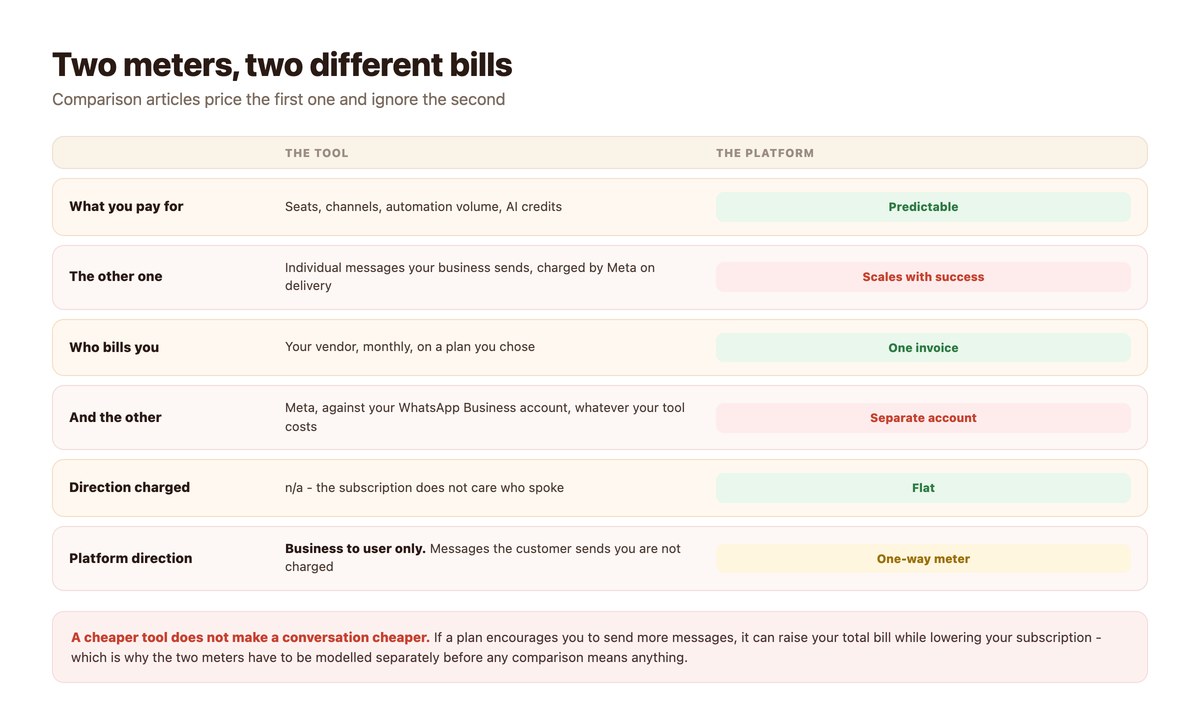
Almost every article comparing DM automation pricing compares subscriptions. That is half the bill, and frequently the smaller half, because the platforms charge for messages separately and those charges scale with how well the automation works.
The two meters behave differently. A subscription is predictable, chosen in advance and paid to your vendor. Platform message fees are charged by Meta against your own WhatsApp Business account, on delivery, in one direction only – and a tool that encourages you to send more can lower one bill while raising the other.
What follows is what each meter charges for, what is genuinely free, and how to build an estimate you can defend. Exact subscription prices are not compared here because they change; the structure does not.
Key takeaways
- Two separate bills: your tool’s subscription, and the platform’s per-message charges. Most comparisons only price the first.
- WhatsApp has billed per message since 1 July 2025, charged on delivery and only on messages your business sends.
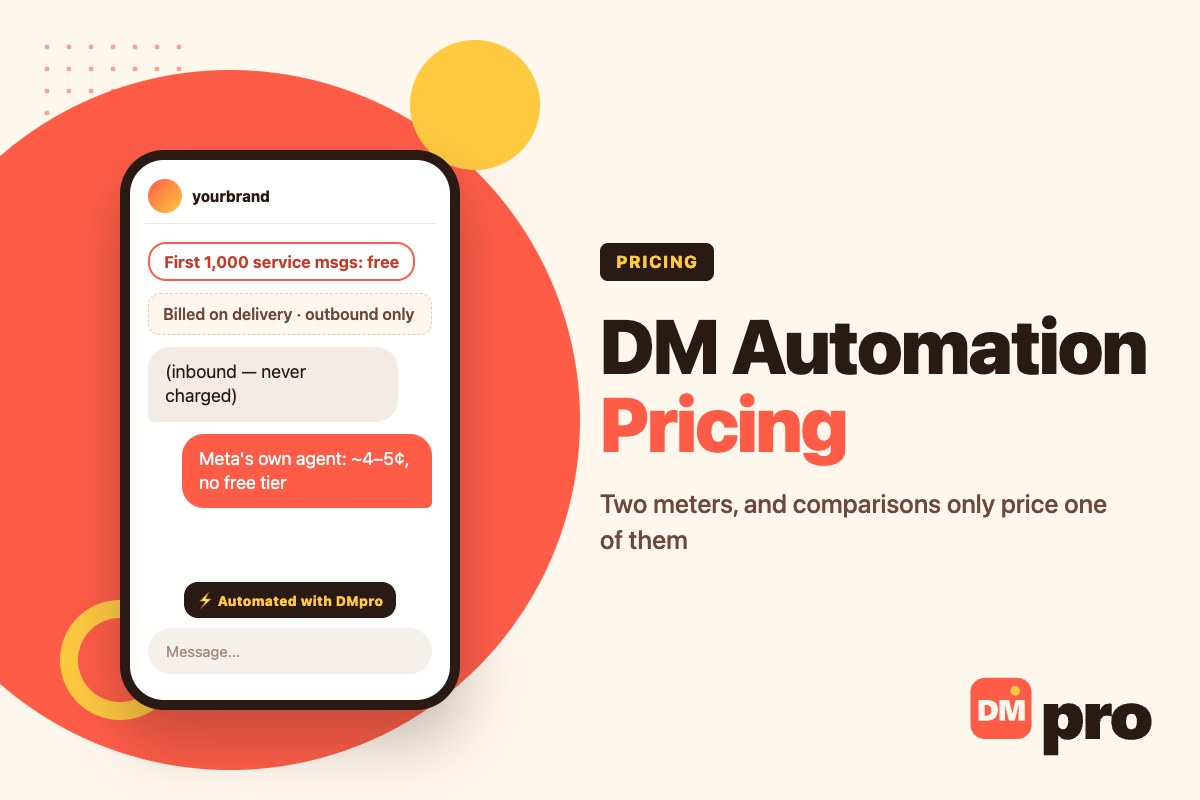
- The first 1,000 service messages each month are free, per business phone number.
- Conversations started from a click-to-WhatsApp ad carry a free window of up to seven days.
- Template messages – marketing, utility, authentication – are charged by category and cost more than service messages.
- Meta’s own AI agent has no free tier: about 4-5 cents a message, charged even inside the free entry point window.
- Meta counts a non-template message not powered by its own agent as a service message, whether a third-party AI or a person wrote it.
Meter One: The Subscription
The one everybody compares, and the easier of the two to reason about.
What You Are Buying
Seats, connected channels, some volume of automation, and usually a monthly allowance of AI credits. It is predictable, it is chosen in advance, and it is the number that appears on a pricing page.
Because it is predictable it is also the number people optimise, which is how a business ends up on a cheaper plan with a larger total bill.
The Questions Worth Asking a Vendor
Whether the price changes with message volume or only with seats. Whether AI usage is metered separately. Whether each connected account or each channel costs extra. And what happens at the plan boundary – a hard stop and an overage charge are very different experiences on a busy week.
If several people will be answering, seat pricing matters more than automation volume – which is a staffing question before it is a pricing one, covered in the social media team inbox.
Meter Two: What WhatsApp Charges
The one that changes the shape of a business case.
Per Message, On Delivery, One Direction
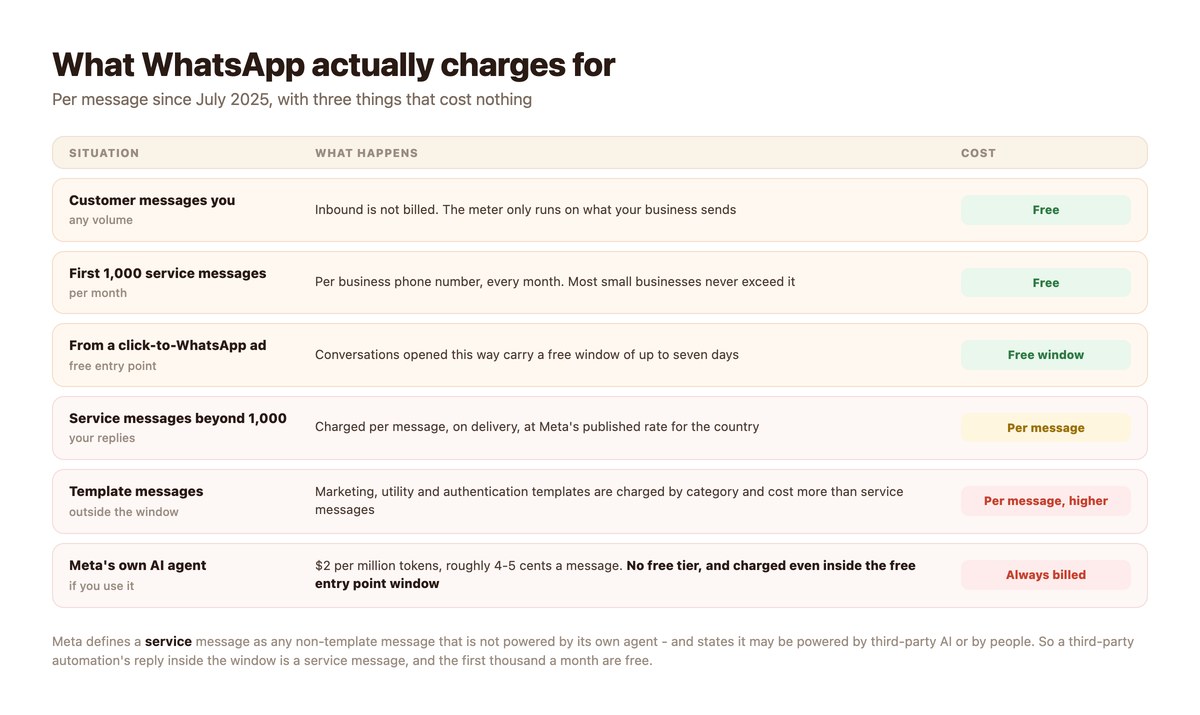
Since 1 July 2025 WhatsApp bills per message rather than per conversation. The charge lands when the message is delivered, and it applies only to messages your business sends – everything a customer sends you is free, in any volume.
That one-directional meter is worth internalising because it inverts a common instinct: a long conversation where the customer does most of the talking is cheap, and a short one where you send five messages is not.
The First Thousand Are Free
Every month, per business phone number, the first 1,000 service messages cost nothing. For a large share of small businesses that is the entire bill, and the per-message rates never come into play.
Note the unit: per number, not per business. A company running several numbers gets the allowance several times over, and a company consolidating onto one number loses the duplicates.
Free Entry Point Conversations
A conversation that begins when someone taps a click-to-WhatsApp ad carries a free window of up to seven days. That is considerably more generous than the standard inbox window and it is the strongest cost argument for routing paid traffic into WhatsApp rather than to a form.
It is also a reason to measure acquisition and support costs together rather than separately – the ad spend bought a week of free messaging.
Templates Cost More
Reaching someone outside an open window requires an approved template, and templates are billed by category – marketing, utility and authentication – at higher rates than service messages.
This is why reactivation campaigns need a business case of their own, and why flows designed to stay inside the window are cheaper as well as better received.
Meta’s Own AI Agent Is a Third Meter
Worth separating out, because its economics are unlike the other two.
No Free Tier
Meta’s Business Agent is priced at about $2 per million tokens, which works out to roughly four to five cents per message in practice. There is no free allowance, and – unlike service messages – it is charged even inside the free entry point window.
So the channel’s most generous free window stops being free the moment Meta’s own agent is answering in it. That is a surprising interaction and it is the single most expensive thing to discover after launch.
What Counts as a Service Message
Meta’s own definition is useful here: a service message is any non-template message that is not powered by its agent, and Meta states it may be powered by third-party AI or by people.
Which means a reply produced by a third-party automation inside the window is a service message, and the first thousand a month are free. The distinction is about whose agent wrote it, not about whether a machine did.
Building an Estimate You Can Defend
Five numbers. Four of them you already have.
| Input | Where to get it | Note |
|---|---|---|
| Messages you send per month | Your current inbox | Only outbound counts |
| How many are service vs template | Your flow design | Templates cost more; redesign before you budget |
| Free allowance | 1,000 per number per month | Multiply by numbers, not by brands |
| Share from click-to-WhatsApp ads | Your ad reporting | Those carry a free 7-day window |
| Whether Meta’s agent is in use | Your own setup | No free tier, charged even in free windows |
| Subscription | The vendor | Ask what scales: seats, volume or AI |
The reason there is no single number across channels is the same reason costs do not unify at all, set out in the unified social inbox.
Comparing Two Tools Honestly
An hour, and it will change which one looks cheaper.
- Count your outbound messages for one real month. Not conversations, not inbound. Only what your business sent.
- Split them into service and template. If more than a few are templates, redesign the flow before you price it.
- Subtract the free allowance per number. 1,000 service messages a month, per business phone number.
- Apply Meta’s published rate for your countries. Rates are per country and per category. An average across markets hides a lot.
- Add the subscription, at the plan your volume puts you on. Not the entry plan. The one you will actually be on in month three.
- Add AI separately if Meta’s agent is involved. No free tier, charged even inside the free entry point window.
Doing It With DMpro
Where the design choices move the platform bill.
Stay Inside the Window
DMpro flows are triggered by something the customer did – a comment, a message, a Lead Ad submission – which means most replies land inside an open window as service messages rather than as templates.
That is a cost decision as much as a design one, and it is the single largest lever on the platform meter.
Send Fewer, Better Messages
Because billing is per message on delivery, a flow that splits one answer across four sends costs four times as much as one that answers in a single message. Per-recipient cooldowns and no-response follow-up limits exist partly for this reason.
Reviewing flows for unnecessary sends is usually the fastest saving available, and it improves the experience at the same time.
AI Credits Are the Tool’s Meter, Not Meta’s
AI responses consume monthly AI credits from your plan, and they run on Instagram, TikTok, Telegram and Discord – not WhatsApp and not Messenger. That is a separate meter from Meta’s agent pricing, which applies only if you use Meta’s own agent.
Price Both Meters Before You Choose
A cheaper subscription that encourages more sends is not cheaper. Messages are billed on delivery, in one direction, and the first thousand service messages a month are already free.
DMpro triggers on what the customer just did, so replies land inside the free window as service messages – and gives you the cooldowns and limits to stop a flow sending four messages where one would do.
Conclusion
Two bills. The subscription is predictable and is what everybody compares. The platform meter is charged per message on delivery, only on what your business sends, and it scales with how much the automation does – which is to say it scales with success.
Three things cost nothing and are worth designing around: inbound messages, the first thousand service messages per number each month, and the seven-day window on conversations that start from a click-to-WhatsApp ad.
The expensive surprise is Meta’s own agent: no free tier, roughly four to five cents a message, and charged even inside the window that is otherwise free. Decide that one deliberately rather than by switching something on.
Frequently asked questions
How much does DM automation cost?
Two separate bills: a tool subscription, and the platform’s own per-message charges. The second is usually missing from comparison articles and often grows faster, because it scales with how much your automation sends.
How does WhatsApp billing work?
Per message since 1 July 2025, charged on delivery, and only on messages your business sends – inbound is free at any volume. The first 1,000 service messages each month are free per business phone number.
What is a service message?
Meta defines it as any non-template message that is not powered by Meta’s own agent, and states it may be powered by third-party AI or by people. Replies from a third-party automation inside the window count as service messages.
Is Meta’s AI agent free inside the free entry point window?
No. It is priced at about $2 per million tokens – roughly four to five cents a message – with no free tier, and it is charged even inside the free entry point window.
Do template messages cost more?
Yes. Templates are required to reach someone outside an open window and are billed by category – marketing, utility and authentication – at higher rates than service messages.
Can I get one cost-per-conversation across all channels?
No. The meters differ by channel and the free allowances have no equivalent elsewhere, so any single blended number is an average of unlike things. Model each channel separately.