
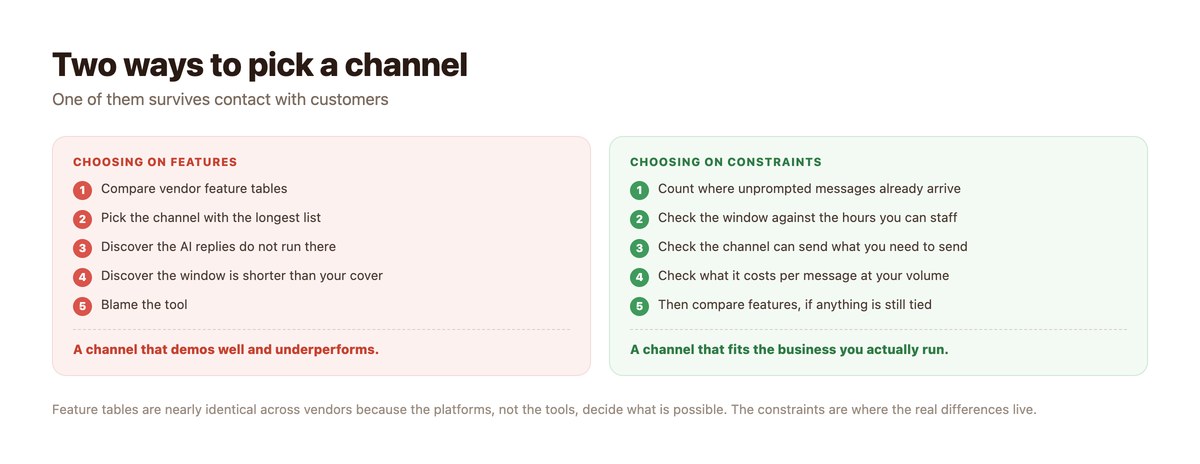
Feature comparisons between messaging channels are close to useless, because the features are not set by the tools. The platforms decide what is possible, every vendor is working inside the same limits, and the tables end up looking identical.
What actually differs is the constraints: how long you have to reply, what the channel will let you send, and whether your customers are there in the first place. Those three decide the fit, and two of them you can check this afternoon without buying anything.
Below is each of the six channels on those terms. How many to run at once is a different question, answered in omnichannel messaging strategy – the short version is fewer than you think.
Key takeaways
- Choose on constraints, not features. The platforms set the features, so every vendor’s table looks the same.
- WhatsApp has the highest intent and sends catalogue products – but AI replies are not available there.
- Instagram’s comment-to-DM is the strongest entry point of any channel, and the 7-day private reply window is its underrated advantage.
- TikTok gives volume at lower intent, allows 48 hours and a maximum of ten consecutive messages, and cannot send product cards.
- Telegram and Discord have no platform reply window, which is a real advantage where your audience is already on them.
- LinkedIn cannot be automated for DMs – comment triggers only – and its User Agreement restricts automated activity.
- The best first check is free: count where unprompted messages already arrive.
The Three Questions
In this order. Most shortlists are settled by the first.
Where Do Messages Already Arrive?
Count a month of unprompted inbound by channel – not campaign replies, which measure the campaign rather than the channel. The distribution is usually lopsided and frequently contradicts whichever channel the team is most attached to.
This is the strongest signal available and it costs nothing, because the data is already sitting in your inboxes.
Does the Window Fit Your Cover?
Meta channels give you 24 hours from the customer’s last message, resetting every time they write again. A private reply to a public comment gives you seven days, which is a materially different operating position. TikTok gives 48 hours and caps you at ten consecutive messages. Telegram and Discord impose no equivalent restriction.
If you cannot reliably be at a keyboard inside a channel’s window, that channel needs automation covering the gap before it is worth opening – the models are in covering DMs after hours.
Can It Send What You Need to Send?
This is where the real differences sit and where most disappointment comes from. A store that wants to send products has a different shortlist from a service business booking calls, and the gaps are not where people assume.
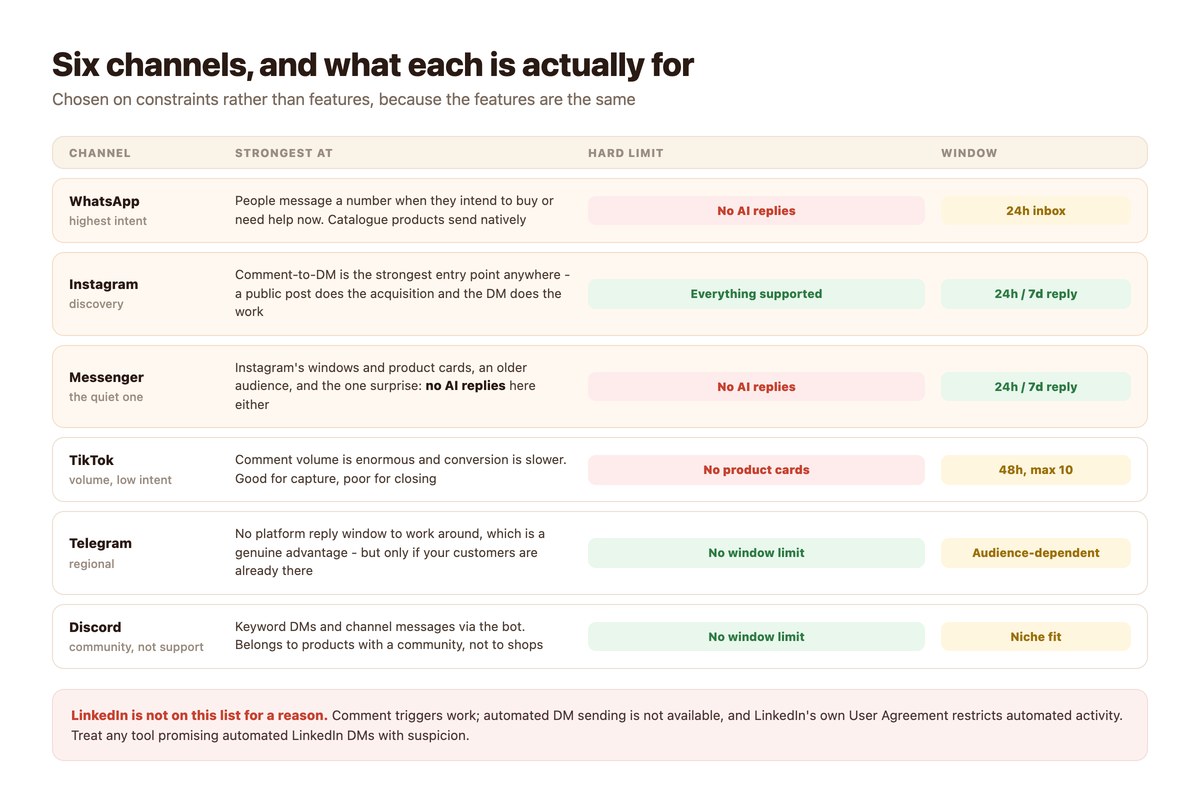
The grid below is the short version: check it before committing, not after building.
Channel by Channel
The honest version of each, including the part that is usually left out.
WhatsApp — Intent, Minus the AI
People message a phone number when they mean it. Intent on WhatsApp is higher than anywhere else on this list, catalogue products send natively, and the identity is a phone number, which makes it the easiest channel to match against your own records.
The limitation that catches people out: AI replies do not run on WhatsApp. Keyword flows, catalogue sends and webhooks all work; the generative layer does not. Build the flows accordingly rather than planning around an AI step that will never fire.
Instagram — The Entry Point
Comment-to-DM is the single strongest acquisition mechanic in messaging: a public post does the reach, a comment signals interest, and the conversation moves into a private thread where you can actually do something.
The underrated part is the seven-day private reply window. Replying to a comment privately buys you a week rather than a day, which changes what is possible for a business that cannot staff evenings.
Messenger — Worth Enabling Alongside
Mechanically close to Instagram – the same 24-hour inbox window, the same seven-day private reply, the same product cards – generally reaching an older audience. It is rarely the channel somebody chooses first and frequently worth switching on next to Instagram, because the incremental cost is close to zero once the flows exist.
One difference that surprises people: AI replies do not run on Messenger, just as they do not on WhatsApp. Keyword flows, comment-to-DM, webhooks and product cards all work; the generative layer does not.
TikTok — Volume, Patience Required
Comment volume dwarfs the other channels and intent is lower, so TikTok is strong for capture and weak for closing. Forty-eight hours is generous; the cap of ten consecutive messages without a reply is the real constraint and it rules out drip-style sequences.
Product cards do not send on TikTok, which means an e-commerce flow built on Instagram does not transfer – see e-commerce DM automation for what that flow depends on.
Telegram and Discord — No Clock
Neither imposes a platform reply window, which removes the single biggest operational constraint in this article. That is a genuine advantage and it only matters if your audience is already there – which is regional for Telegram and community-shaped for Discord.
Discord in particular belongs to products with a community rather than to shops. Keyword DMs and channel messages work through the bot; the fit question is whether your customers live there at all.
LinkedIn — Say This Plainly
Comment triggers work. Automated DM sending is not available, and LinkedIn’s User Agreement restricts automated activity generally.
Any tool that promises automated LinkedIn DMs is either describing something against the platform’s terms or describing something it cannot do. Plan LinkedIn as a place to catch comments and move the conversation elsewhere.
Shortlist by Business Type
A starting point rather than a rule. Your inbound counts override this.
| If you are | Start with | Add next | Skip |
|---|---|---|---|
| An online store | WhatsApp for catalogue + intent | TikTok for selling | |
| A local service | Instagram for discovery | Discord | |
| A coach or consultant | WhatsApp for booked clients | TikTok | |
| A SaaS product | Instagram or Messenger | Discord if you have a community | |
| A restaurant or salon | WhatsApp for confirmations | Telegram |
Whichever two you land on, the operating model is the same once more than one person answers: one queue and named owners, as in the unified social inbox.
Making the Decision
An afternoon, and most of it is counting rather than evaluating.
- Export a month of inbound per channel. Unprompted messages only. This usually settles the shortlist on its own.
- Write down the hours you can genuinely cover. Honestly. A channel you cannot staff inside its window needs automation first.
- List what you need to send. Products, bookings, files, links. Check each against the grid above before you build.
- Estimate volume and cost at that volume. The per-channel meters differ – the numbers are in the pricing comparison.
- Pick two. Write down why. The written reason is what makes the quarterly review possible.
- Set a review date. Ninety days, booked before you open anything.
Doing It With DMpro
What is supported where, stated once.
Six Channels, One Builder
DMpro connects Instagram, TikTok, WhatsApp, Messenger, Telegram and Discord, with the same visual builder behind all of them – triggers, conditions, delays, branches, product cards, webhooks and AI responses.
Which means a flow designed once is mostly portable, and the exceptions are the ones named above rather than arbitrary.
The Exceptions, Again
AI responses run on Instagram, TikTok, Telegram and Discord – not on WhatsApp and not on Messenger. Product cards do not send on TikTok. LinkedIn is comment-trigger only with no DM sending and is disabled by default.
These are platform limits rather than product gaps, which is why no vendor can offer you a way around them.
Try Before Committing
Connecting a channel and watching a week of real inbound is a better evaluation than any comparison table, including this one. The counts tell you what the feature lists cannot.
Pick on Constraints. Check in a Week.
The feature tables all look the same because the platforms set the features. What differs is the window you have to reply, what the channel will send, and whether your customers are there – and the last one is already measurable in your inbox.
DMpro connects all six, puts them in one queue, and uses the same builder across them, so choosing wrong costs you a week rather than a quarter.
Conclusion
Choose on constraints. The reply window decides what staffing you need, the capability list decides whether your flow will even run, and your existing inbound decides whether anybody is there to talk to. Features come last because they are mostly identical.
For most businesses the answer is Instagram plus one other – WhatsApp where intent and catalogue matter, Messenger where the audience skews older, TikTok only if you accept it as capture rather than closing. Telegram and Discord are excellent where your people already are and pointless where they are not.
And treat LinkedIn honestly: comments yes, automated DMs no. That is a platform rule, not a tooling gap, and nobody can sell you around it.
Frequently asked questions
Which messaging channel is best for business?
There is no single answer – it depends on where your customers already message you, what hours you can cover against each channel’s reply window, and whether the channel can send what you need. For most businesses it is Instagram plus one other.
Does WhatsApp support AI replies?
No. Keyword flows, catalogue product sends and webhooks all work on WhatsApp, but AI responses are not available there. They do run on Instagram, TikTok, Telegram and Discord – but not on Messenger either.
How long do I have to reply on each channel?
Meta inboxes give 24 hours from the customer’s last message, resetting each time they write. A private reply to a public comment gives seven days. TikTok gives 48 hours with a maximum of ten consecutive messages. Telegram and Discord have no equivalent restriction.
Can I automate LinkedIn DMs?
No. Comment triggers work, but automated DM sending is not available and LinkedIn’s User Agreement restricts automated activity. Any tool promising automated LinkedIn DMs should be treated with suspicion.
Is TikTok good for selling in DMs?
It is better for capture than for closing. Comment volume is high and intent is lower, product cards cannot be sent there, and you are capped at ten consecutive messages without a reply.
Should I add Messenger if I already have Instagram?
Usually yes. The mechanics, windows and capabilities are the same, the audience often skews older, and the incremental work is small once the Instagram flows exist.