
Almost everything written about omnichannel messaging is an argument for being on more channels. It is written by people who sell channels, and it is not wrong so much as incomplete: it describes the benefit and never prices the obligation.
An open channel is a promise that you answer there. That promise is paid monthly, in attention rather than money, and it is the reason most multi-channel setups are worse than the single-channel setup they replaced. The common failure is not a missing channel – it is four channels and no one accountable for any of them.
So this page is mostly about subtraction: what a channel genuinely costs, how to choose the small number worth having, and how to close one properly. Which specific channel suits which business is a separate decision, laid out in choosing a messaging channel.
Key takeaways
- A channel costs an expectation, not a subscription. The invoice is the smallest part of what you are committing to.
- Two channels answered properly beat four answered eventually. Attention is the scarce resource, not seats.
- Pick channels on where your customers already message you, not on where your competitors have a logo.
- What you build does not port cleanly – AI replies run only on Instagram, TikTok, Telegram and Discord, and product cards do not send on TikTok.
- Set a review date before you open a channel. It is what makes the decision reversible.
- Closing a channel with a notice that points somewhere you do answer is better service than leaving it open and silent.
- A channel nobody checks is worse than one you never opened, because it has already made a promise.
What You Are Actually Committing To
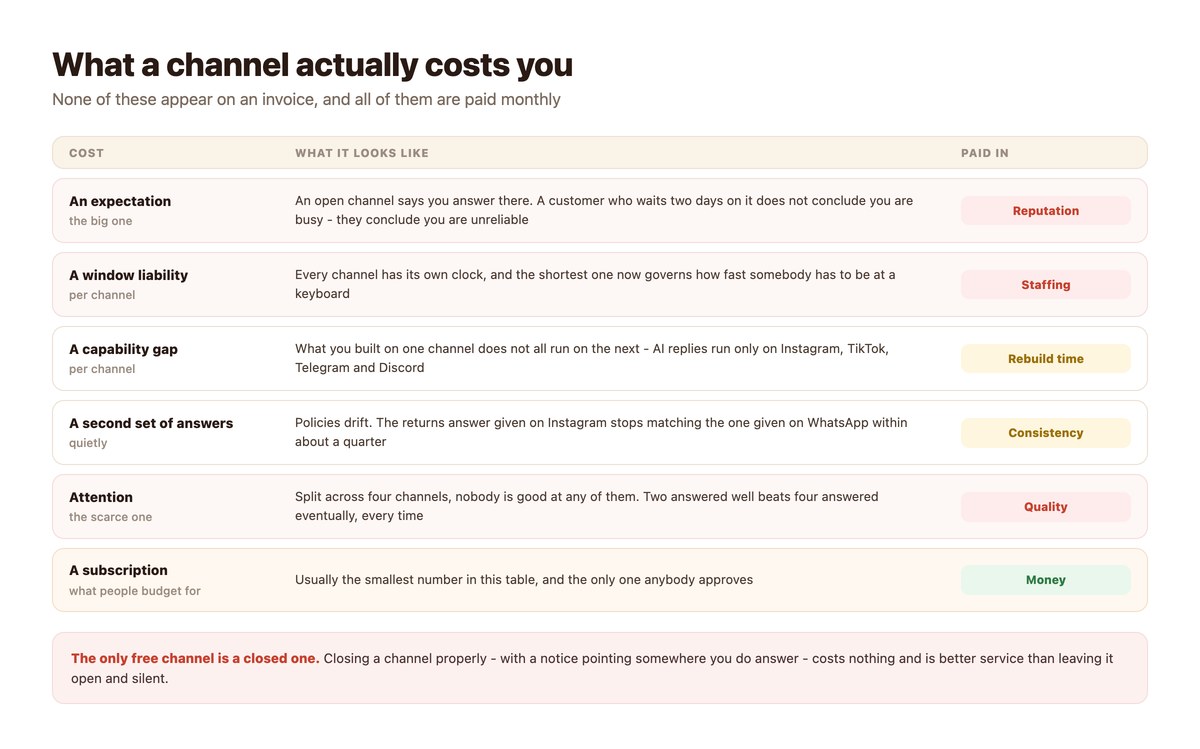
Six costs. One of them is money.
An Expectation, Permanently
This is the whole thing. A channel with your name on it says, without anybody writing it down, that messages sent there get answered. Customers do not distinguish between the channel you take seriously and the one somebody opened in 2023 – they distinguish between businesses that reply and businesses that do not.
A two-day silence is read as unreliability rather than as busyness, and it is read that way on the channel you care least about just as much as on the one you care most about.
The Clock You Inherit
Each channel brings its own reply window, and the shortest one effectively governs your staffing. You cannot average them. If one channel gives you 24 hours from the customer’s last message and another gives you 48, your coverage has to satisfy the 24 – and that is a rota decision, not a software one.
This is where a lot of multi-channel plans quietly fall over: the channel was free, the cover it requires was not.
The Rebuild
Automations do not port cleanly, and the gaps are not where people guess. AI replies run on Instagram, Messenger, TikTok, Telegram and Discord – and not on WhatsApp. Product cards send on WhatsApp and Instagram – and not on TikTok. LinkedIn offers comment triggers and no DM sending at all.
So “we will just turn it on over there too” is usually a week of work and sometimes an impossibility. Check before you commit, not after.
Two Sets of Answers
Policies drift the moment they live in two places. Within a quarter the returns answer given on Instagram no longer matches the one given on WhatsApp, because somebody improved one and not the other.
This is fixable – one set of rules applied everywhere is exactly what the unified social inbox is for – but it is work that scales with channel count and it does not do itself.
Choosing the Short List
Three questions, in this order. Most businesses end up with two channels.
Where Do People Already Message You?
Not where you have an account – where unprompted messages arrive today. That number is already in your inboxes and it is the single most reliable signal you have, because it reflects what customers actually do rather than what a survey says they would prefer.
Count a month. The distribution is usually more lopsided than anybody expects, and it frequently contradicts the channel the marketing team is most attached to.
Which One Can You Staff?
A channel you can cover during the hours customers use it is worth more than a channel with better features that goes quiet at five. If the honest answer is that you can cover one channel properly, the strategy is one channel and an automated, honest holding answer on the rest – the models for which are in after-hours coverage.
What Do You Need It to Do?
A store that sends product cards has a different shortlist from a service business that books calls. The capability differences are real and they are the reason the shortlist cannot be copied from someone else’s blog post.
The per-channel grid is in which channel to choose, which is the page to read with this one.
Closing One Properly
The skill nobody writes about, and the one that improves service fastest.
Silence Is the Bad Option
There is a version of closing a channel that is strictly worse than keeping it: leaving it open, unanswered and unlabelled. The promise is still being made and no longer kept.
Closing properly means an automated message that says where to reach you, a profile bio that says the same, and – where the platform allows it – the account turned off rather than left dormant.
Say Where Instead
“We do not monitor messages here – reach us on WhatsApp and we answer within a few hours” is a good customer experience. It is more honest than most open channels manage, and it redirects rather than refuses.
Set it as the automatic first reply so it goes out instantly, and check it once a quarter so it does not outlive the channel it points at.
Expect It to Feel Like Retreat
It will be argued against internally on the grounds that closing a channel looks like decline. It does not look like anything to customers, who were not being answered there anyway.
What is visible to them is the channel you do answer getting faster, which is the whole point of the subtraction.
Three Honest Shapes
Most businesses are one of these. Pick the row you are actually in.
| Shape | Looks like | Right move |
|---|---|---|
| One person, one channel | Owner answers everything, usually on a phone | Stay there. Automate the repeat questions, add nothing |
| One person, several channels | Everything open, one of them neglected | Close the neglected one with a redirect. Keep two |
| Small team, several channels | Coverage gaps and duplicate replies | Unify the queue, name owners, then review channel by channel |
| Multi-brand or multi-location | Several accounts per channel | A different problem – see managing multiple accounts |
If you are in the last row, the constraint is account structure rather than channel count – that is managing multiple social accounts.
Doing the Review
Half a day, once a quarter. It is mostly counting.
- Count a month of inbound by channel. Unprompted messages only. Exclude anything you drove with a campaign, because that measures the campaign.
- Write down who answers each one, by name. If a channel has no name against it, you have found the one to close.
- Check your median reply time per channel. One of them is embarrassing. That is the finding, not a failure.
- Decide: keep, fix, or close. Three options only. ‘Keep an eye on it’ is how a neglected channel survives another quarter.
- Close with a redirect, not with silence. An automatic first reply pointing at a channel you do answer.
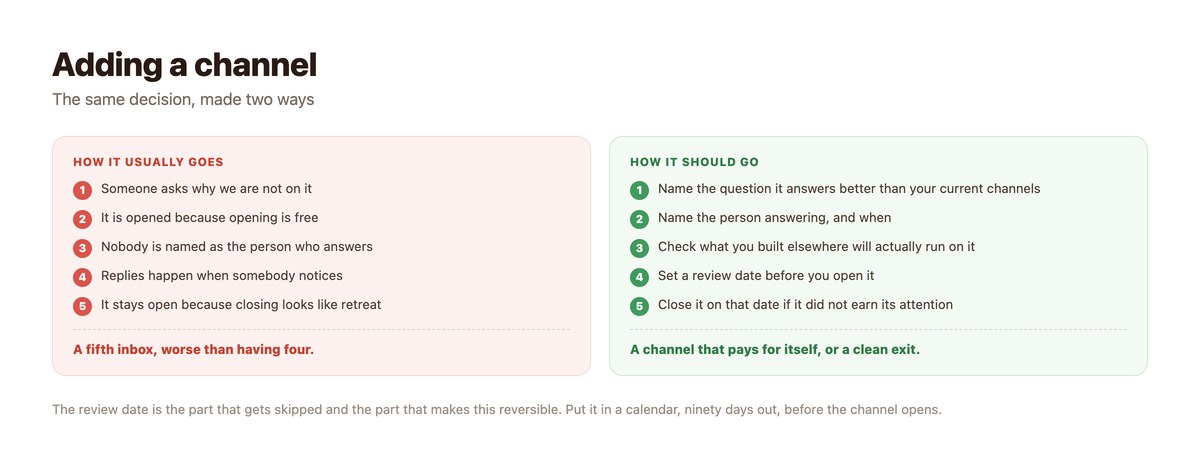
- Book the next review before you finish. Ninety days. The discipline is the strategy.
Doing It With DMpro
Where the tooling helps, and where it is still your decision.
Count Before You Decide
DMpro brings Instagram, TikTok, WhatsApp, Messenger, Telegram and Discord into one Conversations view, which is what makes the counting exercise above a five-minute job rather than a week of exports.
Seeing a month of inbound side by side is usually enough on its own to settle an argument about which channels matter.
Close a Channel Without Abandoning It
A keyword-matched or catch-all flow can send your redirect message instantly on the channel you are stepping back from, so the promise is replaced with an accurate one rather than broken.
That is the cheapest service improvement in this whole article.
What It Will Not Decide For You
Which channels to keep. That is a staffing judgement, and no tool has the information – it depends on who is available, during which hours, and how fast you intend to be.
Fewer Channels, Answered Properly
Most businesses do not have a channel problem. They have four channels, one of which nobody has opened this week, and no agreement about who answers what.
DMpro puts every channel in one queue so you can see which ones earn their attention – and lets you close the rest with an honest redirect instead of silence.
Conclusion
Omnichannel is sold as addition and works as subtraction. The constraint is attention, and attention does not scale with the number of accounts you open – it divides.
Count where people actually message you, keep what you can staff during the hours customers use it, and be honest about the rest. Two channels answered quickly is a better experience than four answered eventually, and it is a far better experience than one channel sitting open and unread.
And set the review date before you open anything. A channel with a review date is an experiment; a channel without one is a permanent obligation nobody agreed to.
Frequently asked questions
What is an omnichannel messaging strategy?
A decision about which messaging channels you will answer, who answers them and how fast – not a decision to be present on all of them. In practice it is mostly about which channels to close.
How many channels should a small business be on?
Usually two, answered properly. Attention divides rather than scales, so two channels with fast replies beat four with slow ones, and one channel done well beats two done badly.
What does a messaging channel really cost?
An expectation that you answer there, a reply window that affects your staffing, a rebuild of automations that do not all port, and a second set of policies to keep in sync. The subscription is usually the smallest cost.
Is it bad to close a social channel?
No – leaving it open and unanswered is worse. Close it with an automatic message pointing to a channel you do answer, and update the bio to match.
How do I pick which channels to keep?
Count a month of unprompted inbound messages by channel, check which you can staff during the hours customers use them, and confirm the channel supports what you need it to do. The counts usually settle it.
Do automations work the same on every channel?
No. AI replies run only on Instagram, TikTok, Telegram and Discord, product cards are not available on TikTok, and LinkedIn has comment triggers with no DM sending, so adding a channel often means rebuilding rather than switching on.