
Every unified social inbox promises the same thing: all your messages in one place. That promise is real and it is narrower than it sounds, and the gap between the two is where most disappointment with these products lives.
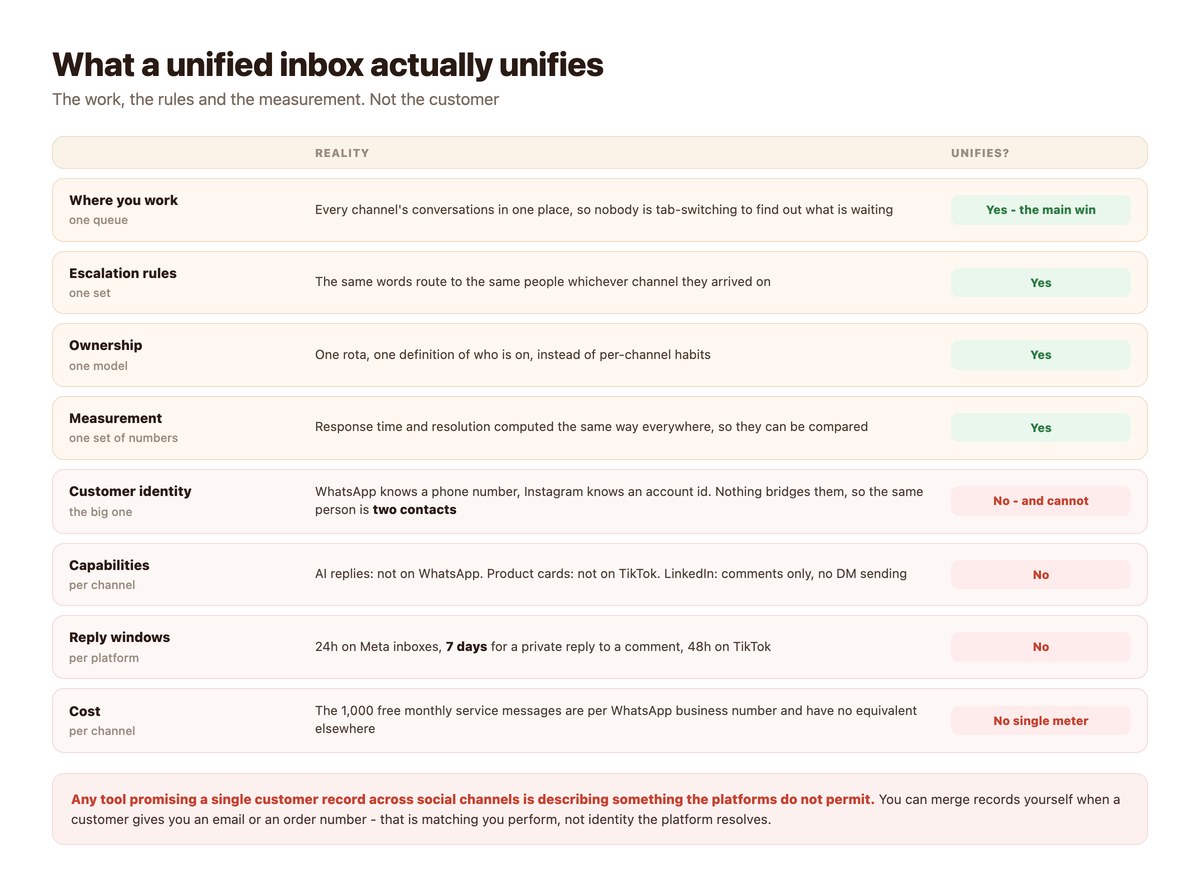
A unified inbox unifies the work. One queue, one set of escalation rules, one ownership model, one way of measuring. What it does not unify – what nothing can – is the customer, because the platforms do not expose an identity that crosses between them. The same person messaging you on WhatsApp and Instagram is two contacts, and will stay two contacts.
This covers exactly what merges, what refuses to, when you actually need one, and what to do about the parts that cannot be unified.
Key takeaways
- A unified inbox unifies the work, not the customer. WhatsApp knows a phone number, Instagram knows an account id, and nothing bridges them.
- What genuinely unifies: the queue, the escalation rules, the ownership model and the measurement. That is enough to be worth it.
- Capabilities do not unify – AI replies run only on Instagram, TikTok, Telegram and Discord, product cards are not available on TikTok, LinkedIn has no DM sending at all.
- Reply windows differ: 24 hours on Meta inboxes, 7 days for a private reply to a comment, 48 hours on TikTok.
- Cost does not unify either – the free monthly service allowance is per WhatsApp business number with no equivalent elsewhere.
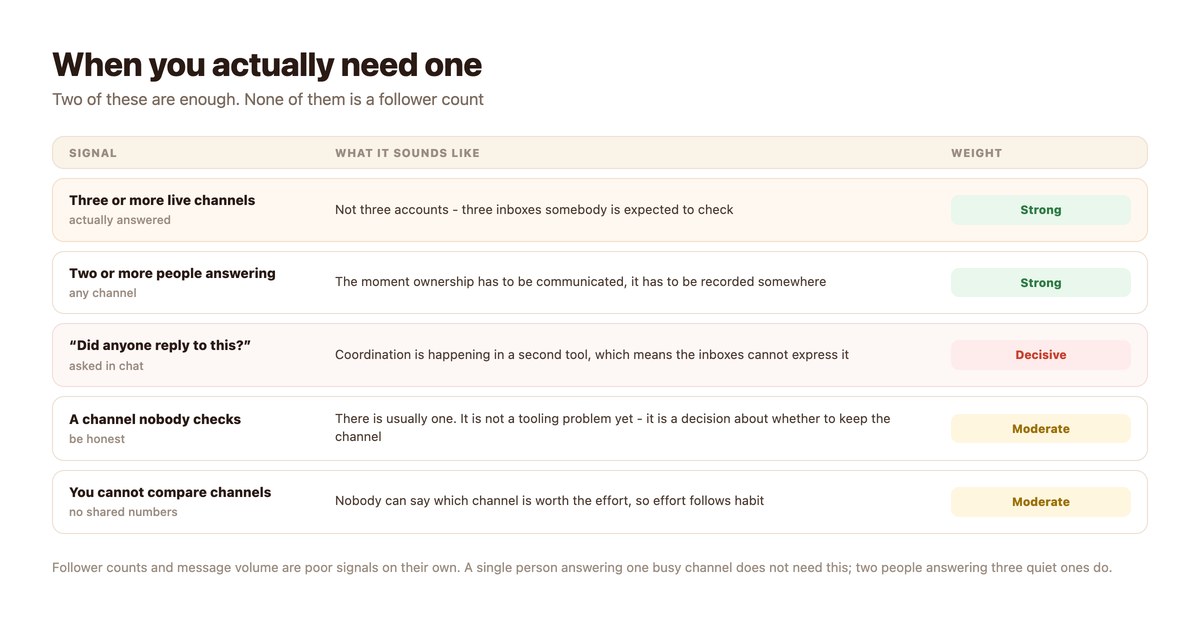
- The decisive signal is coordination happening in a second tool: “did anyone reply to this?” asked in a group chat.
- You can match customers yourself using an email or order number. That is matching you perform, not identity the platform resolves.
What Genuinely Merges
Four things, and they are worth more than the marketing suggests.
One Queue
The obvious one, and the largest practical gain. Not because switching tabs is hard, but because what is waiting in a tab nobody opened is invisible – and every multi-channel business has one channel that quietly goes unanswered for days.
A single queue makes neglect visible, which is most of what fixes it.
One Set of Rules
The word refund should route to the same person whether it arrived on Instagram or WhatsApp. Without unification each channel develops its own habits, usually shaped by whoever happens to watch it, and the customer experience varies by the channel they picked.
Writing the rules once and applying them everywhere is a quieter benefit than the single queue and arguably a bigger one – see how escalation rules get written.
One Ownership Model
A rota that covers all channels, rather than an implicit arrangement where one person watches Instagram because they always have. The ownership question is the same one that decides shared inbox versus helpdesk, and unification is what makes a single answer possible.
One Set of Numbers
Response time computed the same way everywhere is what finally lets you compare channels – and the comparison is usually surprising. Most businesses discover they are slowest on the channel they consider most important.
Without a shared definition, per-channel numbers are not comparable and effort follows habit rather than evidence.
The Identity Problem
The part vendors are vague about, and the part worth understanding before you buy anything.
Two Contacts, One Human
WhatsApp identifies a person by phone number. Instagram identifies them by an account id. Messenger, Telegram and TikTok each have their own. None of these is exposed to anybody else, and there is no lookup that connects them.
So a customer who asks about an order on Instagram and follows up on WhatsApp appears as two separate conversations with two separate histories, in every tool, including this one. An inbox can put those conversations next to each other; it cannot know they are the same person.
What You Can Do Instead
Match on something the customer gives you. An order number, an email address, a booking reference – any of those lets you join the records yourself, and a webhook lookup can pull the matching history into the conversation.
That is matching you perform, deliberately, on data you were given. It is not the platform resolving identity, and it only works where the customer volunteers the key.
Design Around It
Practically: ask for the order number early in support flows, because it is the join key as well as the lookup key. And do not promise customers that you will remember a conversation they had on a different channel, because you will not reliably.
The order-status pattern in the order-status lookup is the same mechanism doing double duty.
Three More Things That Do Not Unify
Each one surprises somebody during implementation.
Capabilities
AI replies work on Instagram, TikTok, Telegram and Discord, and not on WhatsApp or Messenger. Product cards work on WhatsApp, and not on TikTok. LinkedIn offers comment triggers and no DM sending at all. Rich sends – locations, contact cards, stickers, invoices – differ channel by channel.
A flow built once therefore does not behave identically everywhere, and a unified inbox does not change that. What it changes is that you can see it happening in one place.
Windows
Twenty-four hours from the customer’s last message on Meta inboxes, resetting each time they write. Seven days for a private reply to a public comment. Forty-eight hours on TikTok, with a cap of ten consecutive outbound messages.
Which means “reply within 24 hours” is not a single policy you can apply across the inbox – it is the strictest common denominator, and treating it as universal wastes the seven-day window where you have it.
Cost
There is no single meter. WhatsApp’s thousand free monthly service messages are per business phone number and have no equivalent on the other channels, which have their own arrangements.
So a per-conversation cost across a unified inbox is an average of unlike things. Model each channel separately – the method is in the cost arithmetic.
What Survives Unification, by Channel
Worth having on a wall during implementation, because every one of these catches somebody out.
| Channel | AI replies | Product cards | Window |
|---|---|---|---|
| No | Yes, from your catalogue | 24h inbox | |
| Yes | Yes | 24h inbox / 7d private reply | |
| Messenger | No | Yes | 24h inbox / 7d private reply |
| TikTok | Yes | No | 48h, max 10 consecutive |
| Telegram | Yes | Via menus | No equivalent restriction |
| n/a | No | Comment triggers only, no DM sending |
Which channel to put effort into, given all that, is its own decision – choosing a messaging channel goes through it.
Setting One Up Properly
A week, and most of it is decisions rather than configuration.
- List the channels somebody is actually expected to answer. Not accounts you own – inboxes with an expectation attached. There is usually one you should close rather than unify.
- Write one set of escalation rules. Channel-agnostic, with named owners. This is the real work and it is worth more than the tooling.
- Agree one ownership rota. One person on, per day, across all channels – not per channel.
- Define the metrics once. Time to first useful reply, resolution, repeat contacts. Same definitions everywhere or the comparison is meaningless.
- Accept the identity limit and design for it. Ask for an order number or email early in support flows so you can match when it matters.
- Keep a per-channel capability note. AI only on Instagram, TikTok, Telegram and Discord; no product cards on TikTok; LinkedIn comments only. People will forget and build flows that silently do nothing.
Doing It With DMpro
What is actually provided, and where the limits sit.
One Conversations Inbox
DMpro brings threads from Instagram, TikTok, WhatsApp, Messenger, Telegram and Discord into a single Conversations view, grouped by the person on each platform, with manual replies, saved templates and real-time updates.
Team seats make the workspace multi-user with invites and seat management, which is the ownership half – the point at which escalations can go to a named person rather than a pile.
Grouped by Platform Identity
Worth stating plainly because it is the subject of this page: conversations are grouped by the recipient on that platform. There is no cross-channel person record, here or anywhere, because the platforms do not provide one.
A webhook can pull your own customer data into a conversation when the person gives you a key, which is the practical substitute.
And the Channel Differences Remain
Unifying the inbox does not unify the platforms. AI replies still will not run on WhatsApp or Messenger, product cards still will not send on TikTok, LinkedIn still has no DM sending. The inbox shows you one queue; the rules underneath stay per-channel.
The Rest of This Guide
Ten pages on the pieces. Start with whichever decision is in front of you.
- Omnichannel messaging strategy — deciding which channels to be on at all
- Choosing a messaging channel — the decision table across all six
- Managing multiple accounts — several brands or locations in one workspace
- A social media team inbox — what changes when more than one person answers
- Assigning conversations — ownership, rotas and the collision problem
- Social inbox integrations — webhooks, CRMs and getting data out
- CRM for social DMs — treating conversations as records, within the identity limit
- Migrating from ManyChat — how to move without two weeks of worse service
- DM automation pricing compared — what the per-channel meters actually cost
- DM automation glossary — the windows, the message types and the words vendors use loosely
One Queue, One Rota, One Set of Numbers
Most multi-channel businesses have one inbox nobody opens and no way to say who is answering what. That is not a volume problem – it is a visibility problem.
DMpro brings every channel into one Conversations view, applies the same escalation rules whichever way a message arrived, and routes to named people through team seats.
Conclusion
A unified social inbox is worth having and it is worth being precise about. It unifies the queue, the rules, the ownership and the measurement – four real things that together fix the commonest multi-channel failure, which is a channel nobody opened.
It does not unify the customer. The platforms expose no shared identity, so the same person on two channels is two contacts in every tool on the market. Design around it: ask for an order number early, match on data the customer gives you, and never promise to remember a conversation from somewhere else.
And keep a note of what stays per-channel – capabilities, windows and cost. A flow built once does not behave identically everywhere, and the inbox that shows you one queue is still sitting on six different sets of rules.
Frequently asked questions
What is a unified social inbox?
One place to read and answer messages from several social channels, with one set of escalation rules, one ownership model and one way of measuring response. It unifies the work rather than the customer.
Can it show one customer record across channels?
No. WhatsApp identifies people by phone number and Instagram by an account id, and nothing bridges them, so the same human is two contacts in every tool. You can match them yourself when the customer gives you an order number or email.
Do automations work the same on every channel?
No. AI replies run only on Instagram, TikTok, Telegram and Discord, product cards are not available on TikTok, and LinkedIn offers comment triggers with no DM sending. A unified inbox shows one queue but the underlying rules stay per-channel.
Is the reply window the same everywhere?
No. Meta inboxes give 24 hours from the customer’s last message, a private reply to a public comment gives seven days, and TikTok gives 48 hours with a cap of ten consecutive outbound messages.
When does a business need one?
When three or more channels are genuinely expected to be answered, or when two or more people answer and coordination has started happening in a group chat. Follower count and raw volume are poor signals.
Does unifying reduce the cost per conversation?
Not directly, and there is no single meter – WhatsApp’s free monthly service allowance is per business phone number with no equivalent elsewhere. Model each channel separately.