
A plumber, an electrician, a cleaner or a gardener gets the same two questions all day, and local business DM automation exists to answer them: do you cover my area, and do you do this kind of job. Both have fixed answers. Neither gets answered promptly, because the person who knows is on a job with their hands full.
That is the actual problem local business DM automation solves. Not sophistication – availability. The enquiry goes to three local businesses and whoever replies first usually gets the work, and “first” often means “this evening”.
The flow shape is standard – see DM automation by industry. Below are the two filters and the one thing that must skip them entirely.
Key takeaways
- Two filters answer most enquiries: do you cover the area, and do you do that job.
- Both have fixed answers, which makes this the easiest flow in the cluster to get value from.
- Emergencies must bypass the flow and route to a phone immediately.
- No price leaves the automation – a quote is a commitment, and trades get held to it.
- An honest no about area or job type saves a call and often earns a referral.
- The flow should end in a callback time, not a promise to get back to them.
The Emergency Route
First, because it overrides everything else in the article.
Somebody With a Leak Should Not Answer Questions
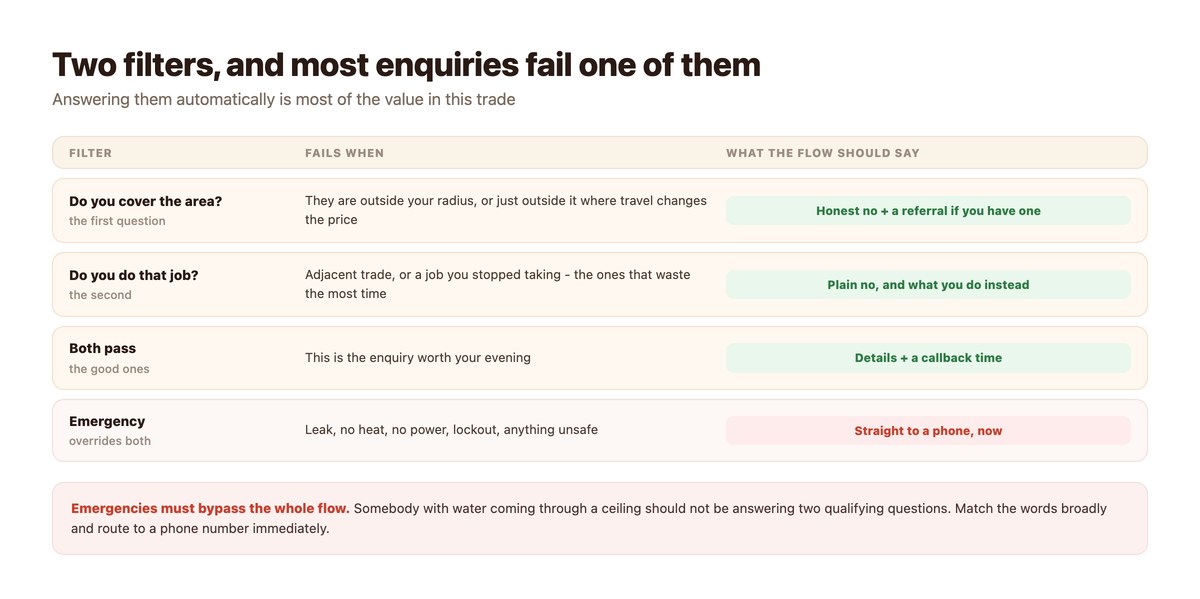
Water coming through a ceiling, no heating in February, no power, a lockout, a smell of gas. These are not enquiries to be qualified; they are people who need a phone number and a human voice.
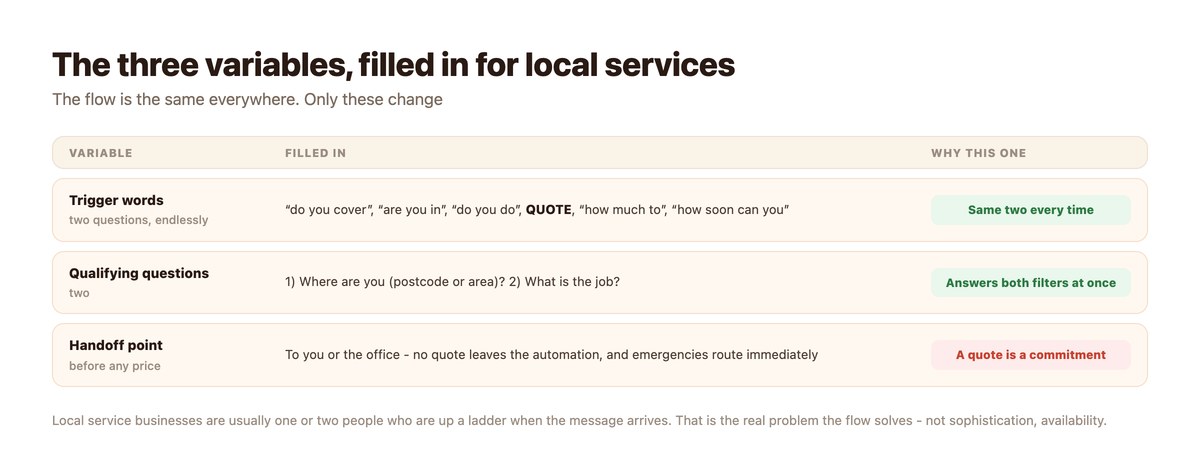
Match the words broadly – leak, flooding, no heat, no power, gas, smoke, locked out, emergency, urgent – and route before any other branch runs. Give the phone number directly in the message.
Say Clearly If You Do Not Do Emergencies
Plenty of trades do not, and that is fine. What is not fine is silence at eleven at night while somebody assumes help is coming.
If you do not, say so and point to who does. That one sentence is genuinely the difference between a bad night and a bad review.
The Two Filters
Between them they resolve most of what arrives.
Do You Cover the Area?
Ask for a postcode or offer your areas as buttons. It is the first thing the customer wants to know and the first thing you need, and getting it answered before anybody speaks saves a call for both sides.
Build in the edge case: the area just outside your normal radius where you will travel but the price changes. “We do cover that but there is a travel charge – still interested?” is better than a flat no and better than an awkward conversation later.
Do You Do That Job?
The one that wastes the most time when it goes unanswered, because adjacent trades sound close enough that customers reasonably guess. Offer your actual services as buttons and include “something else”.
A clear no here is valuable. “We do not do that, but X does and they are good” takes ten seconds and is remembered.
Then Take the Details
For the enquiries that pass both: what the job is, where, and when suits for a callback. The flow should end in a time – “I will call you between 6 and 7 this evening” – rather than “we will be in touch”.
A named time is what stops them ringing the next business on the list.
Never Quote
Short section, and it is the rule most often broken in this trade.
A Number Becomes a Promise
“Roughly two hundred” sent by an automation will be quoted back when the actual job turns out to need a day and new parts. Trades get held to numbers more literally than most businesses, and the dispute costs more than the job.
A band is acceptable – “most jobs like this are between X and Y, I will confirm when I see it” – because it is explicitly not a quote. A single figure never is.
Call-Out Fees Are Different
A fixed call-out charge is a published fact and should be in the flow. It manages expectations, filters out people who did not realise there was one, and prevents an argument on the doorstep.
What to Automate
Short list for a trade that does not need a long one.
| They ask | Automate? | Note |
|---|---|---|
| Do you cover my area? | Yes | Postcode or buttons, plus the travel edge case |
| Do you do X? | Yes | Your services, plus an honest no |
| What is the call-out fee? | Yes | A published fact |
| How soon can you come? | Partly | Your general availability, not a slot you cannot keep |
| How much for this job? | No – a band at most | A quote is a commitment |
| Emergency of any kind | No – a phone number, now | Bypass the whole flow |
If you do take bookings for routine work, connecting a calendar turns the flow into a filled diary – the booking integrations are listed in DM automation by industry.
Building It
Two hours. This is the simplest build in the cluster.
- Write the emergency keywords and the phone number. Before anything else. Broad matching, immediate route, no qualifying questions.
- List your areas as buttons, including the travel-charge edge. Or ask for a postcode if your patch is awkward to describe.
- List your actual services, plus ‘something else’. And write the honest no, with a referral where you have one.
- End in a callback time, not a promise. “I will call between 6 and 7”. A named time stops them ringing the next business.
- Put the call-out fee in, if you have one. It filters and it prevents a doorstep argument.
- Keep every price out except bands. You will be held to a number sent by a bot.
Where This Connects
Two things.
Evenings Are When It Arrives
People notice the broken thing after work, and the business is one person who is no longer working. That is the entire case for automating here – the coverage models are in the after-hours coverage models, and for this trade the stated-hours-plus-automated-answers model is almost always correct.
Knowing It Worked
One number: enquiries answered within an hour, before and after. In a trade where the first reply usually wins the job, that is the whole measurement – and it needs no attribution model, for the reasons in where the savings actually are.
Answer From the Ladder
“Do you cover Chorlton?” and “do you do boilers?” have fixed answers, and they arrive while you are on a job with your hands full. Whoever replies first usually gets the work.
DMpro answers both instantly, gives an honest no when it is not your area or your trade, takes the details when it is, and sends emergencies straight to your phone.
Conclusion
This is the simplest flow in the cluster and one of the most valuable, because the problem is not complexity – it is that the person who knows the answer is up a ladder when the message arrives.
Two filters do nearly all of it: do you cover the area, and do you do that job. Both have fixed answers, and an honest no on either one saves a call and sometimes earns a referral.
Build the emergency bypass first and keep every price out of the automation. Somebody with water coming through a ceiling should get a phone number, not two qualifying questions – and a number sent by a bot will be quoted back to you when the job turns out to be bigger.
Frequently asked questions
What should a local service DM flow ask?
Two things: where they are, and what the job is. Those are the two filters that resolve most enquiries, and both have fixed answers you already know.
How should emergencies be handled?
They must bypass the flow entirely and route to a phone number immediately. Match words like leak, flooding, no heat, no power, gas and locked out broadly, and never make somebody with water coming through a ceiling answer qualifying questions.
Should the bot give a price?
No. A single figure from an automation becomes a promise, and trades get held to numbers literally. A band with an explicit ‘I will confirm when I see it’ is acceptable; a call-out fee is a published fact and should be stated.
What if they are just outside my area?
Build that edge case in. ‘We do cover that but there is a travel charge – still interested?’ is better than a flat no and prevents an awkward conversation later.
Is it worth saying no automatically?
Yes. A clear ‘we do not do that, but X does and they are good’ takes ten seconds, saves a call for both sides, and is remembered – those referrals come back.
What should the flow end with?
A callback time, not a promise. ‘I will call between 6 and 7 this evening’ is what stops somebody ringing the next business on their list.