

Online course DM automation has to handle two things that nothing else in this cluster does. Enquiries are shaped by a deadline, which means the same question has a different right answer depending on the date, and a large share of them are asked on behalf of somebody else.
Both change how online course DM automation has to work. The first means the most valuable answer you give is usually about timing. The second means a question you might treat as an administrative detail – who is this for – is actually the fork that determines your obligations.
The flow shape is standard, see DM automation by industry. Below are the two questions and the branch most providers never build.
Key takeaways
- Ask early who the enquiry is for. A parent, an under-18 asking for themselves, and an adult learner are three different conversations.
- Any enquiry concerning a child should reach admissions, not a flow.
- The most valuable answer is usually about timing – the exact deadline, plainly.
- Build the after-the-deadline branch: say so, then offer the next intake and a reminder.
- Enquiries cluster at weekends and evenings, when parents have time.
- Eligibility, funding and special requirements are judgements, never automated.
Who Are You Actually Talking To
The question that determines everything else, and it has to be asked early.
Three Different Senders
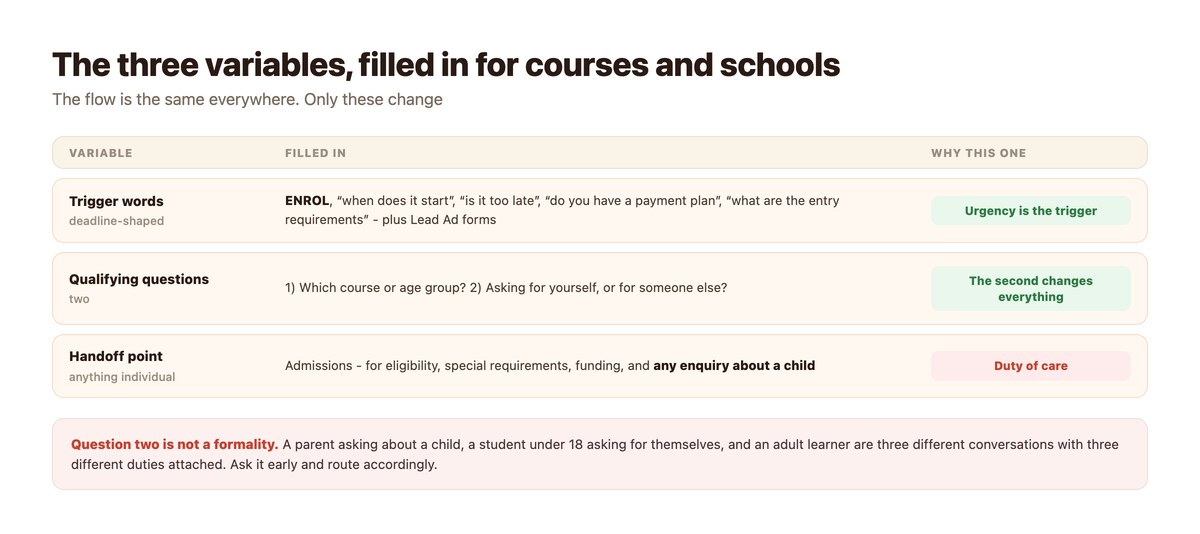
A parent enquiring about a child, a young person enquiring for themselves, and an adult learner. They ask similar questions and they need different handling – in tone, in what you may discuss, and in who should be replying.
Ask it as the second question, as buttons: “for yourself” or “for someone else”. It is unremarkable to the sender and it is the most important routing signal in the flow.
Anything About a Child Goes to a Person
Where the enquiry concerns a child – their suitability, their needs, their circumstances – it should reach admissions rather than be handled by an automation, regardless of how factual the question looks.
This is a duty-of-care position rather than a support one, and it is worth writing into the escalation rules explicitly rather than relying on the flow happening to route it.
Be Careful With Young Senders
If your intake includes under-18s, assume some enquiries come directly from them. Keep the automated layer to published facts – dates, subjects, how to apply – and route anything personal, financial or pastoral to a named person.
Nothing here should be collecting personal detail from a young person through a chat flow.
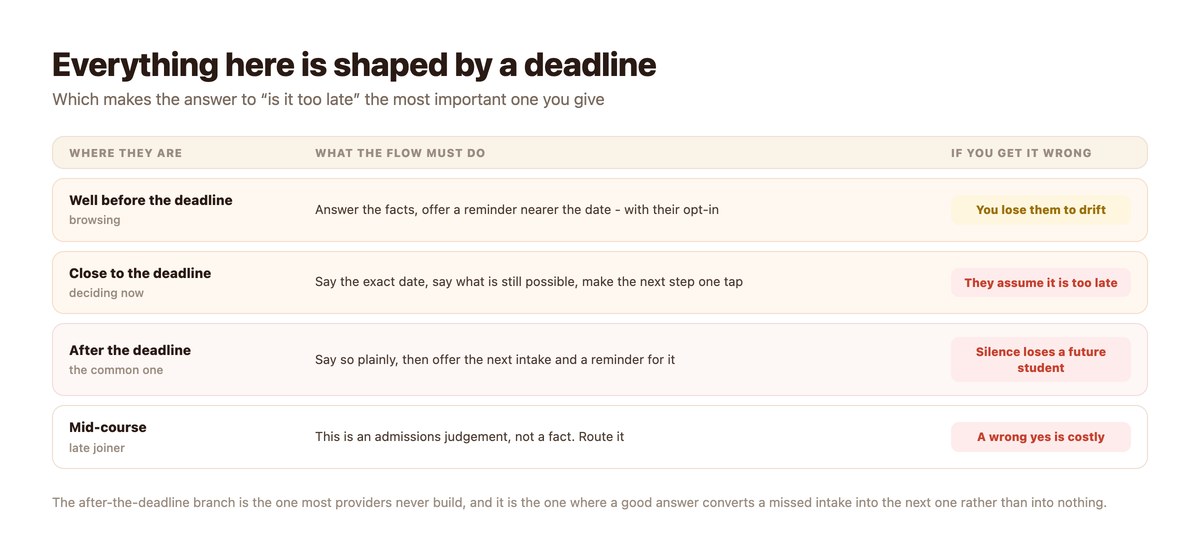
Everything Is Shaped by the Deadline
Which makes timing the content, not the context.
Say the Exact Date
“Applications close on the 14th” beats “applications are closing soon” by a wide margin, because the first lets somebody decide and the second asks them to come back and find out.
Put the real date in the flow and keep it current. It is the single most asked question in this vertical and the one most often stale on a website.
Build the After-the-Deadline Branch
Most providers never do, and it is where the easiest wins are. Someone asking the day after closing is interested, motivated and usually assumes they have missed out entirely.
Tell them plainly, then offer the next intake with a date, and offer a reminder nearer the time. That converts a missed intake into a future student rather than into nothing.
The Reminder Is Outbound
Messaging somebody weeks later because a deadline is approaching means contacting a person who is not currently in a conversation with you – an approved template plus their opt-in, taken when they asked to be reminded.
Set it up properly for the same reasons described in post-purchase messaging.
What to Automate
Facts yes, judgements no – and in this trade the judgements carry more weight than usual.
| They ask | Automate? | Why |
|---|---|---|
| When does it start / close? | Yes | A date, and the most common question |
| What does it cost? Payment plans? | Yes | Published, and asked constantly |
| What are the entry requirements? | Yes – list them | Published facts |
| Do I qualify with my grades? | No – admissions | A judgement about a person |
| Funding, bursaries, hardship | No – a person | Individual circumstances |
| Anything about a named child | No – admissions | Duty of care |
| Special educational needs | No – a person | Individual, and sensitive |
Writing them down with named owners is the subject of support escalation rules.
Building It
An afternoon, plus keeping the dates honest afterwards.
- Put the real dates in the flow. Start date, application deadline, next intake. Set a calendar reminder to update them, because stale dates here lose students.
- Ask who the enquiry is for, second. For yourself, or for someone else. Two buttons, and it routes everything after.
- Write the hard routes first. Anything about a child, eligibility, funding, special needs. Named owner in admissions.
- Build the after-the-deadline branch. Say it plainly, offer the next intake with its date, offer a reminder.
- Set up the reminder properly. Template plus opt-in taken at the moment they ask. Not an improvised follow-up.
- Cover weekends. Parents enquire when they are not working, which is exactly when admissions is shut.
Where This Connects
Two neighbours.
Weekends Are the Peak
Education enquiries cluster on Sunday evenings and school holidays, which is precisely when nobody is in. An honest holding message with a real time plus fully answered factual questions handles most of it – after-hours DM support.
Paid Intake Campaigns
If you run Lead Ads for an intake, wire the form submission as a trigger so the follow-up is immediate. The reasoning is the same as in estate agency, where lead decay is measured in hours.
Answer “Is It Too Late?” Before They Assume It Is
Education enquiries arrive on Sunday evenings, often from a parent, and almost always with a deadline in mind. The answer that matters most is a date.
DMpro gives the exact dates, costs and requirements instantly, offers the next intake when this one has closed, and routes anything about eligibility, funding or a child straight to admissions.
Conclusion
Two things make education different. Every answer is shaped by a deadline, so say exact dates rather than “soon”, and build the after-the-deadline branch that most providers skip – it turns a missed intake into the next one.
And a large share of enquiries are about somebody else. Ask early who the enquiry is for, and route anything concerning a child to admissions rather than handling it in a flow, however factual the question looks.
Everything else – dates, costs, requirements, how to apply – is published information asked at the weekend, and automating it is mostly putting your own facts where people are actually asking for them.
Frequently asked questions
What should an education DM flow ask?
Two things: which course or age group, and whether they are asking for themselves or someone else. The second is the important one – it determines tone, obligations and who should reply.
Should enquiries about children be automated?
No. Anything concerning a named child – suitability, needs, circumstances – should reach admissions rather than a flow, however factual the question appears. That is a duty-of-care position, not a service preference.
What is the most valuable thing to automate?
The exact dates. ‘Applications close on the 14th’ lets somebody decide; ‘closing soon’ asks them to come back and find out. It is the most asked question and the one most often stale on the website.
What should happen after the deadline passes?
Say so plainly, then offer the next intake with its date and a reminder nearer the time. Most providers never build this branch, and it converts a missed intake into a future student instead of nothing.
Can we send deadline reminders?
Yes, with an approved template and opt-in taken at the moment they ask to be reminded. It is an outbound message to somebody not currently in a conversation with you.
What must always go to admissions?
Eligibility judgements, funding and bursaries, special educational needs, and any enquiry about a specific child. Write those as hard keyword routes with a named owner before launch.