
Real estate Instagram DM enquiries arrive in the evening, from people comparing three listings at once, and they are worth more than almost any other lead a small business buys. The business that replies first very often gets the viewing.
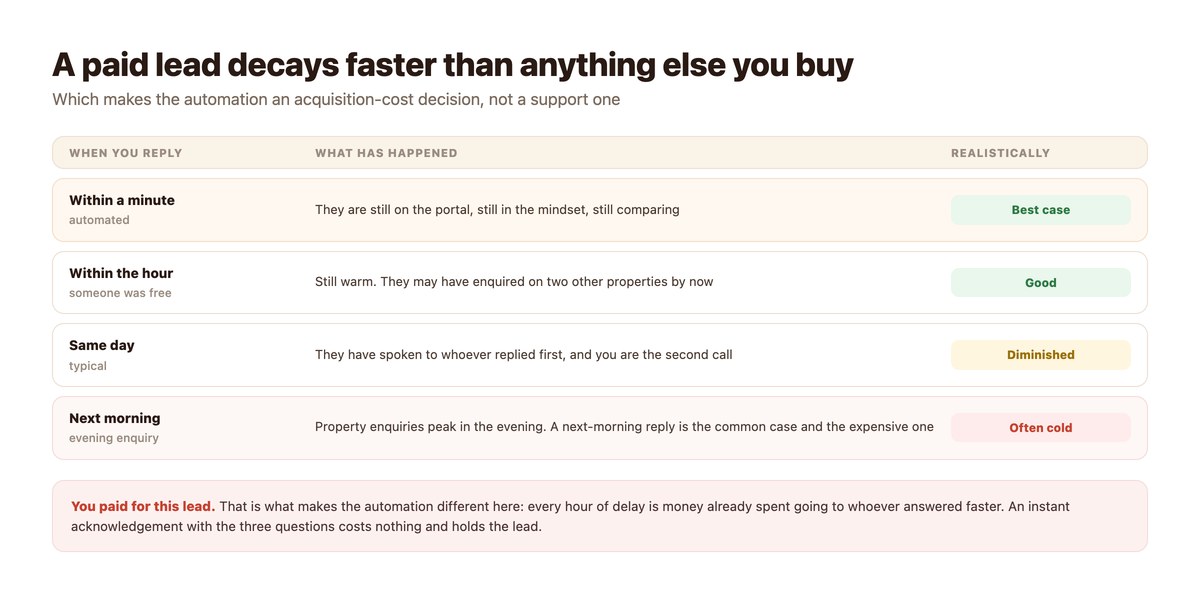
That makes real estate Instagram DM automation an acquisition-cost question rather than a support one. You have already paid for the lead; every hour it sits unanswered is that money going to whoever answered faster.
The flow shape is the standard one – see DM automation by industry. Below are the three variables for this trade, and the one thing a property flow must never do.
Key takeaways
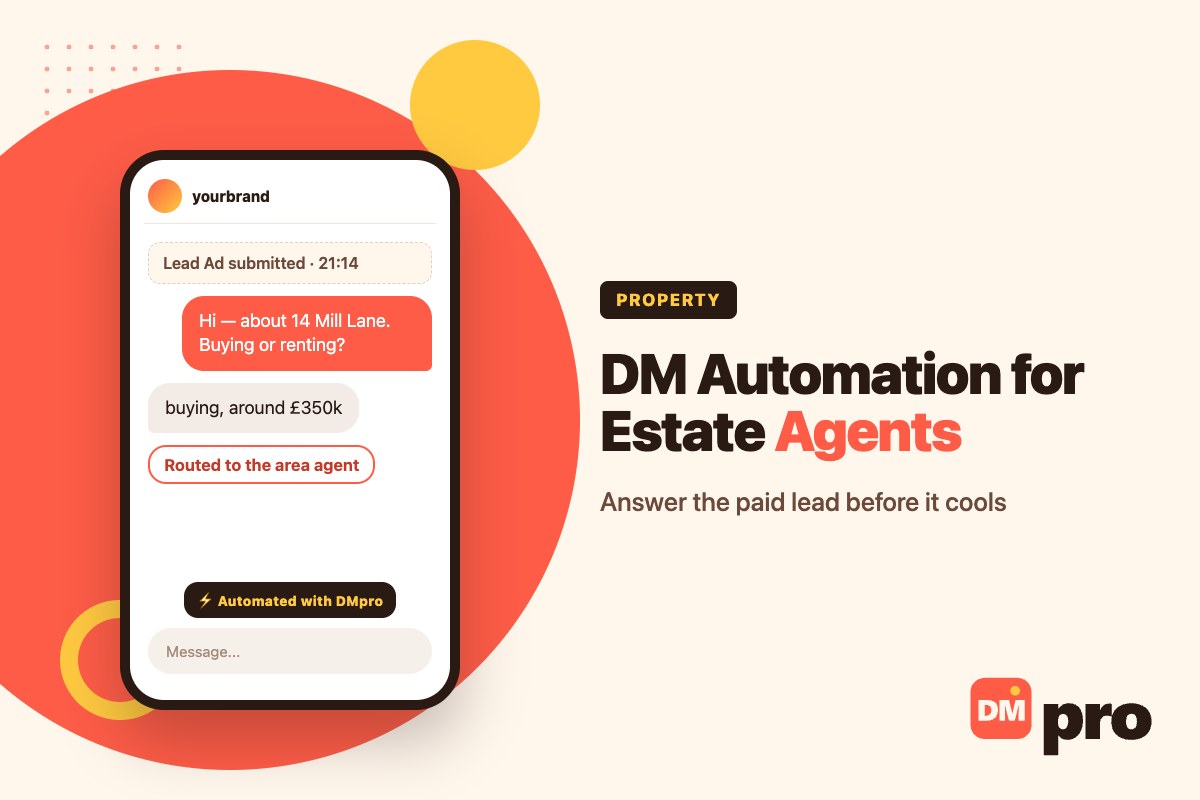
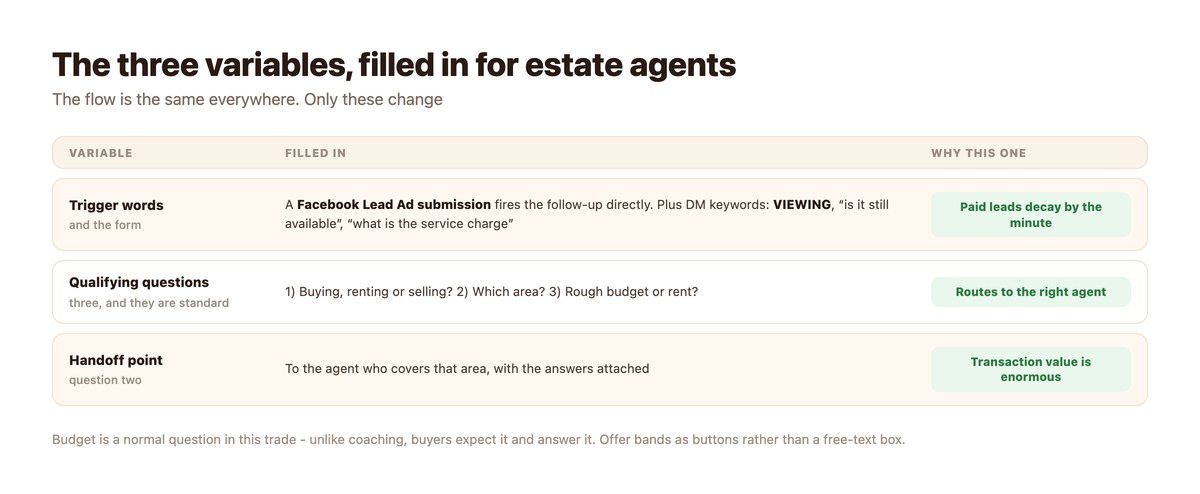
- A Facebook Lead Ad submission can trigger the follow-up directly, which closes the gap between form and first contact.
- Three questions are standard and expected here: buying/renting/selling, area, budget.
- Budget as buttons, not free text – bands get answered, open boxes get abandoned.
- Hand off by question two, to the agent who covers that area.
- Enquiries peak in the evening, so the out-of-hours version of this flow is the main one.
- Never let automation state anything about price history, valuation or legal status.
Why Speed Is the Whole Game Here
More than in any other vertical in this cluster.
The Lead Was Bought
Most property enquiries at the small-agency end come through paid social or a portal, which means a cost per lead that someone in the business can quote from memory. Unlike an organic DM, a slow reply here has a directly attributable price.
Framed that way the automation justifies itself on the first month’s media spend rather than on support hours, which is a much easier internal conversation.
They Enquired on Three Properties
Buyers and renters do not enquire once. They send the same message to everything that looks plausible within ten minutes, and the ordering of replies determines who gets the viewing.
An instant, specific acknowledgement – naming the property, asking the three questions – puts you first in a queue you did not know you were in.
And It Happens at Nine in the Evening
People look at property after work. Which means the out-of-hours version of this flow is not an edge case, it is the primary one, and a next-morning reply is the common failure.
The coverage models are in after-hours coverage; for this trade the automated-answer model is almost always correct.
The Three Questions
Unusually, all three are standard in this trade and nobody resents being asked.
Buying, Renting or Selling
The first fork, and it routes to completely different people and completely different follow-up. A seller enquiry arriving through a buyer-focused advert is common and valuable, and a flow that assumes everyone is a buyer loses it.
Three buttons. This one is never free text.
Which Area
Determines which agent takes over, which is the single most useful routing decision available in this business. Offer your patch as buttons and include an “elsewhere” option – because that answer is also information, and it should produce an honest no rather than a wasted call.
Rough Budget or Rent
Unlike coaching, where the budget question poisons the conversation, here it is expected. Buyers have a number in mind and answer it readily, as long as it is bands rather than an open box.
Three or four bands covering your stock. The person who taps the lowest band on a property well above it has told you something useful and kindly.
What to Automate and What to Route
The line is sharper here than in most trades, because of what the answers are worth legally.
| They ask | Automate? | Why |
|---|---|---|
| Is it still available? | Yes | A fact, and the most common question |
| Can I view it, and when? | Yes – offer real slots | Connect the calendar |
| Service charge, council tax band, EPC | Yes, if from your own data | Published facts |
| What will it go for? | No – route to an agent | A valuation, not a fact |
| Would they accept X? | No – route to an agent | Negotiation |
| Anything about chain, survey or legal | No – route immediately | Liability |
Which of these belong in a written rule set rather than a judgement is covered in escalation rules.
Building It
Half a day. The Lead Ad connection is the part worth getting right.
- Wire the Lead Ad form as a trigger. So a submission fires the follow-up directly rather than waiting for someone to check a dashboard. This is the single highest-value step here.
- Write an instant acknowledgement that names the property. Generic acknowledgements read as autoresponders. The address or reference makes it read as a person.
- Add the three questions as buttons. Buying/renting/selling, area, budget bands. No free text in any of them.
- Connect the calendar for viewings. Ending in a real slot rather than ‘an agent will call’ is the difference between a booked viewing and a lead you paid for twice.
- Route by area to a named agent. With the three answers attached. The agent should open knowing all of it.
- Write the honest no for out-of-area. One sentence plus a referral if you have one. It protects everyone’s time.
What the Automation Must Never Say
One short section, because the cost of getting this wrong is not a bad review.
Valuations and Price Expectations
“What do you think it will go for” is an invitation to make a claim that has consequences. No automation should answer it, however confident the underlying data looks.
Route it, always, with the property reference attached.
Anything Legal or Structural
Chain status, survey findings, lease length, planning, disputes. These are answers with liability attached and they belong to a person who can check before speaking.
Availability It Cannot Verify
“Still available” is only safe if it comes from live data. If your flow is reading a spreadsheet updated weekly, say “let me confirm” rather than “yes” – the same stale-snapshot problem described in connecting a live catalogue.
Be the One Who Replied First
Property enquiries arrive at nine in the evening, to three agencies at once, from a lead you paid for. The viewing usually goes to whoever answered while the person was still looking.
DMpro answers Lead Ad submissions and DMs instantly, asks the three standard questions, offers real viewing slots from your calendar, and routes to the agent covering that area with every answer attached.
Conclusion
Estate agency is the clearest case in this cluster for automating the first reply, because the lead was bought and its value falls by the hour. The gap between a form submission and a human response is money you have already spent.
Three questions, all expected in this trade, all as buttons: buying or renting or selling, which area, and roughly what budget. Then hand to the agent who covers that patch with the answers attached.
And keep valuations, negotiation and anything legal entirely off the automation. Those are the answers that cost more than the lead was worth when a machine gets them wrong.
Frequently asked questions
Can a Facebook Lead Ad trigger a DM follow-up?
Yes – a form submission can fire the follow-up directly rather than waiting for someone to check a dashboard. For paid property leads that is the highest-value part of the whole setup.
What should a property enquiry flow ask?
Three things, all as buttons: buying, renting or selling; which area; and a rough budget band. Unlike some trades, all three are expected here and answered readily.
Should the bot ask about budget?
Yes, in this trade – buyers have a number in mind. Offer bands rather than a free-text box; open boxes get abandoned.
Can the flow book a viewing?
Yes, by connecting your calendar. Ending in a real slot rather than ‘an agent will call you’ is the difference between a booked viewing and a lead you end up paying for twice.
What should never be automated in estate agency?
Valuations, price expectations, negotiation, and anything about chain, survey or legal status. Those carry liability and belong to a person who can check before speaking.
When do property enquiries actually arrive?
Mostly in the evening, after work, to several agencies at once. That makes the out-of-hours version of the flow the primary one rather than an edge case.