
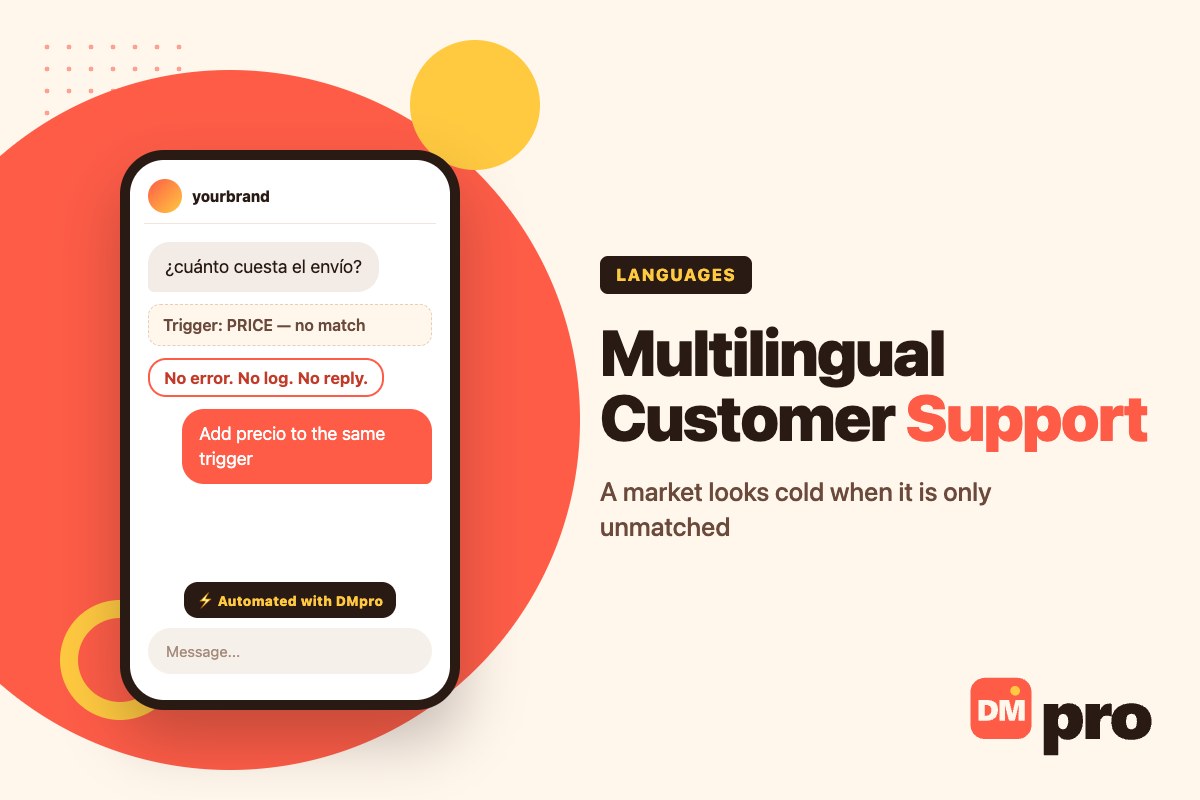
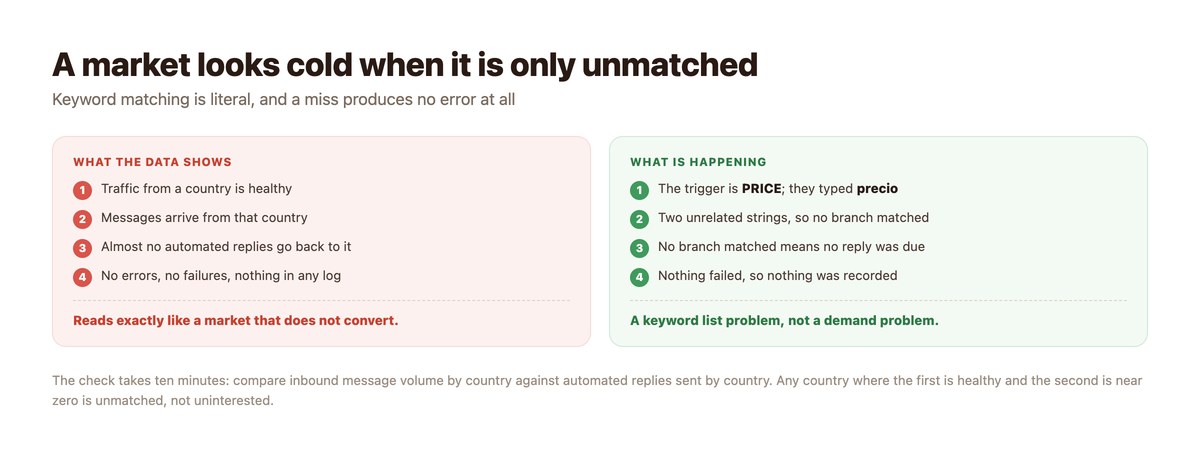
The moment a business sells outside one country, its multilingual customer support develops a blind spot that produces no error message. A customer writes precio, the trigger is PRICE, nothing matches, nothing is sent, and nothing is logged – because from the automation’s point of view nothing went wrong.
This is why an entire market can look cold on a dashboard while actually being unanswered. It does not show up as a failure rate; it shows up as absence.
The fix is less technical than it sounds and more clerical than anyone wants. Here are the four options, what each is genuinely good for, and the one arrangement to avoid. For the wider framework, see customer support automation.
Key takeaways
- Keyword matching is literal. PRICE and precio are unrelated strings, and a miss produces no error.
- Check for it by comparing inbound volume by country against automated replies by country.
- Listing the keywords per language is the first fix and costs an afternoon.
- Replies should be written by someone who speaks the language, not machine-translated once and reused forever.
- Messenger is the only channel where the business can switch on two-way translation, and the customer is told.
- Never make language an escalation rule – it turns one person into a bottleneck.
The Failure Nobody Sees
Worth understanding precisely, because the fix follows from the mechanism.
Nothing Breaks
A keyword trigger compares characters. If the comparison fails, no branch runs, and a flow with no matching branch has nothing to report – it did not error, it simply had no work.
So there is no failure rate to watch, no alert to configure, and no entry in any log. The only visible signature is an absence of replies to a population that is definitely messaging you.
How to Detect It in Ten Minutes
Pull inbound message volume by country and automated replies sent by country, and compare the two lists. Any country where messages arrive in healthy numbers and automated replies are near zero is unmatched rather than uninterested.
This is worth doing before any conclusion about a market underperforming. It is also worth repeating after any big keyword change.
Accents and Case Count
Within a single language the same trap appears in miniature. People type precio, PRECIO and versions with and without accents, and depending on your match settings those may be different strings.
Whatever your tool does about case and diacritics, add the variants you actually receive rather than the dictionary spelling.
The Four Options
In the order most businesses should try them.
List the Keywords, Not the Translations
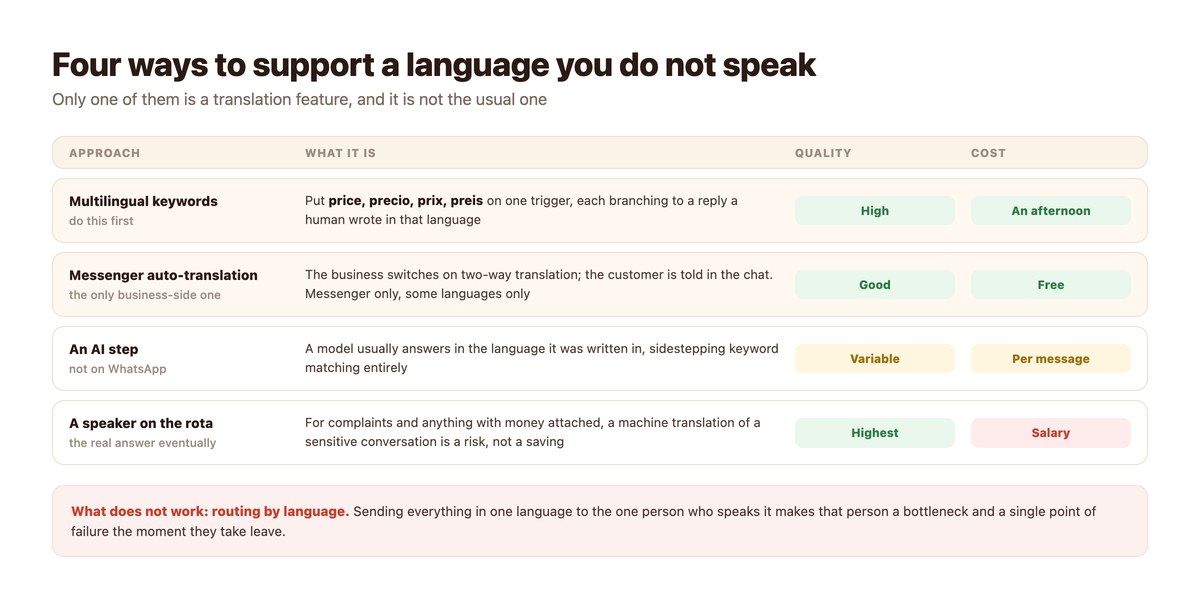
The cheapest and most effective fix. Put price, precio, prix and preis on the same trigger, and branch each to a reply written in that language. You are not translating the keyword – you are listing what people actually type.
Include the misspellings and the unaccented forms. This is clerical work, it takes an afternoon, and it closes most of the gap.
Have the Replies Written, Not Machine-Translated
A machine translation that is slightly wrong in a saved reply repeats itself to every customer who triggers it, forever. Pay somebody who speaks the language to write the ten messages that matter, once.
That is a one-off cost of an hour or two per language and it is the difference between sounding foreign and sounding careless.
Messenger’s Two-Way Translation
The only one of these that is a business-side feature. Messenger documents that a business can turn on automatic translation for a conversation, running in both directions – your agent writes in theirs, the customer reads in theirs – and the customer is told in the chat when it is switched on.
It is available for some languages only and Messenger does not publish the list, so test it on a real conversation rather than assuming your market is covered. Where it works, it is free and it removes the staffing question entirely for that channel.
An AI Step, Where the Channel Allows
A model generally answers in whatever language the question arrived in, which sidesteps keyword matching altogether. That makes it genuinely useful here, with two caveats: it costs per message, and it is not available on the WhatsApp channel.
Scope it to your own products and policies. A model answering freely in a language nobody on the team can read is a quality problem you cannot see.
The Arrangement to Avoid
Common, understandable, and it creates a problem bigger than the one it solves.
Language as an Escalation Rule
Routing everything in a given language to the one person who speaks it feels like good service. It makes that person a bottleneck, a single point of failure, and eventually resentful – and it guarantees that market gets the worst response times in the business the week they take leave.
Language is a translation problem before it is a staffing problem. Solve it in that order, and keep language out of the escalation rules – the list of what genuinely belongs there is in escalation rules.
Where a Speaker Genuinely Is Required
Complaints, refunds, anything legal, and anything where tone carries meaning. A machine translation of a sensitive conversation is a risk rather than a saving, and the customer can tell.
So the honest arrangement is: automate the factual majority in every language you receive, and have a human speaker available for the small slice where it matters. That is a much smaller hiring question than full coverage.
What to Do per Channel
The options are not evenly available, which affects where you put the effort.
| Channel | Best approach | Note |
|---|---|---|
| Messenger | Turn on two-way translation | Business-controlled; customer is told |
| Multilingual keywords, or an AI step | Reader-side translation exists but is theirs to tap | |
| Multilingual keywords only | AI replies are not available on this channel | |
| TikTok | Multilingual keywords, or an AI step | Comments are the main surface anyway |
| Telegram | Multilingual keywords, or an AI step | Reader-side translation needs their Premium for whole chats |
The translation features themselves – what each platform gives the reader, and where the text goes – are covered separately in auto-translate messages.
Fixing It
An afternoon for the detection and the keywords, an hour per language for the copy.
- Compare inbound volume by country with replies by country. Ten minutes, and it tells you whether you have this problem and where.
- Read fifty real messages from the affected market. You are collecting the words people actually type, not the words a dictionary suggests.
- Add those words to the existing triggers. One trigger, several keywords. Do not build a parallel flow per language – that is twice the maintenance for the same result.
- Get the replies written by a speaker. Ten messages, one hour, once. Not machine-translated and reused forever.
- Turn on Messenger translation if that channel matters. Test it on a real conversation first – the supported language list is not published.
- Route the unmatched to a person, as always. This is the safety net that stops the next language being invisible too.
Where This Connects
Two adjacent problems that arrive with the same growth.
Timezones Come With Languages
Selling into another language almost always means selling into another timezone, so the overnight question arrives at the same moment – and the four coverage models are in covering DMs after hours.
If both are true at once, the AI-answering model does double duty: it covers the hours and it answers in the language.
And the Numbers Need Splitting
A single blended response time across all markets hides exactly this problem. Split the figures by market before concluding anything about performance – social media response time covers how to report it.
A Quiet Market May Just Be Unmatched
Customers in a country, messages arriving, and almost no automated replies going back to them. Nothing is broken and nothing is logged – the keywords were written in one language and the questions arrive in another.
DMpro puts every language on the same trigger, sends the reply a speaker wrote for each, and hands anything it does not recognise to a person instead of letting it disappear.
Conclusion
Multilingual support fails silently, which is why it goes unfixed for quarters. There is no error rate to watch – only an absence of replies to people who are definitely writing to you.
The fix is mostly clerical: find it by comparing volume by country against replies by country, list the words people actually type in each language on the existing triggers, and pay a speaker once to write the ten replies that matter.
Then keep language out of your escalation rules. Routing a whole market to the one person who speaks it feels like care and produces a bottleneck, a single point of failure, and the worst response times in the business the week they go on holiday.
Frequently asked questions
Why does my automation ignore messages in other languages?
Because keyword matching is literal. PRICE and precio are unrelated strings, so no branch matches and no reply is sent – and nothing is logged, because as far as the automation is concerned nothing went wrong.
How do I tell if this is happening to me?
Compare inbound message volume by country with automated replies sent by country. Any country where messages arrive and replies do not is unmatched rather than uninterested. It takes about ten minutes.
Should I translate my automated replies?
Have them written by someone who speaks the language rather than machine-translated. A slightly wrong translation in a saved reply repeats itself to every customer who triggers it. Ten messages, one hour, once.
Can the business turn on translation?
On Messenger, yes – the business can enable automatic two-way translation and the customer is told in the chat. It covers some languages only and the list is not published, so test it. On other channels translation is something the reader taps.
Does AI solve multilingual support?
Largely, because a model answers in the language it was asked in – but it costs per message and is not available on the WhatsApp channel, which carries a lot of support volume.
Should I route foreign-language messages to the person who speaks that language?
No. It makes them a bottleneck and a single point of failure, and that market gets your worst response times the week they take leave. Solve it with keywords and written replies first, and keep a speaker for complaints and anything sensitive.