
Ticket deflection on social media is the metric every support automation vendor leads with, and the one every experienced support manager distrusts. Both are right. It measures something real and it is almost uniquely easy to improve by making the product worse.
That does not make ticket deflection on social media useless. It makes it a number that needs its definition attached, a companion metric, and somebody willing to say out loud when it went up for a bad reason.
This is the arithmetic, the three ways it gets gamed – usually without anyone intending to – and how to report it when a stakeholder has asked for it specifically. For the wider argument about what to measure, see customer support automation.
Key takeaways
- Four defensible deflection rates can be computed from the same month. The denominator does all the work.
- Publish the definition next to the number, and never change it mid-quarter.
- Removing the route to a human raises deflection and is the single worst thing you can do to a support experience.
- Expect deflection to dip when you genuinely improve things, because the easy exit gets used more.
- Pair it with repeat-contact rate – that catches ‘answered fast, answered wrong’.
- Cost is the one place deflection is genuinely useful, because messages map to Meta’s free allowance.
What It Is Supposed to Measure
The intention is reasonable. The implementation is where it goes wrong.
Conversations That Did Not Need a Person
The idea is simple: of everything that arrived, how much did the automation handle on its own? Answered honestly that tells you whether the flows are carrying real load or decorating the inbox.
It is also the number most easily converted into a cost saving, which is why finance likes it and why it tends to be the one reported upwards.
Why It Is Fragile
A conversation can avoid a human for two opposite reasons: it was answered, or the person gave up. Deflection counts both identically, and in most tooling there is no field that distinguishes them.
So the number rises when things improve and rises when they deteriorate, which is the property you least want in a headline metric.
The Arithmetic, Honestly
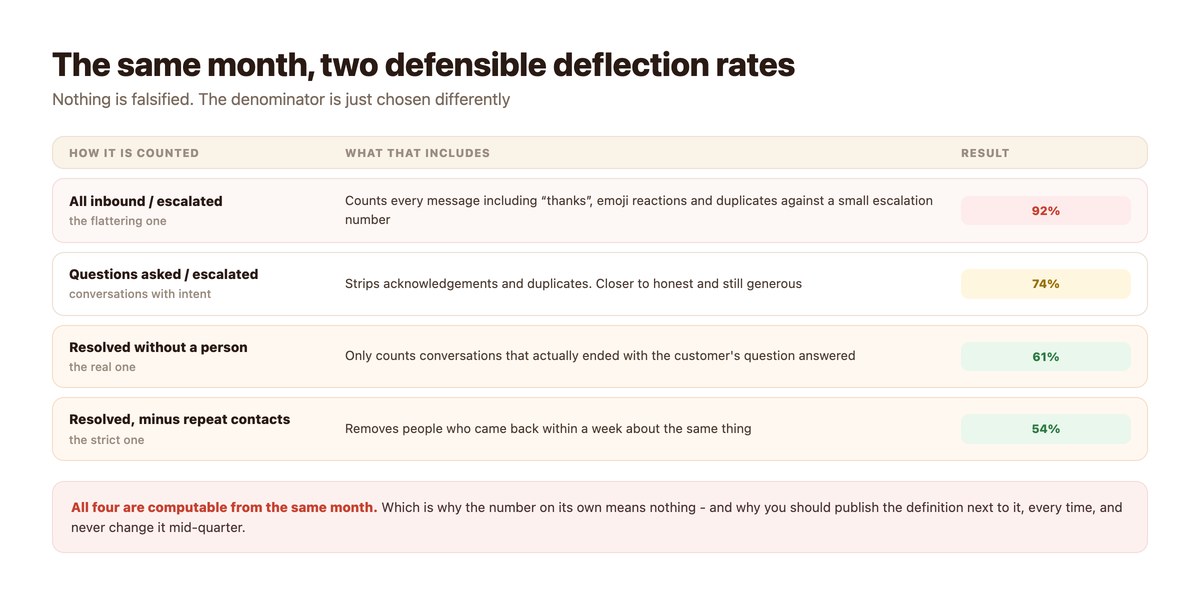
Four denominators, all defensible, producing numbers nearly forty points apart.
Choose the Denominator in Public
The flattering version counts every inbound message – including “thanks”, emoji reactions, duplicates and people saying hello – against a small escalation count. The strict version counts only conversations that actually ended with the question answered, minus anyone who came back about the same thing within a week.
Neither is dishonest. What is dishonest is not saying which you used, or quietly moving between them when a month looks bad.
Write the Definition Down Once
Before you measure anything, write the sentence: “deflection is conversations resolved without a human, over conversations containing a question, excluding repeat contacts within seven days.” Then never change it.
A changing definition destroys the only thing a trend line is for.
Report It With a Companion
Deflection alone is unreadable. Deflection plus repeat-contact rate is not: if deflection rises and repeat contacts rise with it, you have found people being brushed off rather than helped.
That pairing costs nothing to produce and it is the difference between a metric and a story.
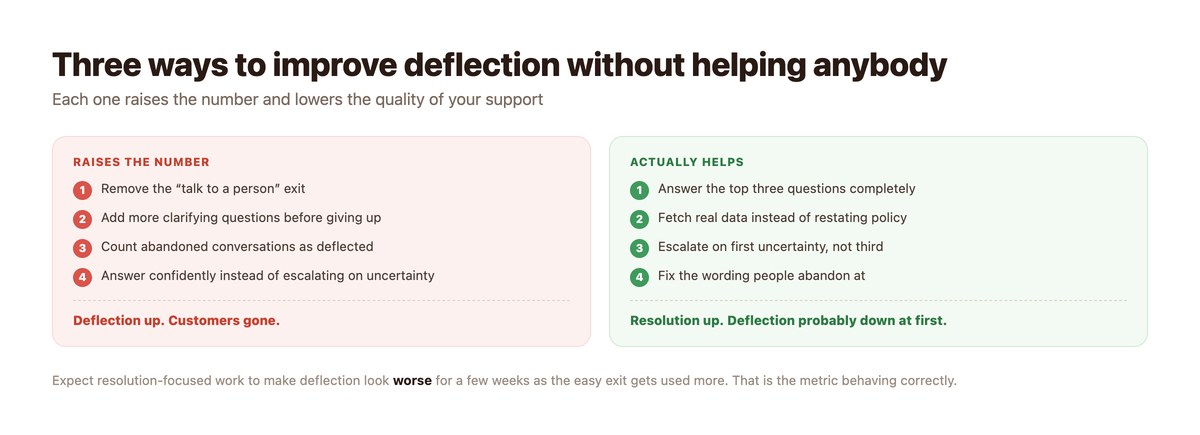
How It Gets Gamed Without Anyone Deciding To
Nobody sets out to do these. They happen because the metric rewards them.
The Disappearing Exit
The fastest way to improve deflection is to make reaching a human harder – bury the option, require three attempts first, stop offering it after hours. Each change nudges the number up and the experience down.
If your deflection improved and nobody can point at a flow that got better, check whether the exit moved.
Clarify-Until-They-Leave
A flow that asks a second and third clarifying question before giving up keeps conversations out of the human queue by exhausting the customer. The dashboard reads this as success.
One clarifying question is reasonable, two is the limit, and uncertainty should escalate – which is the rule in what a good handoff carries.
Counting Abandonment as Victory
Conversations where the customer simply stopped replying are, in most setups, counted as deflected. They are the opposite. Separating them out usually knocks several points off and is the single most useful change you can make to this metric.
What to Report Instead
If someone has asked for deflection specifically, give it to them in this company.
| Number | Why it is there | Cadence |
|---|---|---|
| Resolution rate | The honest version of deflection | Monthly |
| Repeat-contact rate | Catches answered-fast-answered-wrong | Monthly |
| Time to first useful reply | Moves within days of a change | Weekly |
| Escalations by reason | Tells you what to build next | Monthly, read not counted |
| Deflection, defined | Because it was asked for | Monthly, with the definition |
The full dashboard and the reasoning behind each line is in customer support KPIs.
Measuring It Without Fooling Yourself
An afternoon once, then it reports itself.
- Write the definition before you compute anything. One sentence, including what the denominator excludes. Put it in the same document as the number.
- Separate abandoned conversations out. Anyone who stopped replying mid-flow is not deflected. This alone usually moves the figure several points.
- Add repeat contacts within seven days. Same person, same issue. Subtract them from the resolved count.
- Record a baseline before changing anything. Four weeks. Without it the first improvement is unprovable.
- Report it with resolution and repeat-contact rate. Never alone. Alone it is a story rather than a measurement.
- Re-read the definition each quarter. Not to change it – to check nobody else has.
Where Deflection Is Genuinely Useful
Having spent the article qualifying it, here is the case where it is the right tool.
Forecasting Cost
Messages map directly onto Meta’s billing. Every business number gets 1,000 free service messages a month, and Meta counts a human typing in the same category as a bot, so the mix does not change the allowance – only the volume does.
For working out whether next quarter crosses the free threshold, the published rates plus a deflection-style ratio is exactly the right instrument.
Capacity Planning
If you know what fraction reaches a human and you can forecast volume, you can staff. That is a legitimate and common use, and it does not require the number to be flattering – it requires it to be stable.
Peak weeks are where this matters most, and planning for peak goes into the arithmetic.
Not for Judging the Automation
For that, use resolution. The distinction is the whole point of this page, and it is worth one sentence in whatever document the number lives in so that whoever reads it next does not have to rediscover it.
Where This Connects
Two neighbours worth reading alongside.
To the Cost Argument
Deflection converts into hours, and hours convert into a number finance will accept without arguing about attribution – reducing support costs with automation does that conversion properly.
To the Failure Catalogue
Optimising deflection is itself one of the classic support automation mistakes, and it keeps company with several others worth meeting on paper first: support automation mistakes.
Measure Whether People Got Helped
A flow that answers everything and resolves nothing scores perfectly on deflection. The number you actually want is how many people left with what they came for.
DMpro answers the repeats, fetches real data through your own webhook rather than restating policy, and routes anything uncertain to a person – so the conversations that avoid a human avoid one because they were finished.
Conclusion
Deflection measures something real and measures it badly, because a conversation can avoid a human by being answered or by the customer giving up, and the metric cannot tell the difference.
If you report it, report the definition with it, separate out abandonment, and pair it with repeat-contact rate. And expect genuine improvements to make it dip at first, because a good support experience gets its exit used.
Where it earns its place is cost and capacity, not quality. For quality, resolution rate answers the same question without inviting anybody to make the product worse.
Frequently asked questions
What is ticket deflection?
The share of inbound support conversations handled without a human. The idea is reasonable; the problem is that a conversation avoids a human either because it was answered or because the customer gave up, and the metric counts both the same.
What is a good deflection rate?
Unanswerable without the definition. Four defensible rates can be computed from the same month’s data, nearly forty points apart, depending only on what the denominator includes. Publish the definition next to the number.
Why did deflection fall after we improved things?
Usually because the route to a human became easier to find and got used. That is the metric behaving correctly – check resolution rate, which should have risen.
How is deflection gamed?
Three ways, usually without anyone intending it: burying the exit to a human, adding clarifying questions until people leave, and counting abandoned conversations as deflected.
What should I report instead?
Resolution rate, repeat-contact rate and time to first useful reply, with escalation reasons read rather than counted. Give deflection last, with its definition, if somebody asked for it.
Is deflection ever the right metric?
Yes – for forecasting cost and planning capacity, where you need a stable ratio rather than a flattering one. Just not for judging whether the automation is any good.